COULD NEUTRINOS SENSE A FAULT BEFORE AN EARTHQUAKE?
Neutrinos can cross thousands of kilometres of rock. As they travel, they change from one type to another, and the electrons in the matter they cross subtly alter that change. The effect depends on how dense in electrons the rock is along the way. Physicists have long seen in this a way to image the inside of the Earth: its crust, a hidden oil deposit, even its mantle and core.
In 2010, three researchers, Wang, Chen and Li, proposed a more daring use. Some phenomena reported before strong earthquakes might, they argued, involve an unusual rise in the density of electrons in the fault zone. If so, neutrinos crossing the fault might register it. With antineutrinos from nuclear reactors, they found a signal of up to 3%.
The authors of the new study, Bipin Singh Koranga and Samrat Vashisht (Kirori Mal College, University of Delhi) and Vivek Kumar Nautiyal (Chaudhary Charan Singh University, Meerut), are careful from the first page: whether such earthquake precursors are real, and whether short-term prediction is possible at all, remains controversial among geophysicists. They do not settle that question. They ask only what a neutrino experiment could measure if such an anomaly existed.
A beam through the crust
Their test case is DUNE, the Deep Underground Neutrino Experiment, which will send a beam of neutrinos 1,300 kilometres from Fermilab to the Sanford Underground Research Facility (SURF). At its main energy, around 2.5 GeV, the effect of matter on the neutrinos is strong — which is precisely what makes DUNE sensitive to the order of the three neutrino masses — which one is heaviest.
The beam travels in a straight line, so it dips under the curved surface: about 33 kilometres deep at the midpoint, and only 9 to 17 kilometres deep within 100 to 200 kilometres of either end.
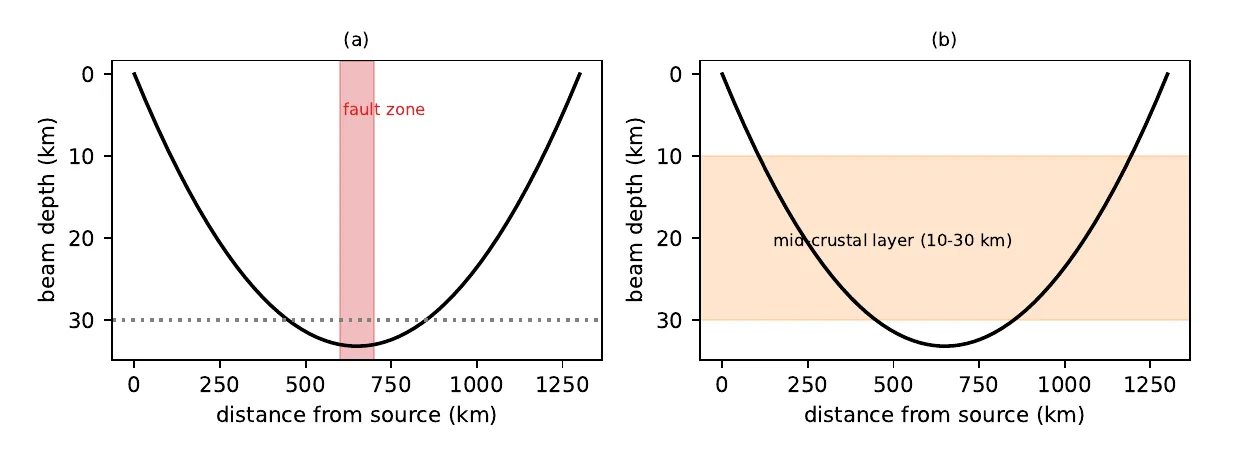
Depth of the 1,300 km beam path below the surface, with a 100 km fault zone at the midpoint (left), compared with a mid-crustal layer 10 to 30 km deep (right): only the parts of the path inside the shading would cross the anomaly. — Figure 1, Koranga, Vashisht & Nautiyal (2026), arXiv:2611.06755.
The team modelled the fault as a slab, between 20 and 100 kilometres wide along the beam, in which the electron density is three times that of normal crust — the value used in the original proposal. (By an empirical rule the paper quotes, a zone about 80 km wide goes with a magnitude-8 earthquake.) Then they computed exactly, with all three types of neutrino, how the chance of a muon neutrino turning into an electron neutrino changes when the beam crosses that slab.
A real but tiny shift
The effect is there. For a zone at the midpoint, the chance of conversion rises by 0.11 to 0.55 percentage points depending on the width, on a baseline of 8.1% — a relative change of 1.4 to 6.8%. For antineutrinos the shift goes the other way and is larger in relative terms, up to about −17%. A fault 100 km from the source instead of in the middle gives about four times less.
There is one elegant feature. A still-uncertain quantity called the CP phase changes the normal conversion rate by tens of per cent. But it barely changes the fault’s effect. So comparing the beam’s data before and after — the same detector, the same beam — would cancel that uncertainty, leaving the stability of the detector and beam as the main remaining source of error.
Not enough neutrinos
The problem is counting. To detect a relative change δ at the usual “three sigma” level — the threshold at which a signal is very unlikely to be a statistical fluke — an experiment needs about 3²/δ², that is 9/δ², events. For the widest zone, that is about 2,000 detected electron neutrinos — or a few hundred antineutrinos — within the window when the anomaly is present.
DUNE is expected to collect between about a thousand and ten thousand such events over several years. A slowly developing anomaly lasting years might, at best, be marginally probed, and only for a wide, strongly anomalous zone in antineutrino mode. A precursor lasting a week — about a fiftieth of a year — would leave only a few events. Short-term forecasting with DUNE, the authors conclude, is not feasible.
There are further catches. The Fermilab–SURF route crosses the stable interior of the continent, and the authors do not claim that any active fault of this width lies on it. The assumed threefold electron excess has never been independently established. And larger detectors would help with statistics, but their baselines are fixed too.
The authors present the result for what it is: a theoretical sensitivity study, not a forecasting scheme. It tells future long-baseline experiments which features would matter — a wide zone, antineutrino running, a before-and-after comparison — if a beam were ever aimed across a known seismic zone.