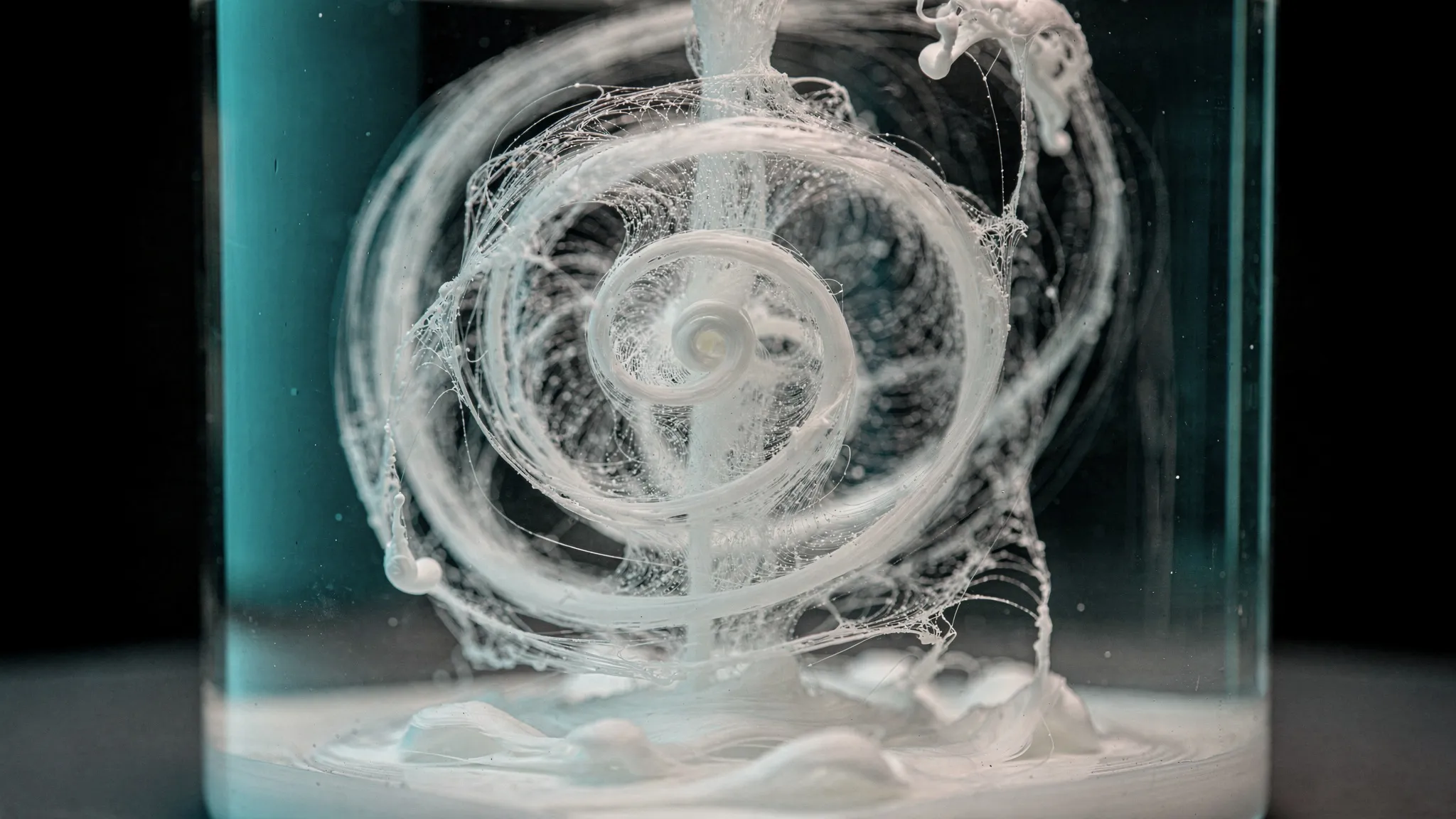
ONE STARTING FLOW, INFINITELY MANY FUTURES
The Navier–Stokes equations describe how a viscous fluid such as water moves. Give them a starting velocity at every point, and they are supposed to tell you what happens next. In 1934, Leray showed that for any starting motion with finite kinetic energy, at least one solution exists — a “weak” one, which need not be smooth — and Hopf did the same for fluids in 1951. These Leray–Hopf solutions obey an energy rule: the energy of the flow, plus what friction has dissipated, never exceeds the energy it started with.
Existence, however, is not the whole story. A physical law should also pick one future. Mathematicians know that it does when the flow is regular enough — under conditions that bound how concentrated the velocity can be. But the energy rule alone does not control how fast two nearly identical solutions can drift apart near the starting time.
A force-free counterexample
Thomas Hou, Xiang Qin, Peicong Song and Wenhan Zhang, applied mathematicians at Caltech, now construct a starting velocity — with finite energy, in three dimensions, with no outside force — from which a whole continuum of different solutions emerges, one for each value of a parameter between 0 and 1.
Each of them:
- is perfectly smooth at every moment after the start;
- starts exactly from the same velocity;
- satisfies the energy rule with equality, both overall and locally;
- differs from every other one during any time interval after the start, however short.
Non-uniqueness had been shown before, but with caveats. In 2022, other mathematicians obtained two different solutions from the same start, but only by adding a carefully chosen outside force. In 2025, Hou and two other colleagues reached the force-free case with a construction assisted by computer. The new proof, the authors stress, is entirely analytic: no step relies on a computer calculation.
Swirls inside swirls
The starting flow is a stack of Gaussian swirls: spinning tubes of fluid whose motion fades smoothly away from the axis, along a bell-shaped curve, all on the same axis, much longer along the axis than they are wide. Their radii shrink geometrically — 1, then 1/R, then 1/R², and so on, piling up towards a single point at the centre. The energy of each swirl is proportional to its radius, so the infinite stack still has finite total energy.
Each swirl is unstable, in the classic way a spinning fluid can be: a small disturbance at the right place grows fast. The authors compute the growth rate exactly, from a one-dimensional problem along the radius, without any computer calculation of that rate.
A difference that climbs
Here is the cascade. Disturb the smallest swirl slightly. The disturbance grows, then dies out under viscosity — but not without a trace. While it was large, it left behind a lopsided stress in the fluid, and that stress has a definite sign. Seen from the next, larger swirl, this trace looks like a tiny point-like kick of a precise shape. Diffusion smooths it into a disturbance of the same form, one scale up. And the process repeats.
A difference born at the finest scale thus climbs, scale by scale, until it reaches a fixed, observable size. The authors first build cascades with a finite number of steps, tuning the initial disturbance so the final effect hits a chosen target. Then they let the number of steps go to infinity: the starting difference shrinks to zero, while the effect at the end stays put. Two solutions with the same start, different futures — and a different solution for each target.
Right at the edge
The starting velocity sits exactly on the borderline. It is smooth everywhere except at the centre, where the swirls pile up, and it just fails the condition that classical uniqueness theorems need: a limit on how concentrated the velocity may be near a point. The authors show this edge is sharp: a solution only slightly better behaved, in a precise technical sense, would be the only one possible.
The theorem holds over a short initial time window, after which each solution can be continued for all time. The paper is a preprint, 113 pages long, and has not yet been reviewed by other mathematicians. The authors state that AI tools, including ChatGPT and Astra, were used to speed up mathematical exploration, and that they directed the process and verified the arguments themselves.
What the result establishes, if the proof holds, is a principle: for the equations of a fluid moving freely, knowing where everything starts and keeping the energy books balanced is not always enough to know where it goes.