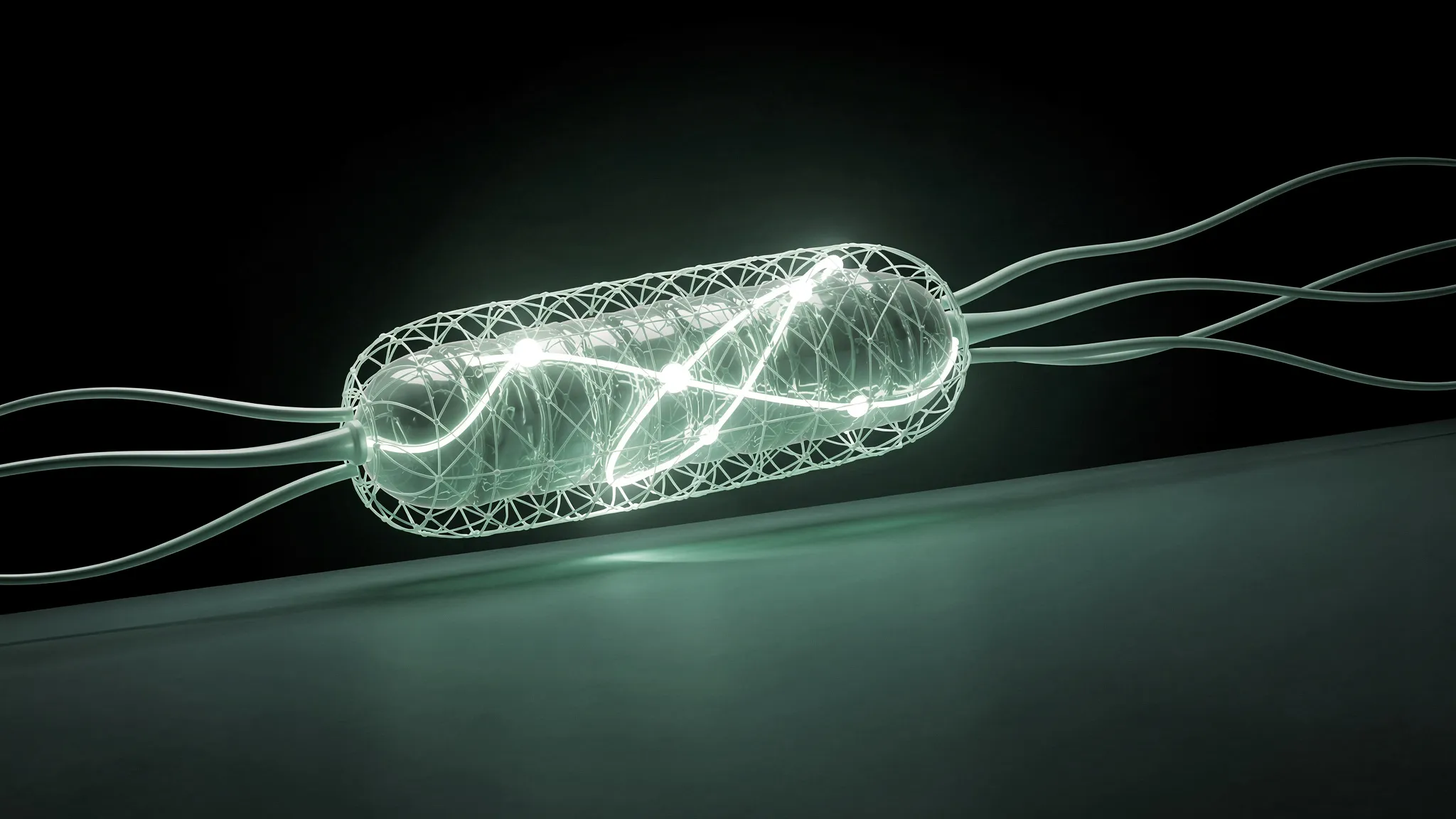
COULD A BACTERIUM'S WALL LEARN TO STEER IT?
A swimming bacterium such as E. coli finds its way mainly through chemistry: a chain of molecules inside the cell senses changes in its surroundings and tells the flagellar motors, which spin the long whip-like filaments (flagella) the cell swims with, when to switch direction. In that picture, the cell wall — a mesh of sugar strands joined by short peptide crosslinks, called peptidoglycan — is just structure. It holds the cell together and anchors the motors, but plays no part in deciding where to go.
Nada Elmeligy, No Chen and J. M. Schwarz, physicists at Syracuse University in the United States, wondered whether the wall could do more. Their field, physical learning, trains materials themselves to perform tasks. A disordered network of springs, for instance, can be trained with simple local rules so that pushing on one spot produces a chosen response at another, far away. The bacterial wall is disordered, filamentous and constantly remodelled by enzymes: in principle, it is trainable.
A collision routed across the cell
The team built a two-dimensional model: a rod-shaped swimmer with four flagellar motors, and a wall represented as a network of 512 nodes and 1,497 springs, to which each motor is anchored. The swimmer alternates as E. coli does between straight runs and “tumbles”, brief pauses in which it turns to face a new, random direction, about once per second, in a channel without any chemical cue, and tends to get trapped near the channel’s walls.
The idea runs as follows. When a flagellum strikes the wall of the channel, it pulls on its anchor in the cell wall. A trained network should turn that pull into compression at the anchors of the motors on the opposite side. There, the authors propose, compression would make the motors’ force-generating units, the stators, let go. The weakened flagella on that side are precisely those that push the cell back toward the obstacle; silencing them leaves the others to turn the cell toward open space.
The size of the training signal was not chosen freely: it is the largest contact force the swimmer itself can generate, about 0.3 piconewtons, the push of a single flagellum.
Trained like a material
Training uses a local rule: each spring’s stiffness is adjusted according to the forces it feels in two states of the network, one where only the input push is applied, and one where the far side is also held at the desired response. After 3,000 training cycles over eight input–output pairings, stiffened chains of springs link each motor to those opposite. The share of a contact load that reaches the far side jumps from 0.0056 to 0.905.
Two results stand out:
- Rigidity matters. When the network has fewer than about four connections per node on average — the threshold at which such a network stops being floppy — no pathway forms at all. The connectivity that makes the wall solid is the one that makes it trainable.
- Timing matters. The routed signal must make the stators let go during the collision, which typically lasts about a tenth of a second. If the stators let go at a rate below about 100 per second, they would react only after the contact had ended, and the wall could not steer the cell, however well it was trained.
Escaping the channel wall
In 100 trials per version, at the first tumble after being trapped, the cell with a trained wall escaped 62% of the time, against 43% with an untrained wall or no network at all. An ideal controller that simply knew which side had been hit reached 65%: the authors calculate that the trained wall recovers 89% of that advantage (about 86% from the rounded rates given here). Even when it failed to escape, it delayed its next contact with the surface.
The wall does not need perfect training. After 300 cycles, the cell already gains 84% of the ideal advantage, while the mismatch between the forces the network delivers and the target keeps falling by more than two orders of magnitude. That matters, because a real wall is constantly rebuilt. The authors estimate that a cell in constant contact with obstacles meets about 400 collisions in one 30-minute generation. When crosslinks were replaced at random during training, the pathway was lost; when the half of the bonds under tension were protected from replacement, it survived.
A hypothesis waiting for a test
The authors list the limits plainly. Their network is far smaller than a real bacterial wall, it ignores the cell’s internal pressure, and training is still guided by an imposed target rather than by the bacterium’s own success. Above all, the key step — compression making stators let go — has never been tested experimentally. They write that they do not claim the model shows cell-scale cognition.
They do suggest how to check. Bacteria that have repeatedly bumped into obstacles, for example after flowing through a field of small posts, should then escape a trapping surface faster than naive cells in a fresh chamber. In soil, mucus or biofilms, where collisions are frequent, such a mechanical shortcut could work alongside chemistry to help cells find their way.