
BOUNCE OR MERGE? A MATTER OF NANOMETRES
Let a small drop fall onto a pool of the same liquid and two things can happen. Either it touches the surface and flows into it, or it bounces off as if the pool were a trampoline. The difference comes from a thin layer of air, trapped between the drop and the bath at the moment of impact. If that cushion holds, the drop rebounds. If it breaks, the two liquids touch and merge.
This everyday scene matters in places as varied as rain falling on the ocean, where it shapes how gases cross the sea surface, inkjet printing and the spray cooling of electronics, according to the paper. Physicists usually describe an impact with the Weber number, We = ρRU²/γ, which compares the drop’s energy of motion with the energy of its surface: ρ is the liquid’s density, R the drop’s radius, U its speed and γ its surface tension. Above a critical Weber number, the drop no longer bounces. Until now, no model could predict that threshold quantitatively.
A cushion only nanometres thick
Peter Lewin-Jones, James Sprittles and colleagues at the University of Warwick, with Daniel Harris at Brown University in the United States, explain why. Just before contact, the air film can be as thin as tens to hundreds of nanometres. That is comparable to the mean free path of air molecules — the average distance a molecule travels before bumping into another, about 70 nanometres at normal pressure — so air in the film no longer behaves like an ordinary fluid. Two effects that standard fluid models ignore take over:
- Rarefied gas. In such a thin gap, air flows out much more easily than usual. When the film is as thin as the mean free path, about ten times more air escapes for the same push than ordinary equations predict.
- The van der Waals force. This weak attraction between the two liquids, which grows sharply as they approach, eventually pulls them together. Below about 10 nanometres, contact becomes unstoppable.
The team built both effects into a simulation of the drop and the bath. Because the bath dents deeply under the impact, the air film is curved, so its thickness had to be measured perpendicular to the drop rather than vertically. One key ingredient, the strength of the van der Waals attraction for silicone oil, came from an independent calculation: nothing was adjusted to match the experiments.
Predictions meet the high-speed camera
To test the model, Harris’s laboratory released tiny drops of silicone oil, of three different viscosities, onto a still bath of the same oil 4.5 millimetres deep, and filmed each impact from the side. For each drop size, they raised and lowered the drop’s release height until they found the speed that separates bouncing from merging, repeating the whole procedure nine times, for 18 measurements.
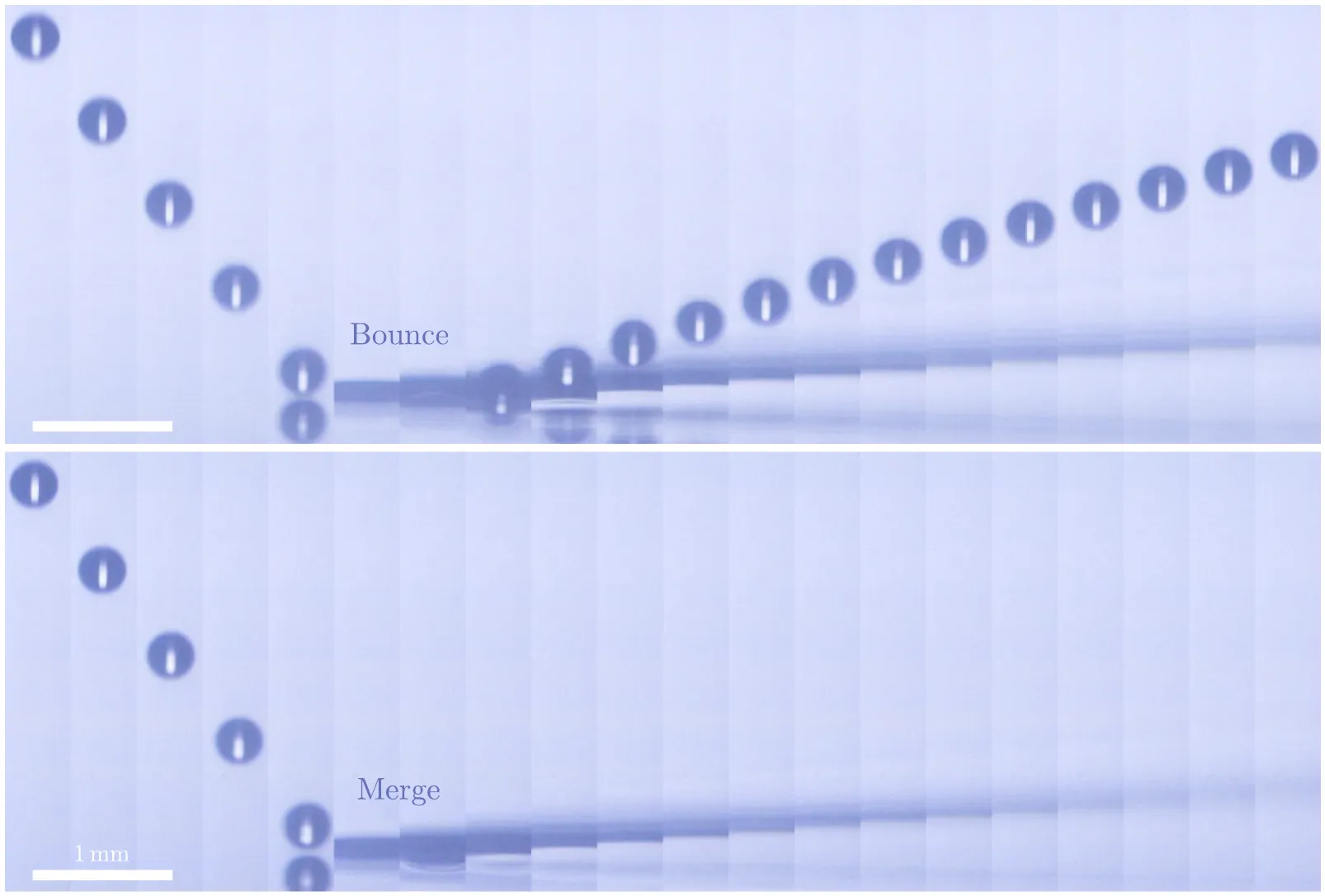
Drops of silicone oil 168 micrometres in radius: bouncing at 88.6 cm/s (top) and merging at 91.1 cm/s (bottom); images spaced 1/1500 of a second apart. Scale bar: 1 mm. — Figure 6, Lewin-Jones et al. (2026), arXiv:2611.07942.
For the least viscous oil and drops 168 micrometres in radius, the measured threshold was a Weber number of 6.34, an impact speed of about 90 centimetres per second; the simulation gave 6.25. Across six cases, three oils and radii from 168 to 439 micrometres, the predicted threshold fell within or just outside the experimental error bar — the first quantitative agreement for this threshold, according to the authors.
Small drops always merge
The model then went where the experiments cannot yet follow:
- Drop size. For large drops, the threshold settles near a Weber number of 7. For smaller ones it drops quickly, until, below a radius of about 0.04 millimetres, the drop always merges. Free-falling drops that small never get fast enough to test this.
- Air pressure. Lowering the pressure lengthens the mean free path. At half or a quarter of an atmosphere, the bouncing region shrinks, and the critical radius grows into a range that falling-drop experiments could reach — a test the authors propose.
- Without the rarefied gas. Switch off the rarefied-gas effects, and the predicted threshold roughly doubles, and the critical radius disappears altogether.
- Floating. At very low speeds, large drops neither bounce nor merge at once: one drop 0.35 millimetres in radius floated for more than 48 milliseconds, where a drop in the merging regime merges after about 10.
When the bath gets shallow
On shallow baths, experiments by another team had found a strange sequence: as the depth decreases, drops bounce, then merge, then bounce again, then merge. The simulations reproduce it. In one “late merging” case, the air film is squeezed against the bottom of the bath until the liquid beneath the drop’s centre is only 9.3 micrometres thick, against 1,400 at the start.
On very thin liquid films, the model suggests that the van der Waals force can lift the film locally towards the drop, causing contact where a solid surface would make it bounce. The authors call this result speculative.
Where the model stops
The simulation ends at the moment of contact: it cannot yet follow the merging itself. It handles only head-on impacts, with the same liquid in drop and bath, and on baths between a quarter and one drop radius deep it still disagrees with the experiments, for reasons the team does not know. Each run takes a few hundred hours on a single processor core. The next step the authors suggest is experimental: drop smaller drops in thinner air, and catch the moment when bouncing becomes impossible.