
THE ISLAND OF STABILITY MAY HAVE NO SUMMIT
The periodic table now runs to element 118, which completed its seventh row. Laboratories around the world are trying to make elements 119 and 120 by smashing nuclei together. It is slow work: such experiments typically yield a few detected atoms after months of beam time. These short-lived nuclei reveal little beyond the way they decay.
To guide such efforts, physicists rely on a landmark of nuclear theory: the “island of stability”. Some numbers of protons or neutrons are “magic”: they exactly fill a shell — a layer of energy levels, much like the electron shells of an atom — and make a nucleus unusually robust. Lead-208, with 82 protons and 126 neutrons, is “doubly magic”. The next doubly magic nucleus is predicted to be element 120 with 184 neutrons, written ³⁰⁴120 (the upper number counts protons and neutrons together). Around it, superheavy nuclei should be especially resistant to splitting apart — at least if, as in known nuclei, the two magic numbers reinforce each other.
Mapping 292 barriers
How well a superheavy nucleus resists splitting is measured by its fission barrier: the energy hump it must cross to break in two. The higher the barrier, the better its chances of surviving after being made. Measuring these barriers is extremely hard, so theory must estimate them.
Yi-Ming Jiang, Shan-Gui Zhou and colleagues at the Institute of Theoretical Physics in Beijing, with partners at the Joint Institute for Nuclear Research in Dubna, Russia, computed the barriers of 292 superheavy nuclei with even numbers of protons and neutrons, from element 100 to element 130. Their model describes the nucleus from its protons and neutrons, and lets it deform in several ways at once, including asymmetric shapes, on its way to splitting. According to the authors, it is the first systematic calculation of this kind.
As a check, the barriers rise locally at 152 and 162 neutrons, two numbers already known to give extra stability to non-spherical superheavy nuclei.
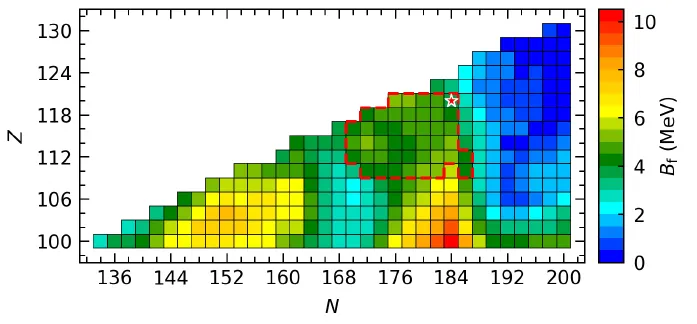
Calculated fission barriers (colour scale in MeV, millions of electronvolts, a unit of energy) by number of neutrons N and protons Z: around the predicted doubly magic nucleus (star), barriers of 4–5.5 MeV form a flat region (dashed outline). — Figure 1, Jiang et al. (2026), arXiv:2611.09099.
A plateau instead of a peak
Around ³⁰⁴120, the barriers do not rise to a summit. They stay at about 5 million electronvolts across a broad region. The island, in this calculation, is flat.
The magic numbers themselves survive. Three standard indicators still single out 120 protons and 184 neutrons as shell closures. The model does not support 114 protons, another long-discussed candidate. It also finds a strong shell effect at 172 neutrons, but ²⁹²120 lies beyond the limit where nuclei shed protons on their own, so the authors do not count 172 as magic. What fails is the partnership: along the chain with 184 neutrons, the neutron shell effect does not grow stronger near 120 protons, and vice versa. The authors call this “mutually suppressed magicity”.
To see it more clearly, they introduce a new indicator, built from the energies needed to remove alpha particles (packets of two protons and two neutrons). Around lead-208, it shows sharp dips at the magic numbers, the signature of shells helping each other. Around ³⁰⁴120, the dips are missing.
Protons and neutrons out of step
The explanation lies in the shape of the nucleus inside. In ²⁹²120 — element 120 with 172 neutrons — both protons and neutrons thin out at the centre, a “semi-bubble”. Their similar profiles let the shell effects at 120 and 172 reinforce each other. In ³⁰⁴120, a neutron orbital that puts neutrons at the very centre is filled, so the neutron density is flat there, while the proton density still dips slightly. Protons and neutrons are distributed differently, and their shell effects pull against each other.
What it means for new elements
If the flat island holds, it changes the estimates of how likely freshly made superheavy nuclei are to survive — numbers that matter for the hunt for elements 119 and 120. The authors suggest using their new indicator to look for other magic numbers and bubble-shaped nuclei, far from the stable nuclei. For now, the summit that nuclear physicists have long pictured may simply be a high, wide plain.