A WHITE DWARF THAT EXPLODED IN A HURRY
A Type Ia supernova is the thermonuclear explosion of a white dwarf — the dense, burnt-out core of a star — locked in a pair with another star. Astronomers rely on these explosions as “standard candles” in cosmology — explosions of known brightness, whose apparent glow reveals their distance —, and they are major sources of iron and its neighbouring elements. Yet a basic question remains open: how long after its stars are born does such a system blow up?
Surveys of distant galaxies suggest two answers. Many Type Ia supernovae seem to come after billions of years. Others, a “prompt” group, appear after only a few hundred million years. But that prompt group has only ever been seen statistically, from averages over whole galaxies. Pinning it down requires something rarer: a single supernova sitting next to a group of stars whose age is known.
A fresh explosion with an archive behind it
On 2 November 2026, the ATLAS survey spotted a new supernova in NGC 1433, a nearby galaxy. Spectra taken at the Keck observatory classified it as Type Ia. It was named SN 2026ahvu.
The galaxy had already been photographed in detail by Hubble and the James Webb Space Telescope, from the ultraviolet to the near infrared, for a survey called PHANGS. A team of 34 astronomers, with Sumit Sarbadhicary of Johns Hopkins University as first author, went back to those archive images to see what lay at the exact spot.
Two clusters, a few parsecs away
They found two compact star clusters, one just north of the supernova and one just south, 0.19 and 0.26 arcseconds away — an arcsecond being a tiny angle on the sky, 1/3,600 of a degree. Turning that angle into a real distance requires knowing how far away the galaxy is, and that is disputed: 9.1 or 18.9 megaparsecs (millions of parsecs, the astronomers’ unit of distance), depending on the method. At the shorter distance, the separations are 8 and 11 parsecs; at the longer one, about 18 and 24 parsecs. For comparison, the two clusters are about 20 or 41 parsecs apart themselves, depending on the distance. One of them had even been missed by the survey’s own cluster catalogue.
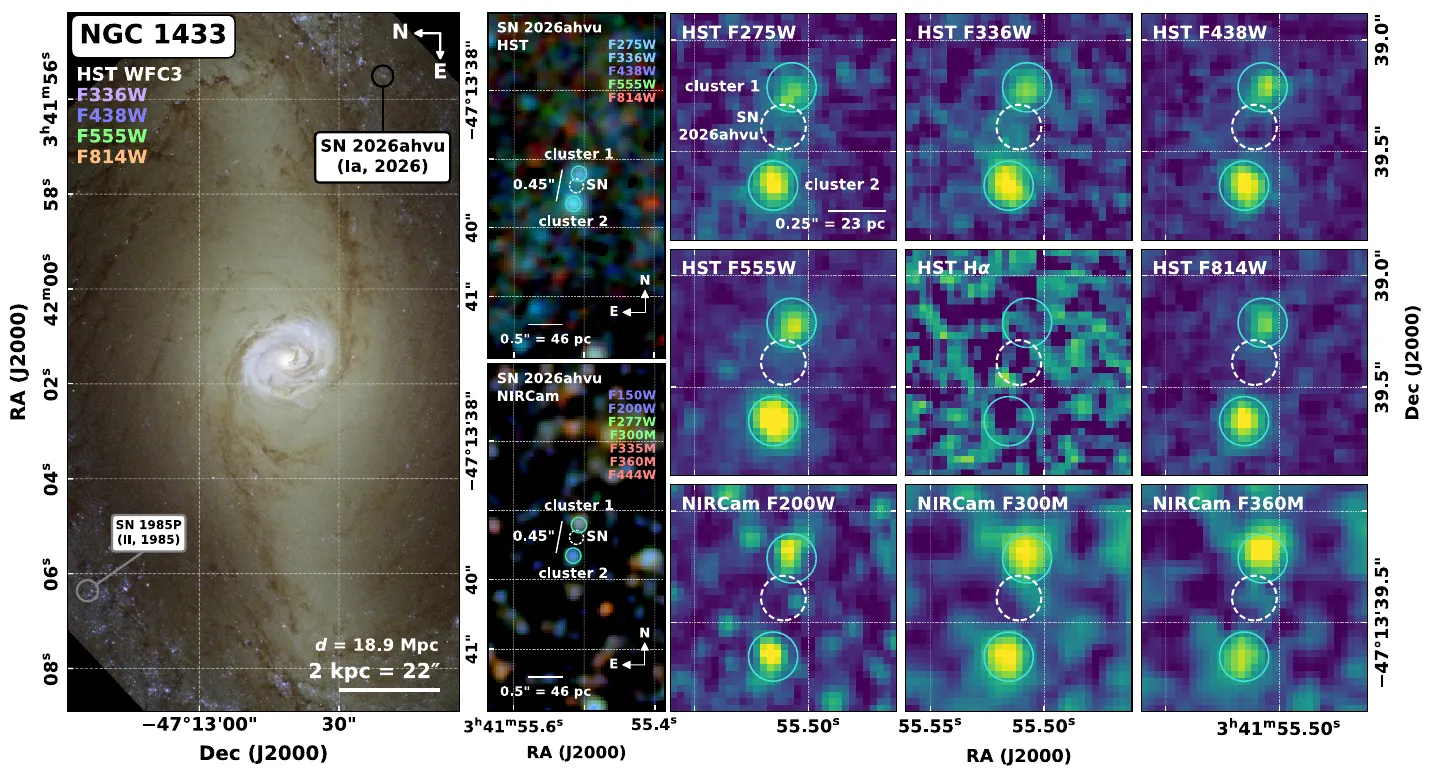
SN 2026ahvu in NGC 1433 (left) and close-ups at several wavelengths: the dashed circle marks the supernova’s position, the cyan circles the two clusters. — Figure 1, Sarbadhicary et al. (2026), arXiv:2611.09875.
Could this be a coincidence? The team used a JWST image that traces where the galaxy’s stars are, as a map of where an old-population supernova would most likely go off. Only about 0.4% of that light lies as close to a catalogued cluster as the supernova does (within 0.25 arcsecond). Even the most cautious version — closeness to any bright ultraviolet spot at all — gives about 4%.
Reading a cluster’s age in its light
A cluster’s colours tell its age. Neither cluster shows the glowing hydrogen gas that surrounds newborn stars, so both are older than about 10 million years. Yet both shine brightly in ultraviolet light, the sign of hot, short-lived stars, so they are younger than a few hundred million years.
Fitting their light across ten filters gives sharper numbers: about 37 million years for the northern cluster and about 95 million years for the southern one. Using Hubble data alone shifts these to 57 and 88 million years. Unlike the separations in parsecs, these ages do not depend on how far away the galaxy is.
Almost too young
White dwarfs come from stars under 8 times the mass of the Sun, and such stars live at least about 40 million years. That sets a floor on how fast a Type Ia can happen. The northern cluster’s age, 37 million years, comes with a margin of 32 to 40 million years: it sits right at that floor. If SN 2026ahvu’s stars were born there, it exploded almost as soon as its white dwarf existed.
The authors see problems with that option. That cluster is light, which may limit how many massive stars it formed, and the supernova sits five times farther out than the cluster’s half-light radius, the circle that holds half of its light. The older, more massive southern cluster is, in their words, “a more natural birthplace”. A pair of stars ejected from its core at about 5 kilometres per second would reach the supernova’s position within a few million years.
If the supernova does come from one of the two clusters, whichever it is, the delay is under 100 million years: according to the team, that would be strong evidence that prompt Type Ia systems really exist, and one of the most concrete measurements of their delay so far.
Waiting for the peak
The supernova is still brightening. Its light curve (how its brightness changes day by day) and spectra over the coming weeks should sharpen its position and reveal more about the pair of stars that produced it. The disputed distance may be settled too: as the authors note, the imminent peak of the light curve “will provide a swift resolution”.