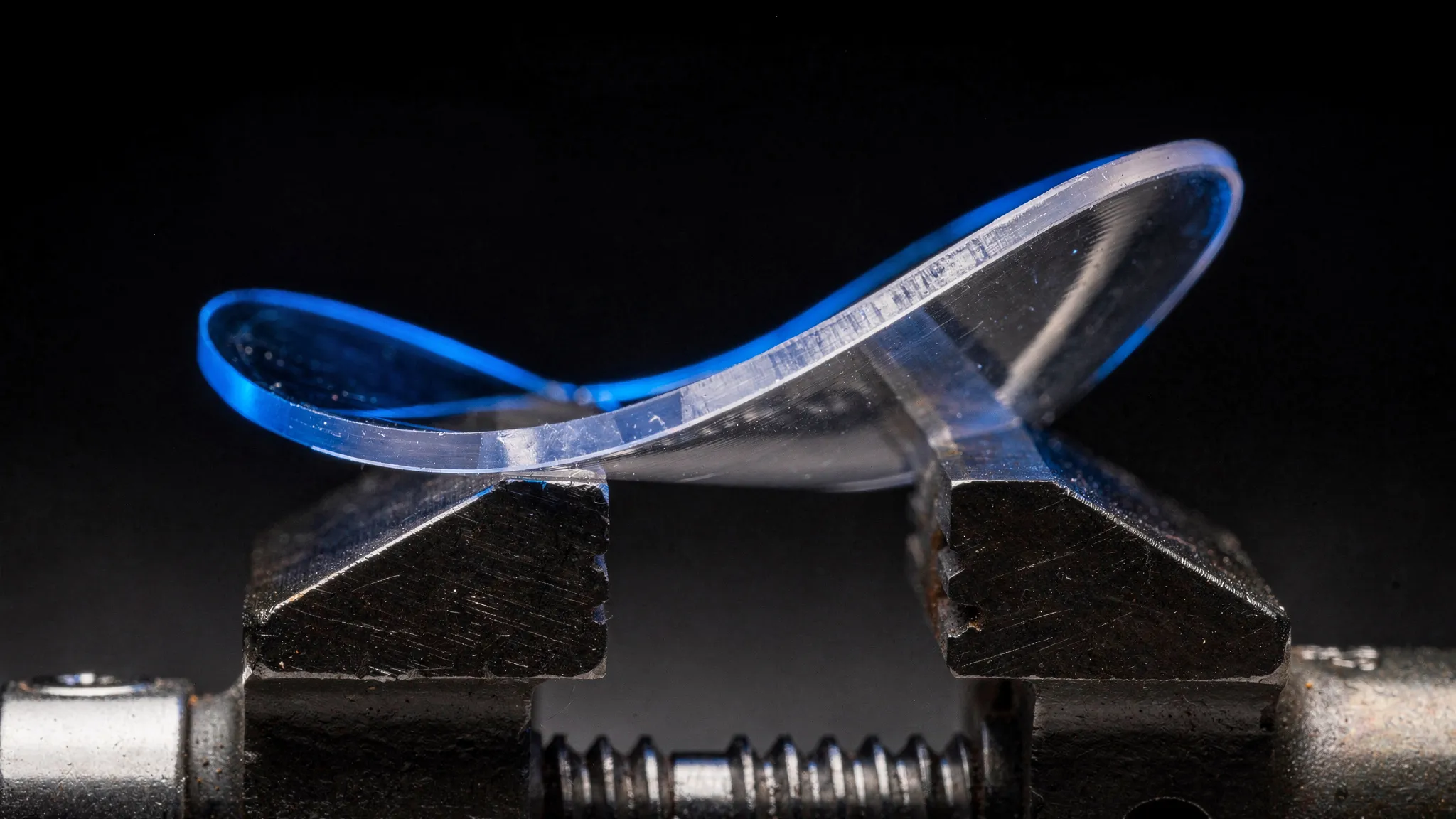
PINCH A POTATO CHIP, FIND LIGHT AND SHADOW
A thin shell is a curved sheet of material. Stretching it costs a lot of energy, so it prefers to bend, and it bends in ways dictated by its geometry — that is what draws the ridges of crumpled paper or makes a curved sheet snap through. Yet how a shell of general shape carries a load applied at a single spot remained unclear, especially for saddles, the shape of a potato chip, curved upward in one direction and downward in the other.
Kosei Kataoka and Tomohiko G. Sano, of Keio University in Yokohama, simply pinched one.
A chip in a vice
Their chips are 3D-printed in clear resin: 0.6 mm thick, cut into a disc 20 mm in radius. The radius of curvature — the radius of the circle that best matches the bend, small for a tight curve, large for a gentle one — along the pinching direction, R₂, is fixed at 20 mm, while the radius in the other direction, R₁, varies from one sample to the next, between 5 and 80 mm. A micrometer screw squeezes the chip at two opposite edge points, and a camera watches the tip, the point of the rim halfway between the two pinched points.
The result splits in two. When R₁ is small, the tip falls; when it is large, the tip rises; around R₁ = R₂ it barely moves. Computer simulations of an elastic shell reproduce the photographed silhouettes.
A wave equation frozen in space
To explain the switch, the authors take the limit of a shell so thin that it cannot stretch at all, only bend. The equation governing how far each point moves up or down, out of the surface, then becomes a wave equation — not in time, but in space: the distance from the line joining the two pinched points, heading towards the tip, plays the role of time, and the “wave speed” is √(R₂/R₁).
Like any wave, the deformation travels along characteristic lines. Here they are the shell’s asymptotic lines, the curves along which the surface does not bend up or down. Through every point of a saddle pass two of them. The pinch, imposed along the grip line (the straight line joining the two pinched points), is carried along these lines into the rest of the surface.
That gives a picture borrowed from optics. A point from which both asymptotic lines reach the grip line is lit: the grip pushes it upward. A point reached by only one is in the penumbra. A point reached by none is in the shadow: free of the grip, it sinks as the shell bends. The tip rises if it is lit, sinks if it is in shadow. The “wave speed” sets how steeply the lines leave the two pinched points: when R₁ is large, they close in gently and meet beyond the tip, which is lit; when R₁ is small, they meet before reaching it, leaving the tip in shadow. For a disc, the boundary falls exactly at R₁ = R₂. For an elliptical chip, the switch moves to R₁ = (a/b)²R₂, where a and b are its long and short half-axes: what matters is where the lines arrive, not the local curvature.
Real chips have a thickness, which lets them stretch a little. That blurs the boundary between light and shadow, shifting the switch slightly below R₂, by an amount roughly proportional to the thickness.
Where a shell holds
The same rule tells where a shell is rigid. Clamp a quarter of the chip’s rim and press on it point by point: the saddle is stiff only inside a diamond bounded by the two asymptotic lines starting from the ends of the clamped edge — the region lit by the clamp. Inside, stiffness is nearly constant; into the shadow, it falls off as one over the cube of the distance from the boundary. A dome casts no shadow at all, because its equation has no characteristic lines; a cylinder is the borderline case, with a stiff band along its straight lines.
In a shell, the authors conclude, curvature does not just store shape: it decides where mechanical information can travel. Since saddle curvature is everywhere in nature and can now be programmed into materials, light and shadow offer a quick way to predict where a curved sheet will move and where it will hold. They also note that stress concentrates in the lit region while the shadow stays nearly unloaded — which could steer cracks along the boundary, a possibility the paper leaves for future work.