
THE QUANTUM TWIN WHO SEEMS TO AGE MORE
Relativity says time does not flow at the same rate for everyone. In the famous twin paradox, the twin who travels accumulates less time than the one who stays home, and comes back younger. A clock lower in a gravitational field also ticks more slowly than one higher up. Both effects have been confirmed with atomic clocks, and the Global Positioning System could not work without taking them into account. In the classical formula, the factor that converts ordinary time into a clock’s own time can never exceed one: a clock in motion, or deeper in gravity, can only fall behind.
Youka Kaku, of the Stevens Institute of Technology and the University of Tokyo, Akira Matsumura, of Kyushu University, and Tomohiro Fujita, of Ochanomizu University and the University of Tokyo, asked what happens when the clock itself is quantum.
A clock entangled with its own motion
An atom makes a natural quantum clock: placed in two energy levels at once (a quantum superposition), it beats at a precise frequency set by the energy gap between them. Put it in such a superposition, and something odd follows from mass–energy equivalence: the atom is in a superposition of two slightly different masses. Each mass feels time dilation differently, so the atom’s motion and its internal ticking become entangled: they can no longer be described separately.
To read such a clock, the authors use Ramsey interferometry: a first pulse puts the atom in a superposition, it evolves for a time t, a second pulse recombines the two levels, and the probability of finding the atom excited reveals how much time the clock has recorded. For Alice, at rest, that is simply t. For Bob, who travels, it is t × (1 − ⟨p²⟩/2m²c²), where p is his momentum, m the clock’s mass and c the speed of light. Since the average of p² can only be positive, Bob always records less time than Alice: the usual twin paradox, intact.
The trick of post-selection
Now Bob adds one step. Just before the final pulse, he checks the state of his clock’s motion and keeps only the runs where it lands in a particular final state, discarding the others. This is post-selection. In the surviving runs, his clock’s time is no longer set by the ordinary average of p², but by a “weak value”, a quantity that can take unusual values, including negative ones, because of interference between the starting and final states. If this stand-in for p² turns negative, the minus sign in Bob’s formula flips: his clock gains time instead of losing it.
In the authors’ simplest example, Bob’s motion starts as a superposition of being at rest and moving with momentum p, with weights set by a number λ between 0 and 1 (the share of the at-rest branch), and is post-selected on a different combination of the two. The clock then records approximately t × [1 + √(1 − λ)/(√λ − √(1 − λ)) × p²/2m²c²]. As soon as λ is above one half (Bob more likely at rest than moving), the correction is positive: Bob’s clock reads more than Alice’s. The authors call it an effective time advance.
The striking part is that nothing in any single branch runs fast. The branch at rest keeps time normally, the moving branch runs slow; it is their interference, filtered by post-selection, that comes out ahead.
Gravity, Gaussians and an atom
The same reasoning works in a weak gravitational field, with a clock in a superposition of two heights. And exotic superpositions are not required: starting and post-selecting on simple Gaussian wave packets (the ordinary bell-shaped spread of a quantum particle, which already mixes a range of speeds), solved exactly in an approximate model, the clock runs ahead at early times, before falling behind again later. The authors single out this special-relativistic effect at short times as the most promising one to observe; the gravitational version would need a post-selection that almost never succeeds.
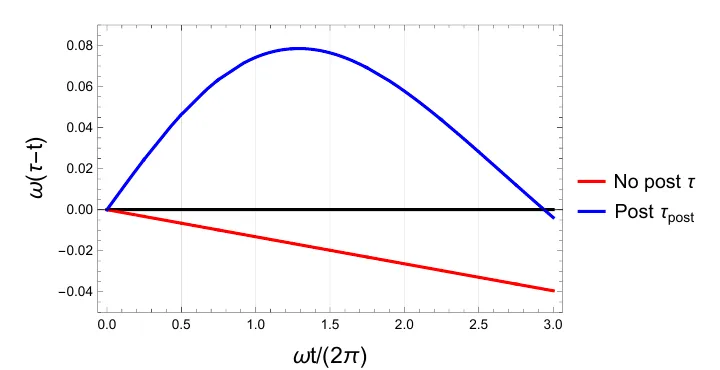
Lead (above zero) or lag (below zero) of the clock’s recorded time over the reference time, expressed as a phase of the clock’s oscillation (vertical axis), against elapsed time counted in clock oscillations (horizontal axis), for Gaussian wave packets: without post-selection (red) the clock always lags; with post-selection (blue) it runs ahead at first, then falls back. — Figure 4, Kaku, Matsumura & Fujita (2026), arXiv:2611.12609.
To make the effect tangible, they model the clock as a hydrogen-like atom whose electron cloud sloshes back and forth as the two levels interfere. At a chosen moment, the cloud of the “delayed” branch still leans one way, while the post-selected cloud already leans the other: its oscillation, and the electric dipole moment that goes with it (the charge imbalance created by the tilted cloud), is ahead of the reference clock.
The advance is conditional: it appears only in the runs that pass the post-selection. Whether it can be seen in a laboratory is the next question. The authors point to Ramsey interferometry with post-selection of the atom’s motion, with two challenges: keeping enough runs that pass the selection, and enough interference contrast to resolve the anomalous phase.