TWO PLANETS THAT BECAME ONE NEXT DOOR
Barnard’s Star is an old M-type dwarf star, between 7 and 12 billion years old, and the nearest single star to the Sun, at 1.828 parsecs (the parsec is a unit of astronomical distance). Very precise measurements of its wobble, the tiny back-and-forth motion its planets’ pull imposes on it, recently revealed four planets, each less massive than Earth. From the inside out, they are called d, b, c and e, and they circle the star in 2.34, 3.15, 4.12 and 6.74 days.
Their spacing hides a puzzle.
Planets that move in step
In compact planetary systems, neighbouring planets often have orbital periods in simple ratios, such as 4:3: the inner one makes four orbits while the outer one makes three. Such planets are said to be in resonance: their mutual pull keeps them locked in this rhythm. Several systems are linked this way from one planet to the next, in a resonant chain.
Such chains are thought to form while the young planets still move through the disc of gas around their star, drifting inward until they lock into step. But most planets observed today are not in resonance, and older systems show fewer chains. Many chains, it seems, break.
A chain with a missing link
At Barnard’s Star, the innermost pair, d and b, sits close to a 4:3 ratio. Planets b and e, which are not neighbours, are close to 2:1: e takes 2.14 times as long as b to go round. But planet c keeps time with neither of its neighbours. The chain looks broken in the middle.
Tian Yi, Chris Ormel and colleagues at Tsinghua University in Beijing, with co-authors in Shanghai and the United States, asked what history could produce this pattern. A similar one had been proposed for another system, Kepler-221: five planets in a chain, two of which merged.
Four histories, two survivors
The team ran computer simulations of how the planets’ orbits evolve, testing four scenarios.
- Four planets from the start, stretched by tides. The star’s tides slowly push a resonant chain apart over billions of years. In 90% of 100 runs, the chain broke before reaching today’s spacing, and in the others it did not match the measurements. Rejected.
- Four planets carried by the retreating disc. As the gas disc thins, its inner edge moves outward and can drag planets along. But planet e, the lightest, cannot keep up: in all 18 runs, it ended too close to c. Rejected.
- Five planets, stretched by tides, then a collision. The chain expands for billions of years, then breaks near today’s spacing; two middle planets, c1 and c2, cross orbits and merge into planet c. It works, but rarely: 12.0% of 75 runs gave the right merger, and 6.7% stayed stable afterwards.
- Five planets, broken while the disc was still there. If the disc’s inner edge sits at planet e’s orbit, the disc keeps pushing inward the planets in the gas-free hole inside its edge, hardest on planet c2, the closest to that edge. In one example run, the chain breaks after about 0.75 million years, c1 and c2 collide, and the disc must vanish just as the spacing matches today’s. The right merger happened in about 47% of 232 runs.
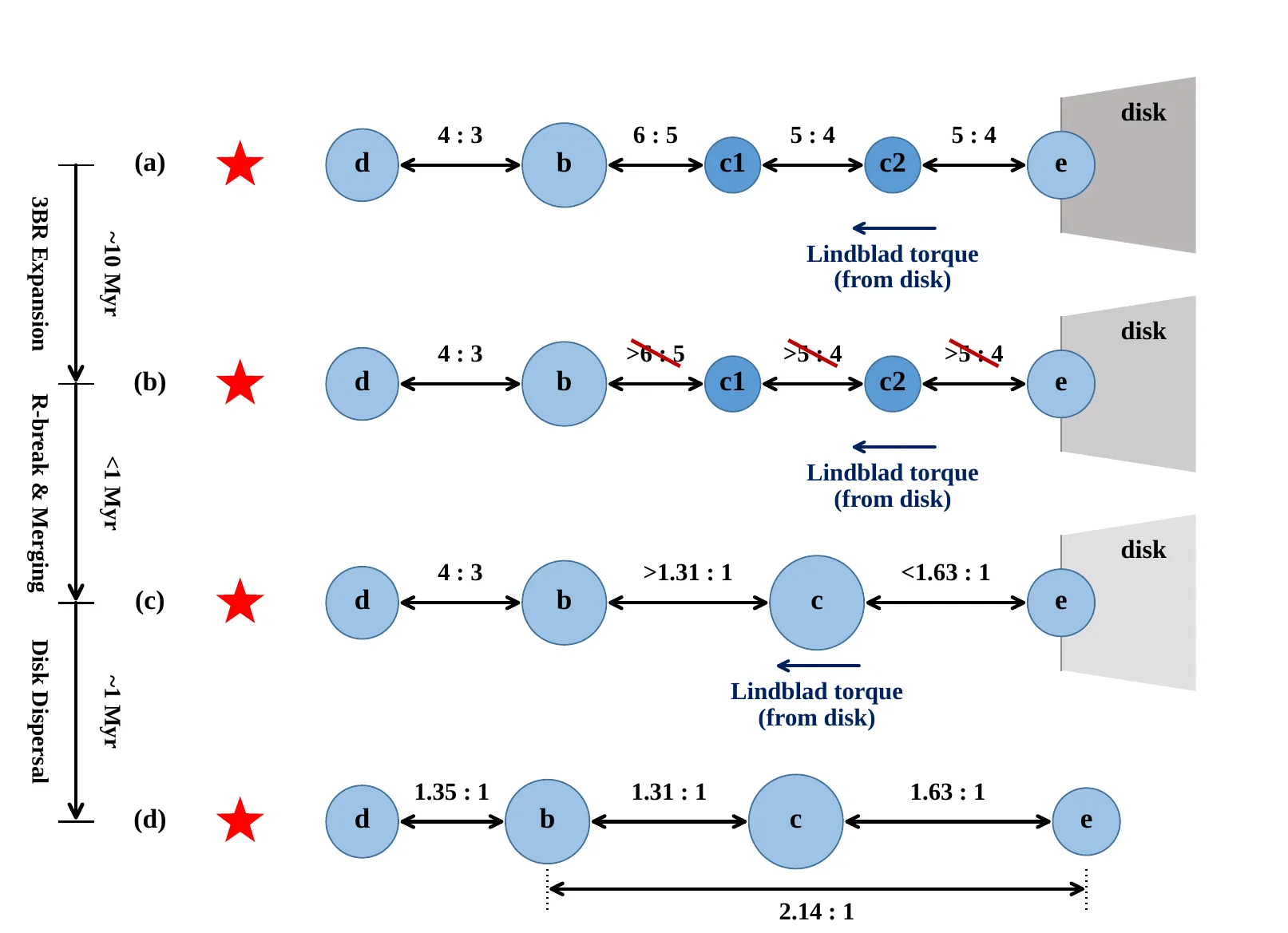
Scenario IIB: the disc’s torque on the inner planets (arrows) breaks the chain, planets c1 and c2 merge into c, and the disc disperses once the period ratios match today’s. — Figure 6, Yi et al. (2026), arXiv:2611.13771.
The third planet, again
Is Barnard’s Star a special case? The team searched for compact four-planet systems with the same broken-chain look and found 14. In 10 of them, the planet out of step is the third one, as at Barnard’s Star. If every planet were equally likely to be the odd one out, that would happen only 0.034% of the time.
That does not prove those planets formed by collisions: other processes can knock a planet out of resonance. But it suggests chains often break between the third and fourth planets, which fits the scenario where the disc pushes hardest on the planet just inside its edge.
How to tell the two stories apart
Both surviving histories include a giant impact, so the loss of an atmosphere would not settle the question. The innermost pair might. In the tidal scenario, the 4:3 lock between d and b was lost in all the stable outcomes. In the disc scenario, it survived in about a third of them. If future measurements show that d and b are still truly locked together, that would favour a chain broken early, while the gas disc was still there.