Edition of November 12, 2026

  1. At The Knowledge Frontier, we pick out the research papers of the day and explain them simply.

    The web has changed in nature. We no longer search, we scroll. Pages look alike, texts are churned out, and we end up reading a great deal without keeping any of it. Educating yourself there has become a strangely passive affair.

    Here, you do more than read. Every article ends with a quiz: a few questions on what you have just read. When the subject lends itself to it, it is an experiment — you set the values yourself and recover, in turn, the researchers' result.

    @VirScience
  2. Earth & climate

    HURRICANES THAT CHANGE THE LENGTH OF THE DAY

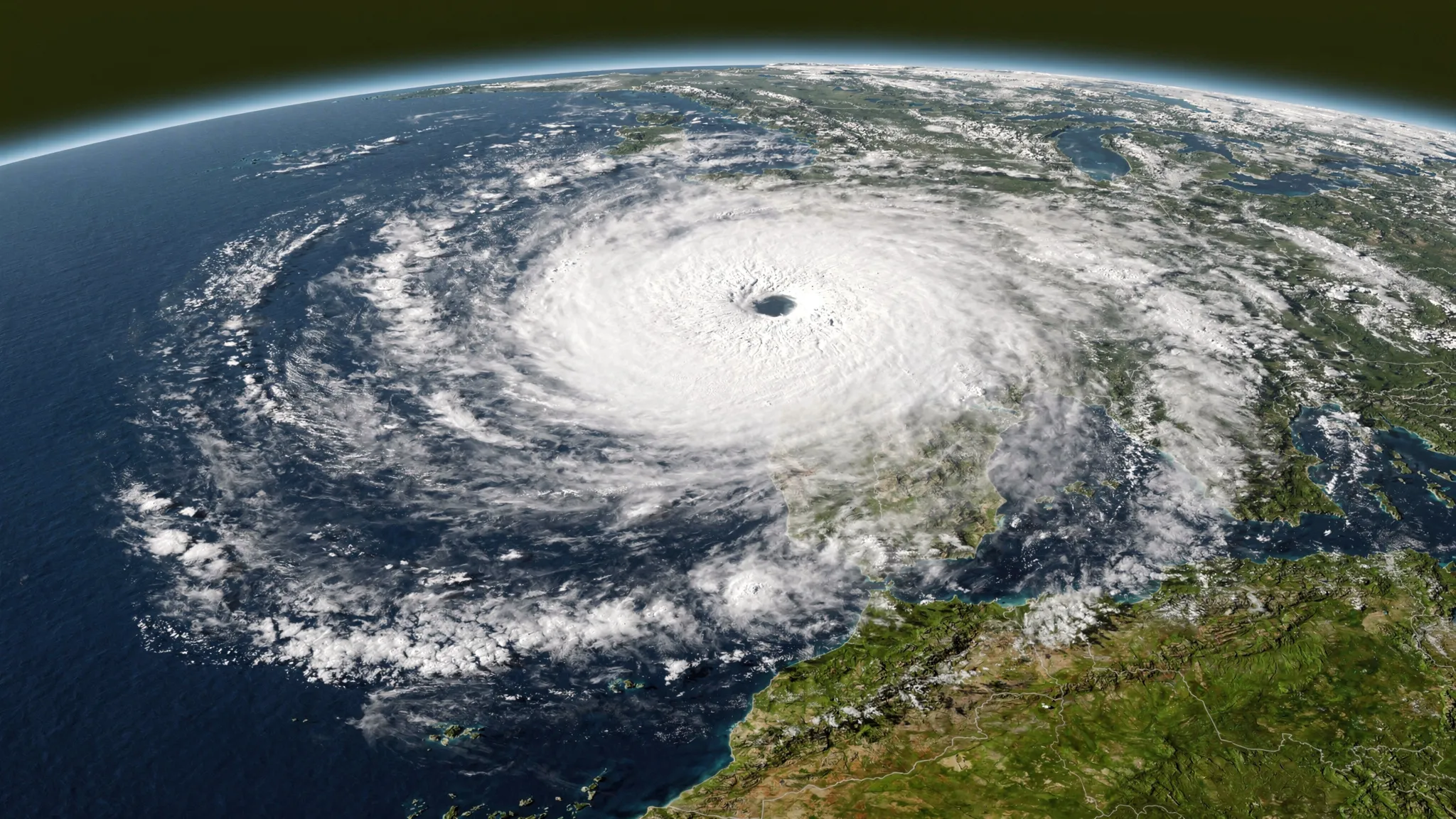
    Satellite view of a large hurricane with a clear eye spinning near a coastline, its cloud bands spreading over green land, with the curved edge of the Earth at the top.

    An earthquake can change the length of the day. In 2011, the Tōhoku quake shortened it by 1.80 microseconds. Can a hurricane do the same?

    A team at Sichuan University studied twelve big Atlantic storms hitting land. They computed how hard the wind rubs on the ground. That friction pushes or brakes the spinning Earth, like a hand on a turning wheel.

    Katrina lengthened the day by 2.29 microseconds, Harvey by 1.87. Mitch shortened it by 3.43. Eight of the twelve storms beat Tōhoku. An old estimate predicted a hundred times less.

    The surprise: the sign depends on where the storm is heading. Heading north, it lengthens the day. Heading south, it shortens it. The effect fades within weeks, but a warming climate could make it larger.

    Source: Landfalling tropical cyclones perturb Earth's rotation, https://arxiv.org/abs/2611.12909
    PreprintData analysis❓ Quiz
  3. Space & astronomy

    A PLANET WHOSE TRANSITS VANISHED

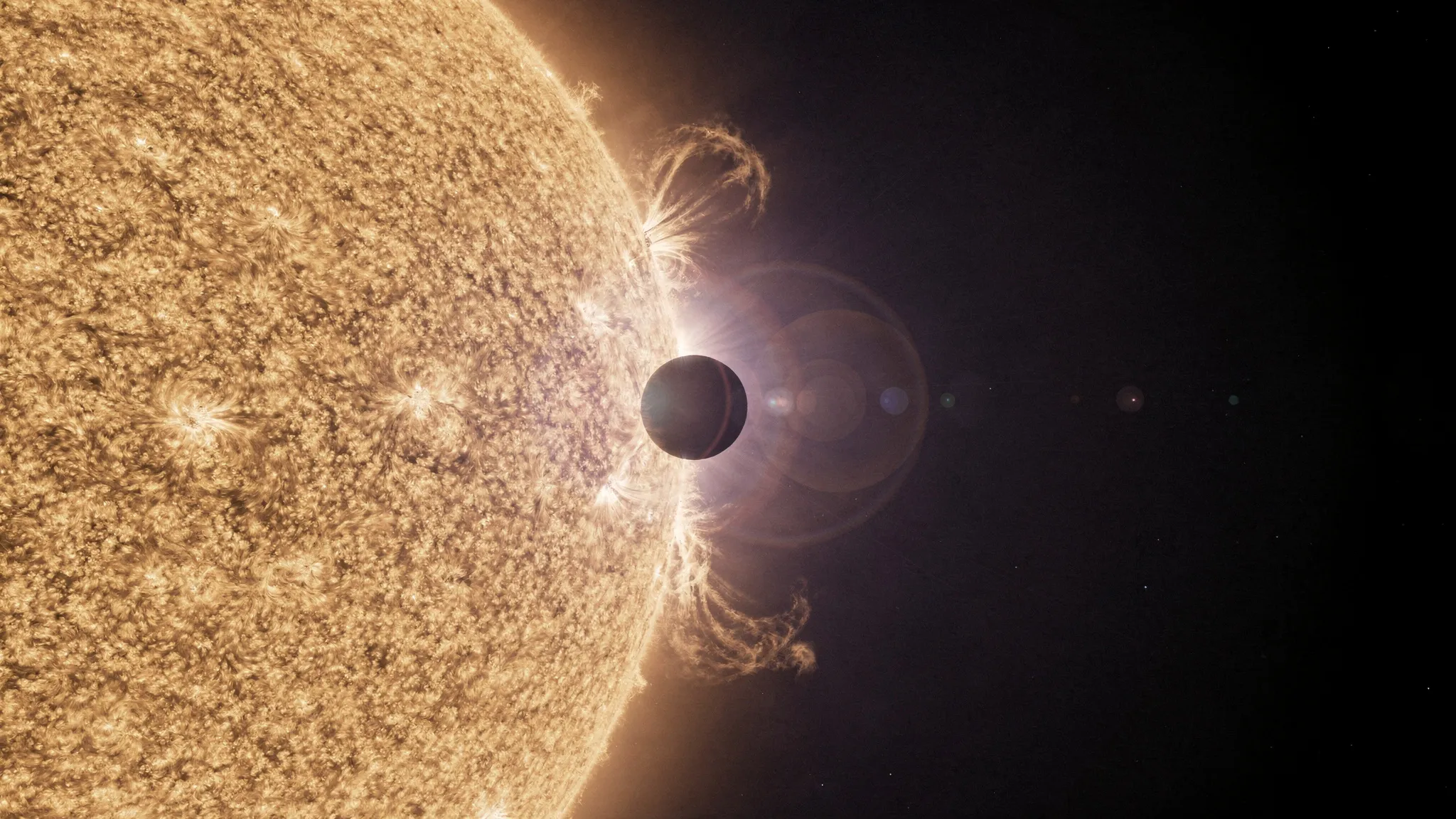
    A small dark planet in silhouette at the very edge of a glowing golden star, half against the star's rim and half against black space.

    A transit happens when a planet passes in front of its star. The star dims slightly for a few hours. Satellites like NASA's TESS watch for these dips.

    TOI-2535 b is a giant planet that circles its star in 8.2 days. NASA's TESS satellite watched it from 2019 to 2026. Year after year, its path across the star slid toward the edge.

    In 2026, the transits were gone. It is a first for a planet around a single star. Its path moves by 0.16 star radii per year, a record.

    The culprit: an unseen neighbour, probably at least as heavy as Saturn. Its tilted orbit makes the giant's orbit swing. The transits also came up to six hours early or late. Next step: weighing it through the star's wobble.

    Source: A TESS Disappearing Act: The Vanishing Transits of TOI-2535 b, https://arxiv.org/abs/2611.13343

    PreprintObservation🧪 Experiment
  4. Physics

    HALF A MILLION ROLLS OF LOADED DICE

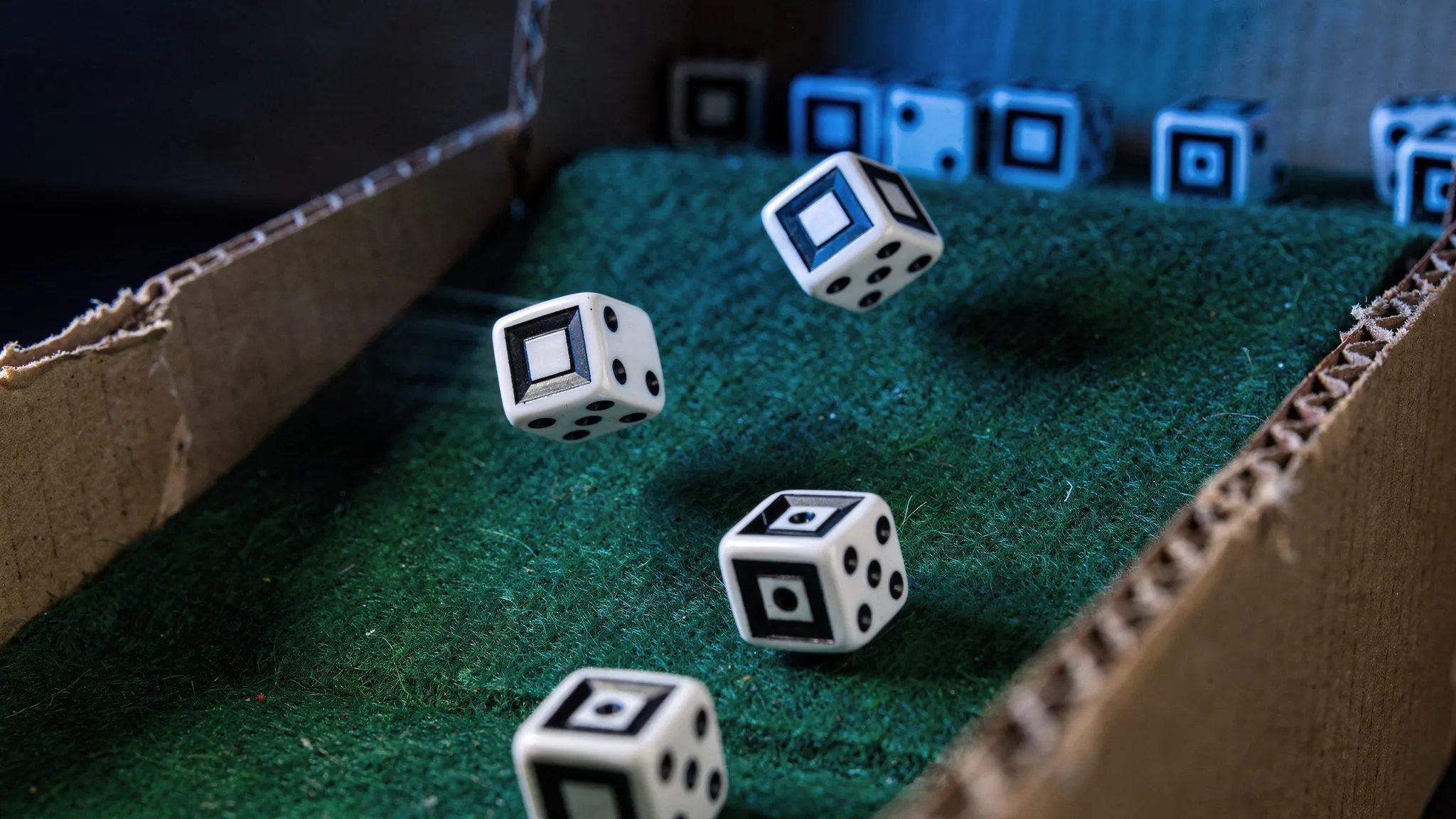
    White dice marked with black and white square patterns tumbling across green felt inside an open cardboard box, in blue light.

    Put a weight in one corner of a die and it cheats. But by how much, exactly? A team at Sweet Briar College in Virginia set out to measure it.

    They 3D-printed 23 kinds of dice, each with a different set of filled corners. A cardboard seesaw driven by an Arduino rolled them day and night. A camera read each result. Total: 515,754 rolls.

    A face's chance grows exponentially with the weight beneath it. Physicists know this law: it sorts states by their energy. Dice with two filled corners follow the steepest curve.

    The surprise: the more corners filled, the less each one counts. Fully loaded dice also come to rest faster. A die that loses its energy quickly has less time to find its favourite face.

    Source: Energy Dissipation Modulates Sensitivity to Corner Advantage in Weighted Dice, https://arxiv.org/abs/2611.13149

    PreprintExperiment🧪 Experiment
  5. Chemistry

    ICE THAT GROWS ON NEGATIVE IONS

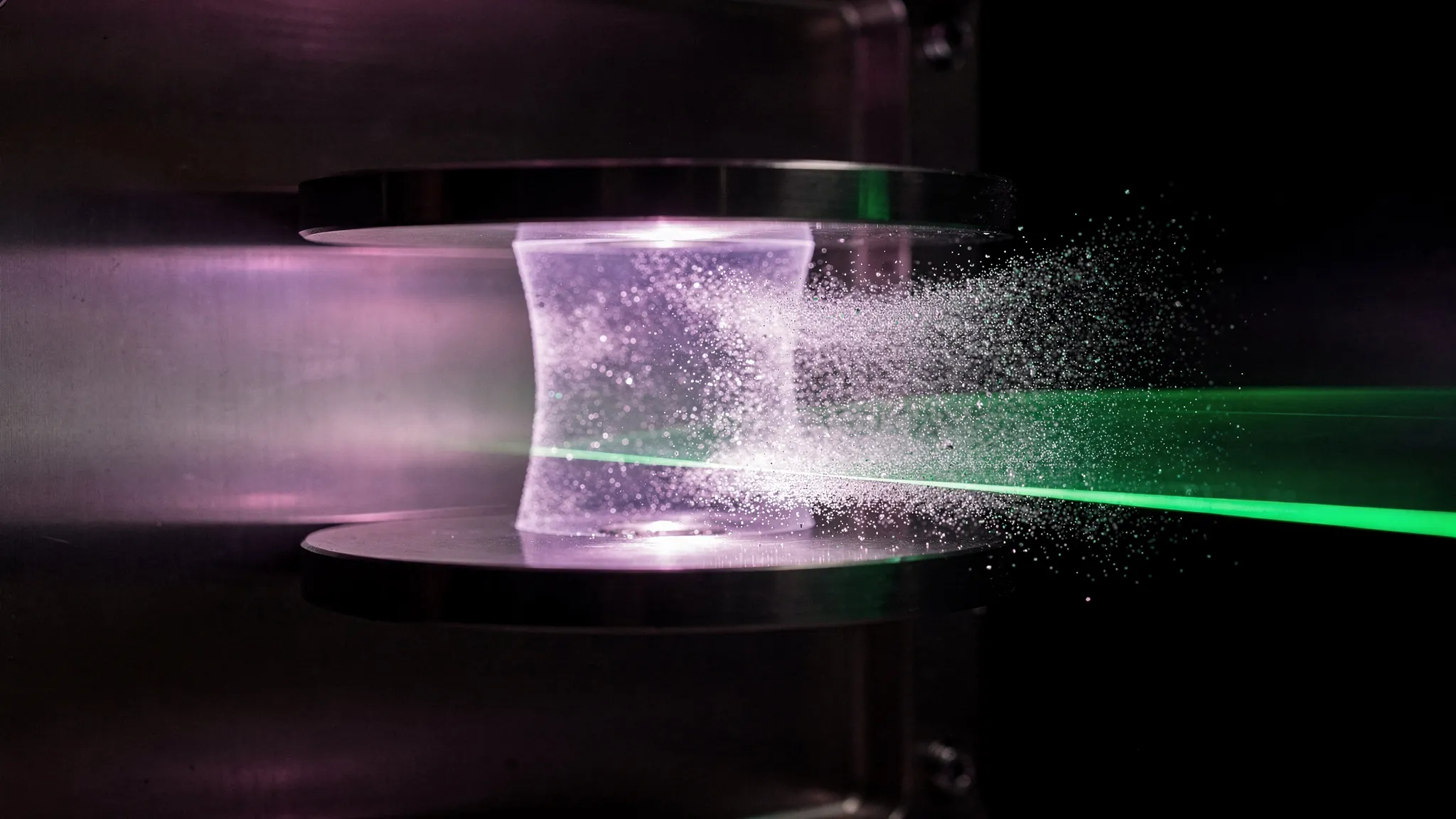
    Seen from the side inside a steel chamber, a cloud of tiny sparkling grains floats between two round metal plates, one above the other, crossed by a thin green laser beam, in purple light.

    How does ice form in space or high in the sky? Usually, it needs a seed, like a speck of dust. Yet pure ice shows up where no seed is seen.

    At Caltech, a team chilled a faintly glowing gas of argon and a little water. Below 190 kelvin, deep cold, ice grains formed by themselves. With no electric charges in the gas, nothing formed.

    The seeds were negative ions, mostly hydroxide, collecting water molecules one by one. Positive ions stayed small: fast electrons kept breaking them up. The sign of the charge makes the difference.

    The same path could explain night-shining clouds 85 km up. It could also make ice in disks where planets form. In one region of such a disk, it could beat dust 2,000 times over.

    Source: Nucleation of water ice under weak ionization via clustering on negative ions, https://arxiv.org/abs/2611.14441

    PreprintExperiment❓ Quiz
  6. Space & astronomy

    GROWING A FOREST ON A WARMED MARS

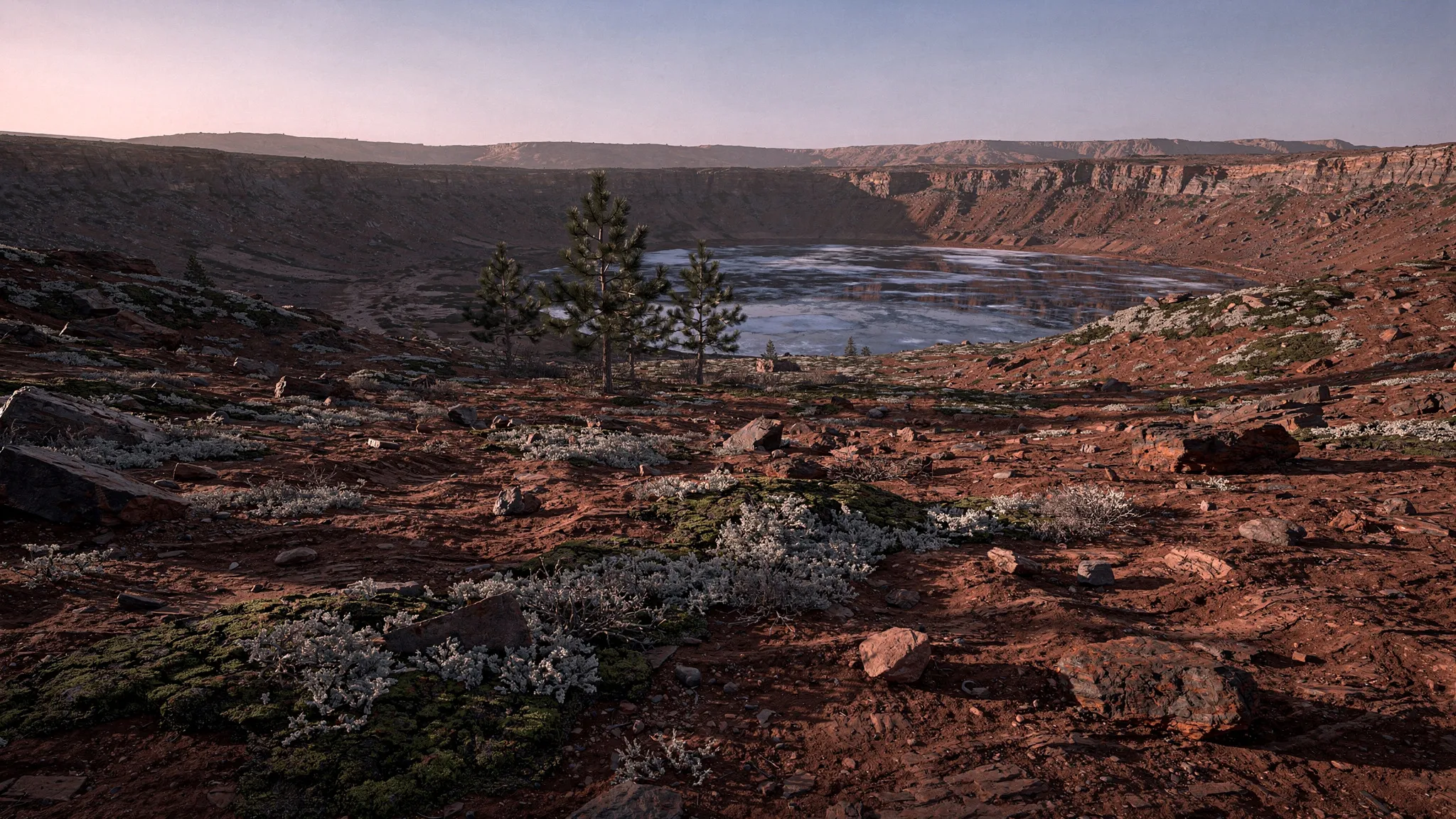
    A wide red rocky crater basin at dusk with patches of green moss and pale lichen, a few small pine trees and a frozen pond at its bottom.

    Mars today is cold and dry, with air too thin for life. Water boils there below 10 °C. Could we ever make it green? A new study tests the idea.

    Researchers from the Astera Institute, Chicago, MIT and NASA's JPL used a climate model. They ran 24 simulations. They pictured a Mars warmed on purpose, its air rich in oxygen. A first in 3D.

    At five times today's pressure, lichens and mosses could grow. At ten times, forests, first in the giant Hellas basin. Nights get milder, but the seasons stay brutal in the south.

    And the oxygen? Plants as productive as Earth's would need at least thousands of years. Mars also lacks the carbon dioxide to make enough, unless it is recycled.

    Source: The climate and potential habitability of a warm and oxygenated Mars, https://arxiv.org/abs/2611.13321

    PreprintSimulation❓ Quiz
  7. Life sciences

    MICROBES CHASING THE OCEAN'S SNOW

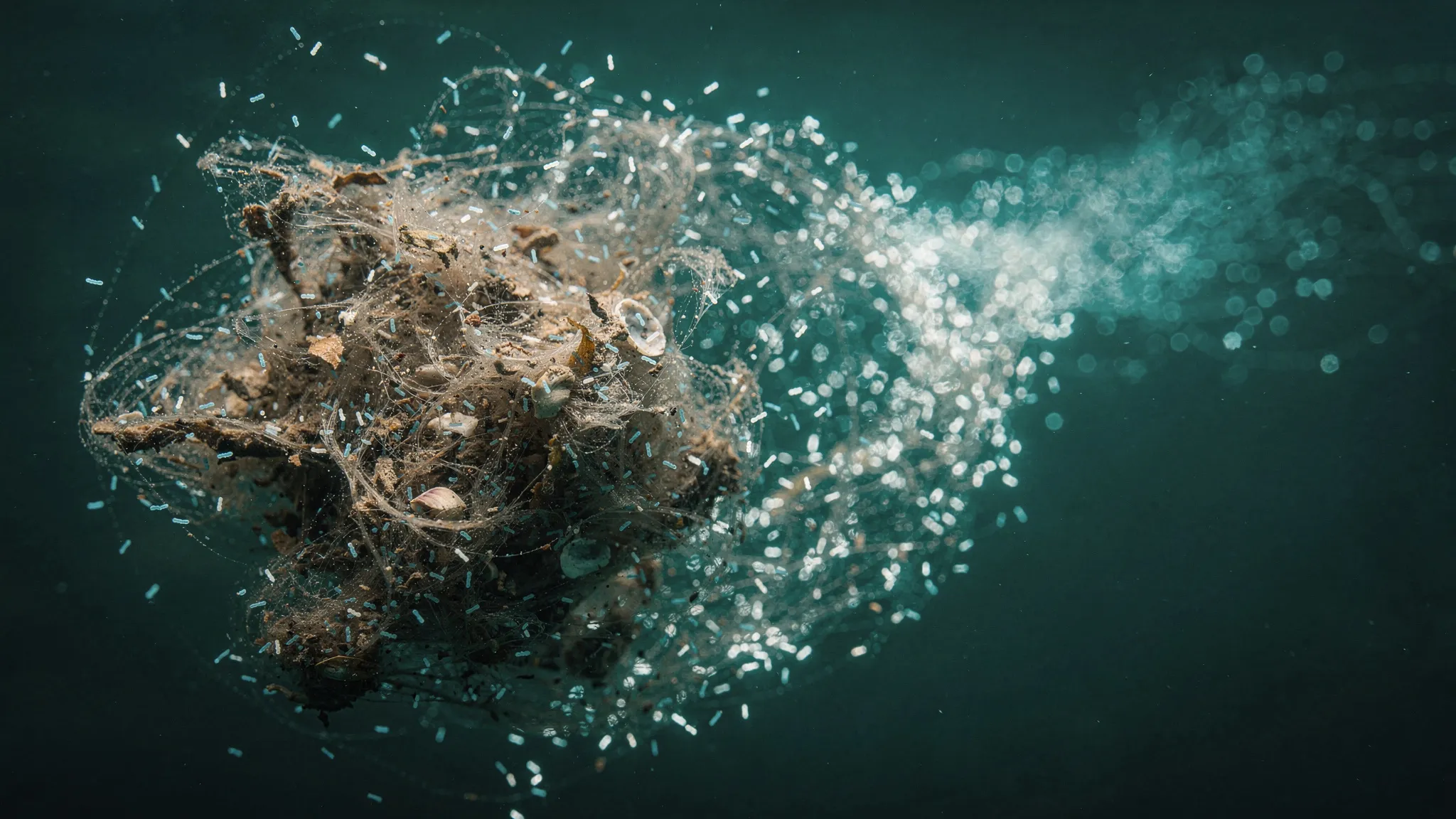
    A brownish clump of organic debris and fine threads drifting in dark green water, with tiny glowing specks swarming around it and streaming off to the right.

    Every day, flakes of organic matter sink through the ocean. Scientists call them marine snow. They carry carbon down to the deep sea, and microbes eat them on the way.

    Two Stanford researchers filmed microbes around fresh marine snow aboard a ship off California. Seawater flowed past a flake to mimic its fall. Every microbe was tracked one by one.

    Encounters peak when the flake sinks at about 14 metres per day. The fitted curve drops to zero near 78 metres per day. Close to a falling flake, its chemical trail beats the swirling water.

    The consequence: slow flakes are eaten near the surface. Fast ones may reach the seabed almost intact. That split could change how we estimate the carbon the ocean locks away.

    Source: Chemotactic Horizons Regulate Threshold Dynamics in the Biological Carbon Pump, https://arxiv.org/abs/2611.13165

    PreprintExperiment❓ Quiz
  8. Earth & climate

    WHAT REALLY GROWS AT THE TIP OF LIGHTNING

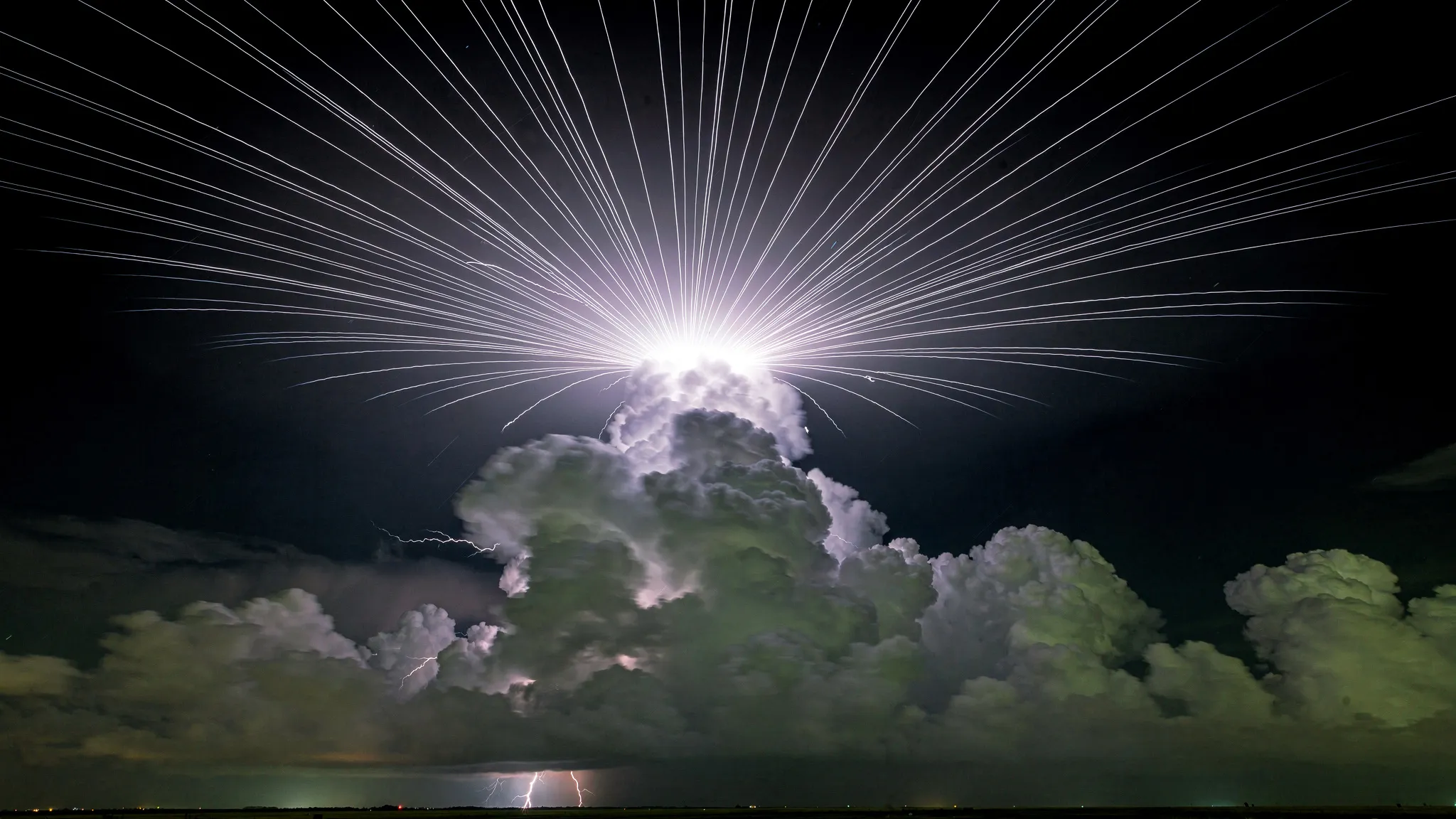
    At night, a fan of thin straight luminous filaments bursts upward from the top of a towering thundercloud, with small lightning bolts near the ground.

    Lightning does not cross the sky in one go. Its negative tip advances in jumps, through bursts shaped like fans. Everyone assumed these fans were sprays of tiny sparks called streamers. Nobody had seen them clearly.

    A team at ASTRON, the Dutch radio astronomy institute, used the LOFAR radio telescope. Its antennas cover the north of the Netherlands. They re-imaged a lightning flash from August 2020 in sharp detail.

    Inside one fan: thin filaments, at most a metre wide, 100 to 500 metres long. They glide at about 100 kilometres per second without widening. They branch, and steer around each other's paths.

    They behave like small leaders, the conducting channels of lightning, not like streamers. Seen blurry, they look like steps. Seen sharp, the step-by-step picture may need rethinking.

    Source: Filamentary dynamics in fan-like structures in high-altitude lightning discharges, https://arxiv.org/abs/2611.14193

    PreprintObservation❓ Quiz
  9. Physics

    LIGHT THAT REFUSED TO FALL APART

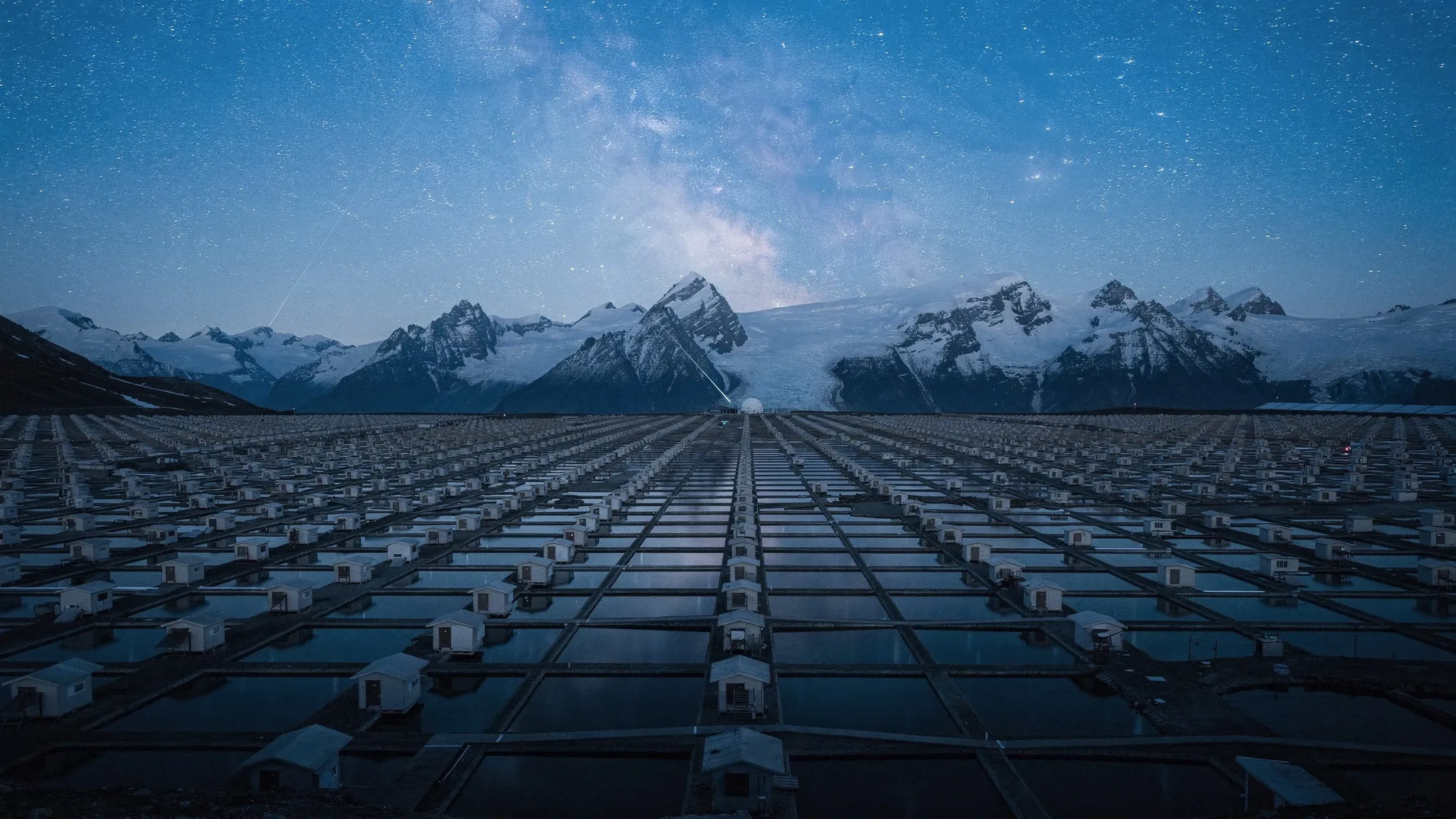
    At night, a high plateau covered with a regular grid of small white huts and dark water ponds, snowy mountains and the Milky Way behind.

    Special relativity says the laws of physics look the same at any speed. Some theories of quantum gravity suggest this could crack at extreme energies. How do you test that?

    The LHAASO observatory sits 4,410 metres up in Sichuan, China. It caught gamma rays of up to 3.7 million billion electronvolts. They came from Cygnus X-3, a binary system about 9 kiloparsecs away. That unit measures vast cosmic distances. The data cover four of its flares.

    If relativity cracked in a certain way, such photons would break apart on the way. They would turn into an electron and a positron, or split into three photons. Their spectrum would stop abruptly. It does not.

    Result: a second-order limit nearly ten times stricter than before. No sign of such a crack, even for the most energetic light ever caught from this source.

    Source: Constraints on Lorentz Invariance Violation from PeV Gamma Rays of Cygnus X-3 Observed by LHAASO, https://arxiv.org/abs/2611.14028

    PreprintData analysis❓ Quiz
  10. Space & astronomy

    TWO PLANETS THAT BECAME ONE NEXT DOOR

    Two round rocky planets smashing together near a dim red star, throwing out glowing debris, with a few small planets as faint dots in the distance.

    Barnard's Star is the nearest single star to the Sun. Four small planets orbit it, each lighter than Earth. Each one takes 2 to 7 days to go round. Astronomers confirmed them only recently.

    Planets often move in step, like links in a chain. One makes four orbits while its neighbour makes three. Here, the third planet breaks the rhythm.

    A team at Tsinghua University simulated four possible histories. Only two work, and both need a lost fifth planet. In both, it collides with a neighbour to form today's planet c. The two other histories failed.

    The clue goes beyond Barnard's Star. In 10 of 14 similar systems, the third planet also breaks the chain. Pure chance would give that only 0.034% of the time.

    Source: Breaking the Chain: The Dynamical History of the Barnard's Star Planetary System, https://arxiv.org/abs/2611.13771

    PreprintSimulation❓ Quiz
  11. Life sciences

    WHAT A CELL PAYS TO FOLLOW A SCENT

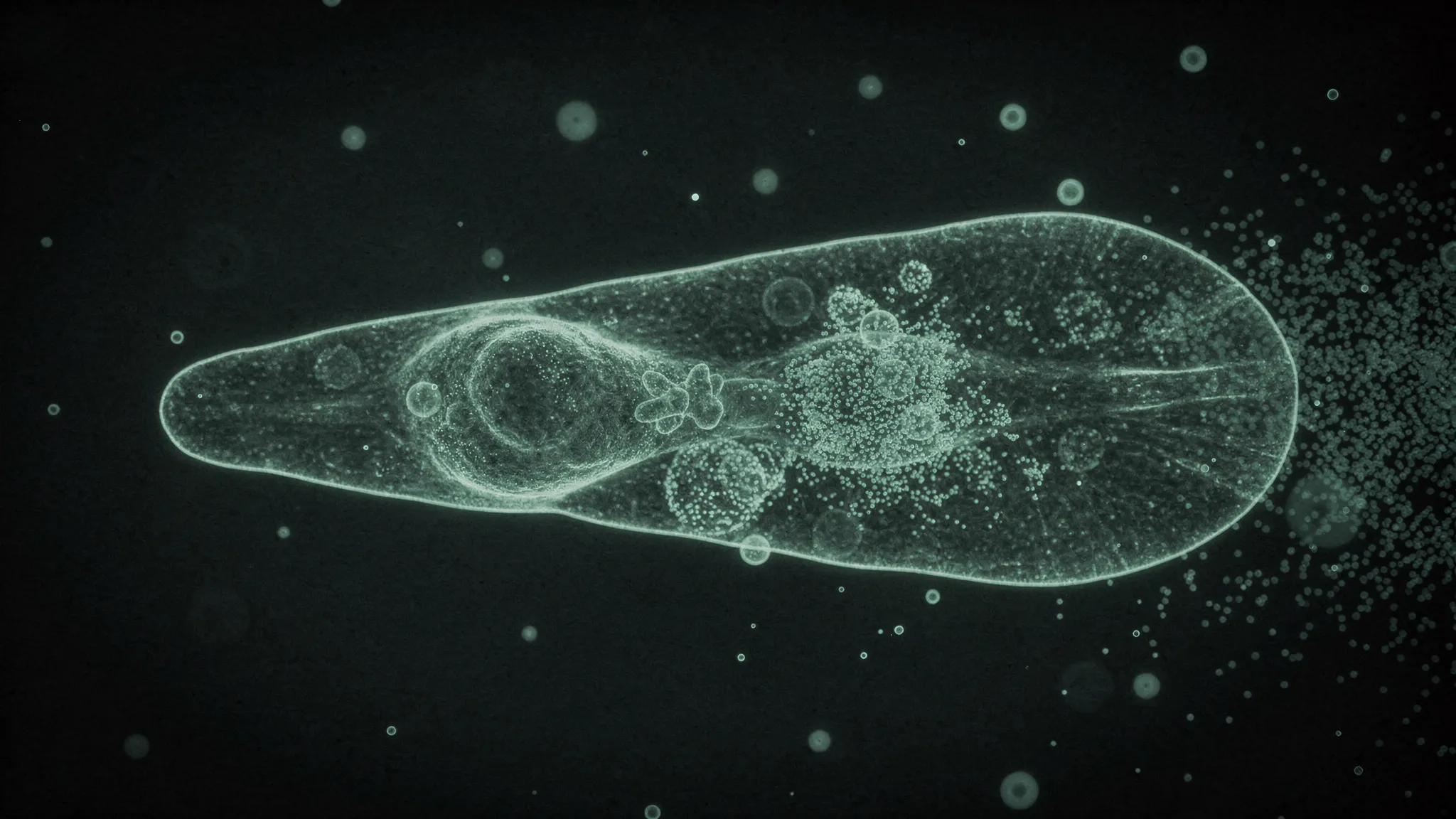
    A pale green elongated cell seen from above through a microscope, wider at one end, surrounded by tiny beads crowding on that side.

    Cells find food or targets by following chemical trails. To read a trail, they capture the molecules that make it. But how many must they catch, and at what cost?

    Three researchers in Copenhagen and London derived exact formulas for this problem. They link a cell's accuracy to the molecules it absorbs. They also link it to the energy it spends.

    They reanalysed data on Dictyostelium, a cell that crawls toward chemical signals. It absorbs only 0.25% of the maximum possible. Tens to hundreds of molecules can be enough.

    The energy bill stays small, about 1% of its sensing budget at worst. What limits Dictyostelium is counting, not fuel. Halve the difference across the cell, and it needs four times more molecules.

    Source: Energetic costs of reaching the physical limits of sensing, https://arxiv.org/abs/2611.14145

    PreprintTheory❓ Quiz
  12. Chemistry

    SOLAR CELLS THAT SURVIVE 400 FREEZE-AND-BAKE CYCLES

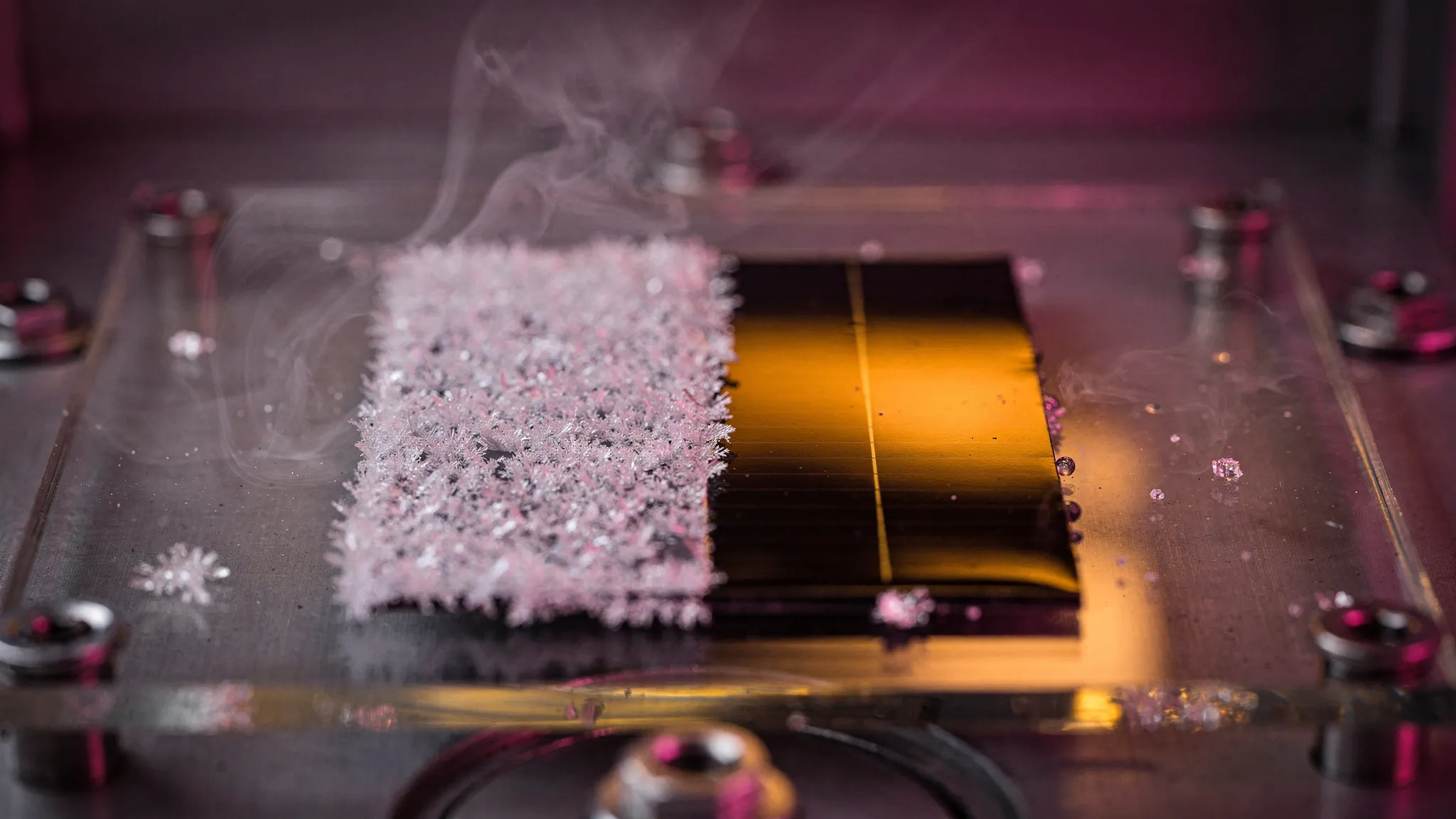
    A small dark solar cell on a glass plate in a metal test rig, its left half covered in white frost and its right half glowing warm amber.

    Outdoors, a solar panel freezes at night and bakes in the sun. For perovskite cells, a promising new kind, this back-and-forth is a killer. Layers expand and shrink, and the joints between them tire.

    A team led from Henan University and Cambridge found where they break. A layer one molecule thick, attached to the glass electrode, comes unstuck. Its bond weakens by 69%.

    The fix: a thin coat of indium chloride before laying that layer. It gives the molecules more points to hold on to. Indium is already part of the electrode, so the salt fits right in.

    Result: 27.3% efficiency, 26.9% certified. After 400 cycles between −40 and 85 °C, the treated cells keep 94% of it. Untreated ones keep only 61%. Under constant light for 2,000 hours, the treated cells keep 95%.

    Source: Hierarchical interfacial anchoring for durable perovskite solar cells, https://arxiv.org/abs/2611.13746

    PreprintExperiment❓ Quiz
  13. Mathematics

    A BALL WITH HOLES BEATS THE PERFECT BALL

    A thin round metal plate with a gently wavy surface and a ring of small round holes near its edge, lying on dark slate in cyan light.

    Squeeze a thin plate clamped at its edges and, past a critical load, it buckles. A higher load brings a second way of buckling. The ratio between these two loads depends only on the shape.

    In 1999, the mathematician Ashbaugh made a bet. A round shape should space these two loads furthest apart. Computations on squares and polygons seemed to agree.

    Three mathematicians from Dalian and Jiangsu universities show the conjecture is false, in every dimension. Their winning shape is a disc punched with tiny holes near its edge.

    The trick: they force the plate to stay flat along a circle near its edge. At first sight, both loads rise by the same share. A closer look shows the second rises a little more. Convex shapes without holes remain an open case.

    Source: Counterexamples to the buckling eigenvalue-ratio conjecture in every dimension, https://arxiv.org/abs/2611.13018

    PreprintTheory❓ Quiz
Legal notice