HURRICANES THAT CHANGE THE LENGTH OF THE DAY
Earth does not spin at a perfectly steady rate. When huge masses of rock, water or air start moving, the planet’s rotation responds, because the total angular momentum — the “quantity of spin” — of the Earth and everything on it must be conserved. The textbook example is the great Tōhoku earthquake of 2011 (magnitude 9.1), which shortened the day by 1.80 microseconds (millionths of a second).
Tropical cyclones are the costliest weather disasters on the planet. Yet nobody knew whether they could alter Earth’s rotation too.
A flywheel that should only slow down
A tropical cyclone gathers spinning air from about 1,000 kilometres around and concentrates it into a core a few hundred kilometres wide. There, the air turns up to a hundred times faster than the Earth itself.
When the storm comes ashore, it loses its supply of warm ocean water, and the rough ground drags hard on its winds. Within about a day, the circulation dies down. That makes landfall the best moment to look for a signal.
The tempting picture is a braked flywheel. A cyclone turns in the same direction as the Earth, in both hemispheres. As friction stops it, it should hand its spin over to the ground, speeding the planet up and always shortening the day. An earlier idealised estimate based on that picture gave a tiny effect: about 0.014 microseconds, a hundred times less than a great earthquake.
Twelve storms seen through a 500-kilometre disc
Yaxuan Yang, Lin Li, Qingyuan Wang and colleagues at Sichuan University in Chengdu, China, with one co-author also affiliated with the University of Michigan, looked at twelve high-impact North Atlantic hurricanes that made landfall on a continent. Ten are among the costliest US storms that were tracked over land for at least four six-hourly reports in a row. Two more, Mitch (1998) and Isidore (2002), were added because they came ashore heading south and east.
For each storm, the team used ERA5, a reconstruction of the real atmosphere from the European Centre for Medium-Range Weather Forecasts. They followed the storm with a disc 500 kilometres in radius and added up how hard the wind pushed east or west on the land inside it. Each patch of ground counts more the farther it sits from Earth’s axis, like a hand pushing a door far from its hinges. They summed this push from first contact with land until the winds dropped below 17.5 metres per second, the threshold of a tropical storm, then converted it into a change in the length of the day.
Bigger than most earthquakes
The braked flywheel was wrong on two counts.
- The effect is huge. Eight of the twelve storms changed the day more than Tōhoku did. Katrina (2005) lengthened it by 2.29 microseconds, Harvey (2017) by 1.87. Mitch shortened it by 3.43, the largest response of all, just ahead of Rita (2005) at +3.41.
- It goes both ways. Ten of the twelve storms made the day longer, the opposite of what the flywheel predicts.
Among all recorded earthquakes, only three changed the day more than the strongest of these storms: Chile 1960, Alaska 1964 and Sumatra 2004.
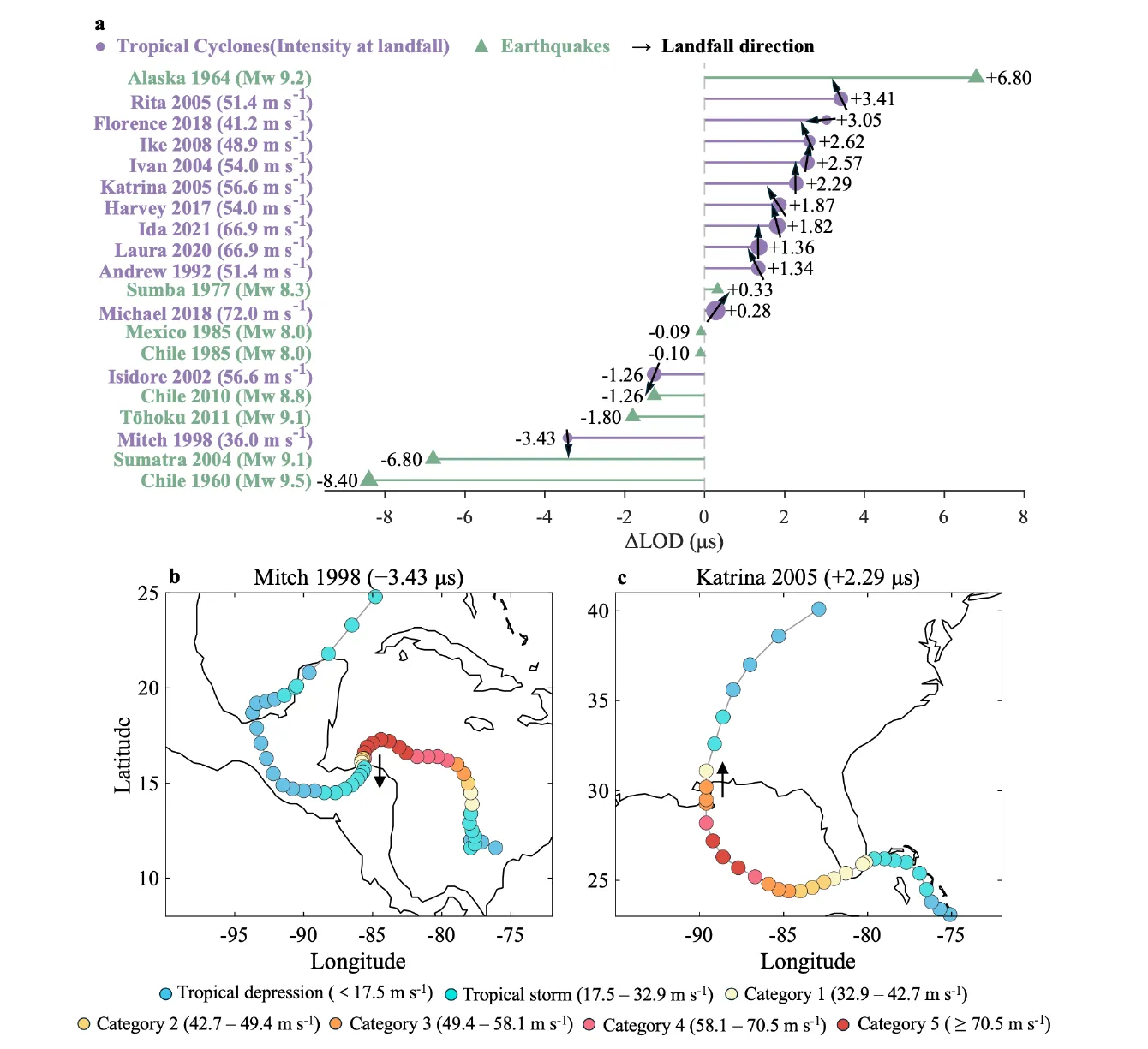
Change in the length of the day for 12 landfalling hurricanes (purple) and 8 great earthquakes (green); arrows show the storm’s direction at landfall. Below, the tracks of Mitch, heading south, and Katrina, heading north. — Figure 1, Yang et al. (2026), arXiv:2611.12909.
The flank that touches land first
The tracks gave the first clue. Mitch moved south into Central America and shortened the day; Katrina moved north across the US Gulf Coast and lengthened it.
To isolate the cause, the team simulated one idealised hurricane crossing a straight coastline, then rotated the whole scene in 3-degree steps to change only the direction of arrival. That change alone flips the sign. The response follows an almost perfect wave: +0.72 microseconds for a storm heading roughly northwest, −0.75 for one heading southeast, and zero for storms heading north-northeast or south-southwest. The simulated values are smaller than the real ones, mainly because the model storm is more compact and the land smoother.
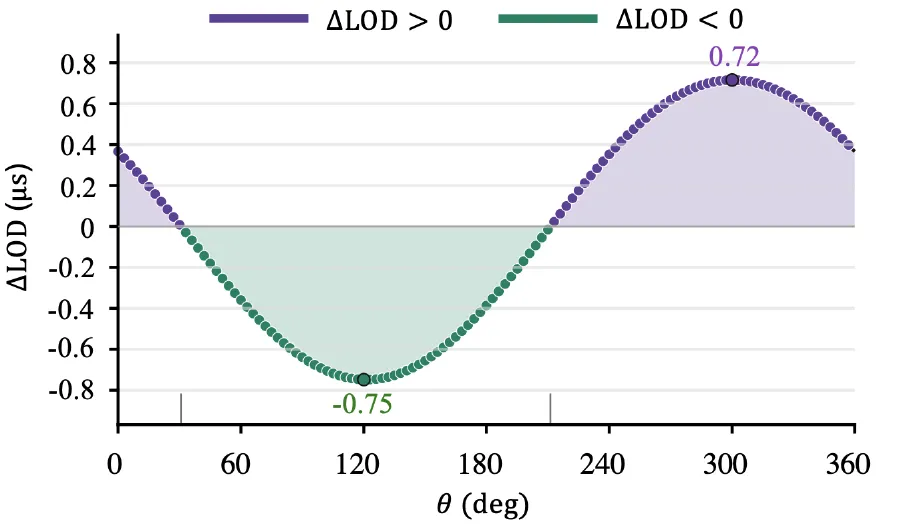
Simulated change in the length of the day versus landfall direction (0° = heading north, 90° = heading east): longer days in purple, shorter days in green. — Figure 2b, Yang et al. (2026), arXiv:2611.12909.
The mechanism is simple. In a storm heading north, the northern flank reaches land first, and there the wind blows westward, against Earth’s spin: the day lengthens. Once the whole storm is over land, its two sides nearly cancel. A storm heading south does the opposite.
For a storm heading west, the leading edge carries winds in both directions. What tips the balance is the wind that carries the storm along: it adds to the winds on one side and subtracts from the other. Because friction grows with the square of wind speed, a small difference in wind becomes a large difference in push. The net push points west, against Earth’s spin, so the day lengthens; a storm heading east does the opposite.
Both effects add up for storms heading northwest or southeast, which is why Rita, heading northwest, gave the second-largest response. They work against each other for storms heading northeast: Michael (2018), the most intense of the twelve at landfall, produced the smallest change, +0.28 microseconds.
No law is broken: a hurricane also trades spin with the air around it, so its own slowdown does not have to speed up the Earth.
Weeks, not forever
Unlike an earthquake, which can change the day for good, a storm’s effect should fade within a few weeks as the atmosphere settles back. But the authors point to trends that could make it grow: stronger storms in a warmer climate, slower decay after landfall, and storms peaking closer to the coast. If storms keep arriving from the same directions, their fingerprints on Earth’s spin may become larger and more frequent.