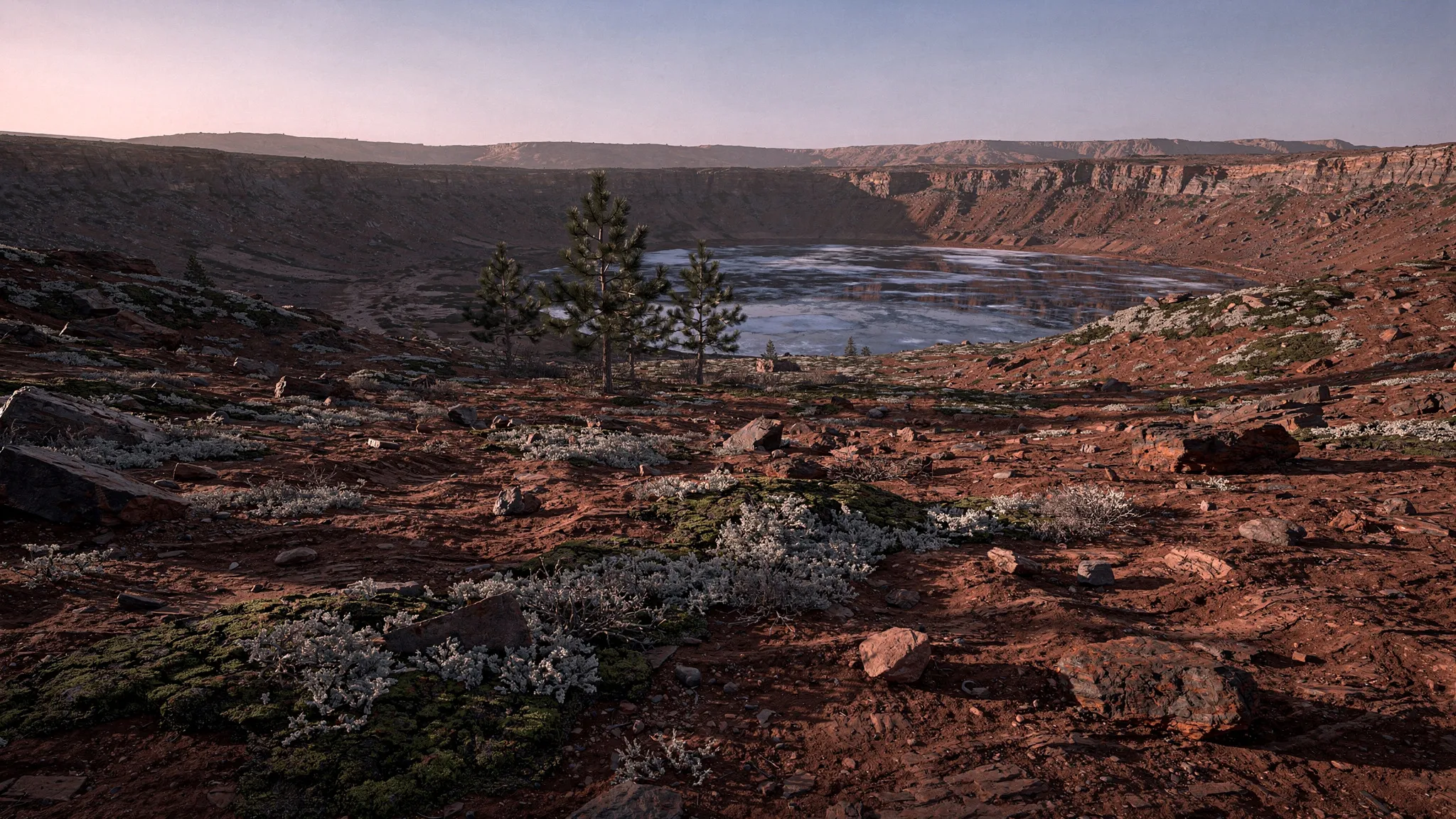
GROWING A FOREST ON A WARMED MARS
Mars is a hostile place for life. Its air is thin, about 6 hectopascals (a unit of pressure) at the surface and 95% carbon dioxide, so close to the limit where liquid water can exist that water either evaporates violently or boils. Days and nights differ by about 100 degrees. Ultraviolet light floods the ground, and the soil is salty and full of toxic perchlorates.
Still, the idea of making Mars suitable for complex life has been studied for more than 50 years. Mars has large reserves of water ice and many of the chemical building blocks of life. The first step would be warming it, for example with an artificial greenhouse effect. The second, much harder, would be filling its air with oxygen, which today is almost absent: about 1 pascal, a hundredth of a hectopascal.
A planet with an artificial greenhouse
Ashwin Braude, Edwin Kite and colleagues at the Astera Institute in California, the University of Chicago, MIT, the University of Oxford, the Woods Hole Oceanographic Institution and NASA’s Jet Propulsion Laboratory used MarsWRF, a global climate model of Mars in three dimensions. Earlier studies relied on simpler one-dimensional models, which cannot properly capture how heat moves around a planet.
They ran 24 simulations. The carbon dioxide stays fixed at 18 hectopascals, roughly what Mars would have if all its known buried and frozen carbon dioxide were released. Oxygen is then added until the total pressure reaches 3, 5, 10, 15, 20 or 30 times today’s value, up to 183 hectopascals. On top of this, an idealised “grey gas” traps outgoing heat at four strengths: a stand-in for whatever warming tool future engineers might use, from a super greenhouse gas to engineered dust or mirrors in orbit.
The model leaves out dust, clouds and rain, and the chemistry of the soil. It then checks where ten species could grow: a cyanobacterium (a microbe that photosynthesises), a lichen, a desert moss, a grass, a Siberian pine, four food crops (sea buckthorn, wheat, kale and lentils) and humans.
Warmer nights, the same harsh seasons
The grey gas does most of the warming: about 30 degrees when it is switched on at its lowest setting. Raising the pressure from five to thirty times today’s adds less than 5 degrees.
Thicker air mostly softens the nights. The gap between day and night shrinks by about 5 degrees for every doubling of pressure. But the seasons barely calm down. Mars’s orbit is elongated, and the planet passes closest to the Sun during southern summer. Even at the highest pressure tested, without the grey gas, seasonal swings exceed 45 degrees on average across the planet, and reach 70 degrees in the Hellas basin, a huge low-lying crater in the south. The northern hemisphere stays milder.
More warming is not always better. With all of Mars’s known buried and frozen carbon dioxide released but too much grey gas, water would boil during the day, and the area where cyanobacteria could live would shrink below that of a Mars with no artificial warming at all.
From lichens to forests
At 30 hectopascals, five times today’s pressure, at most a quarter of the surface would have more than 60 Martian days a year above freezing without boiling. That would be enough for lichens, then mosses, in the Hellas basin, a huge low-lying crater in the south where the air is thickest and best shields the ground from radiation. Around 60 hectopascals, they spread across the southern mid-latitudes, then over almost the whole planet.
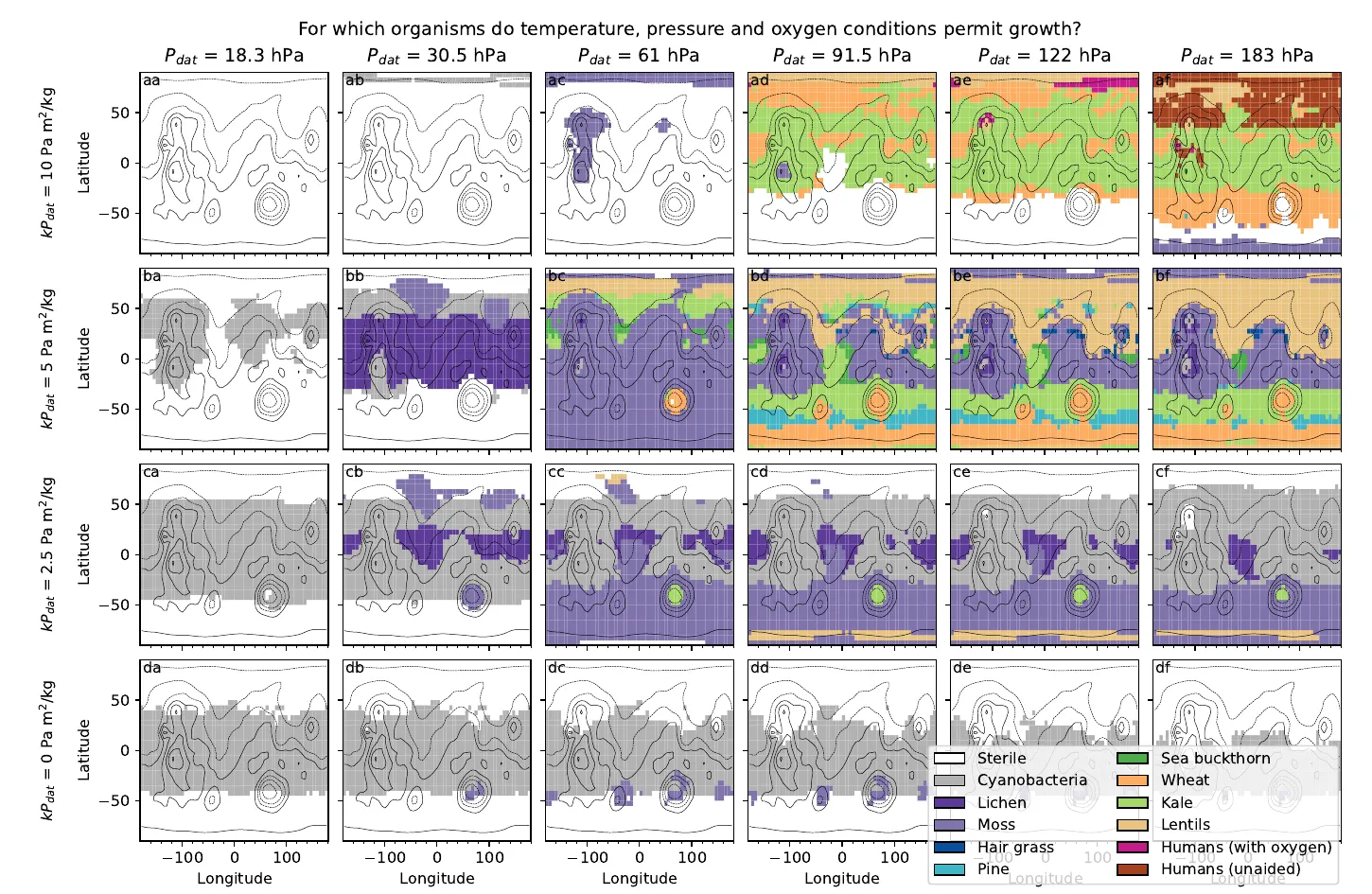
Where temperature, pressure and oxygen would allow each organism to grow: pressure rises from left to right, artificial warming from bottom to top. Water and soil limits are ignored, so these are upper limits. — Figure 5, Braude et al. (2026), arXiv:2611.13321.
Near ten times today’s pressure, the oxygen would allow crops, flowers and forests, with Hellas again first in line for pine trees. People could walk in the equatorial lowlands without a pressure suit, though still with oxygen masks and exposed to radiation. Only above 150 hectopascals could humans breathe the air outdoors, at the lowest elevations. By 20 to 30 times today’s pressure, more than 15% of the surface could hold liquid water all year round.
The slow part: oxygen
How long would plants need to make that oxygen? The team assumed productivity similar to grasslands on Earth where plants and lichens can grow, and half of industrial yields for cyanobacteria. Even then, going from three to five times today’s pressure would take 500 to 7,000 years, and only if the carbon dioxide is fully recycled.
That condition is the catch. Photosynthesis turns carbon dioxide into oxygen, and Mars’s known carbon dioxide could yield at most about 20 hectopascals of oxygen: not enough for humans to breathe, and hard going for plants. More would have to come from water ice, which holds plenty of oxygen; but freeing it means handing the water’s electrons to something else, either by splitting water directly or by having microbes pass them to iron, sulphur or perchlorate compounds in the soil. In the authors’ words, the red planet would then “turn green and black” as the iron in its dust takes up those electrons and darkens. Nitrogen is another unsolved problem: Mars has only about 20 pascals of it.
Not a second Earth
The authors conclude that Mars can be warmed, but that nobody yet knows whether it can practically be filled with oxygen using its own resources. Even if it were, it would remain a different world: seasons stretched over a year almost twice as long as ours, extreme swings in the south, gentler lowlands near the equator and in the north, and far less water than Earth. A terraformed Mars, they write, would open new questions about how wide the range of livable climates can be.