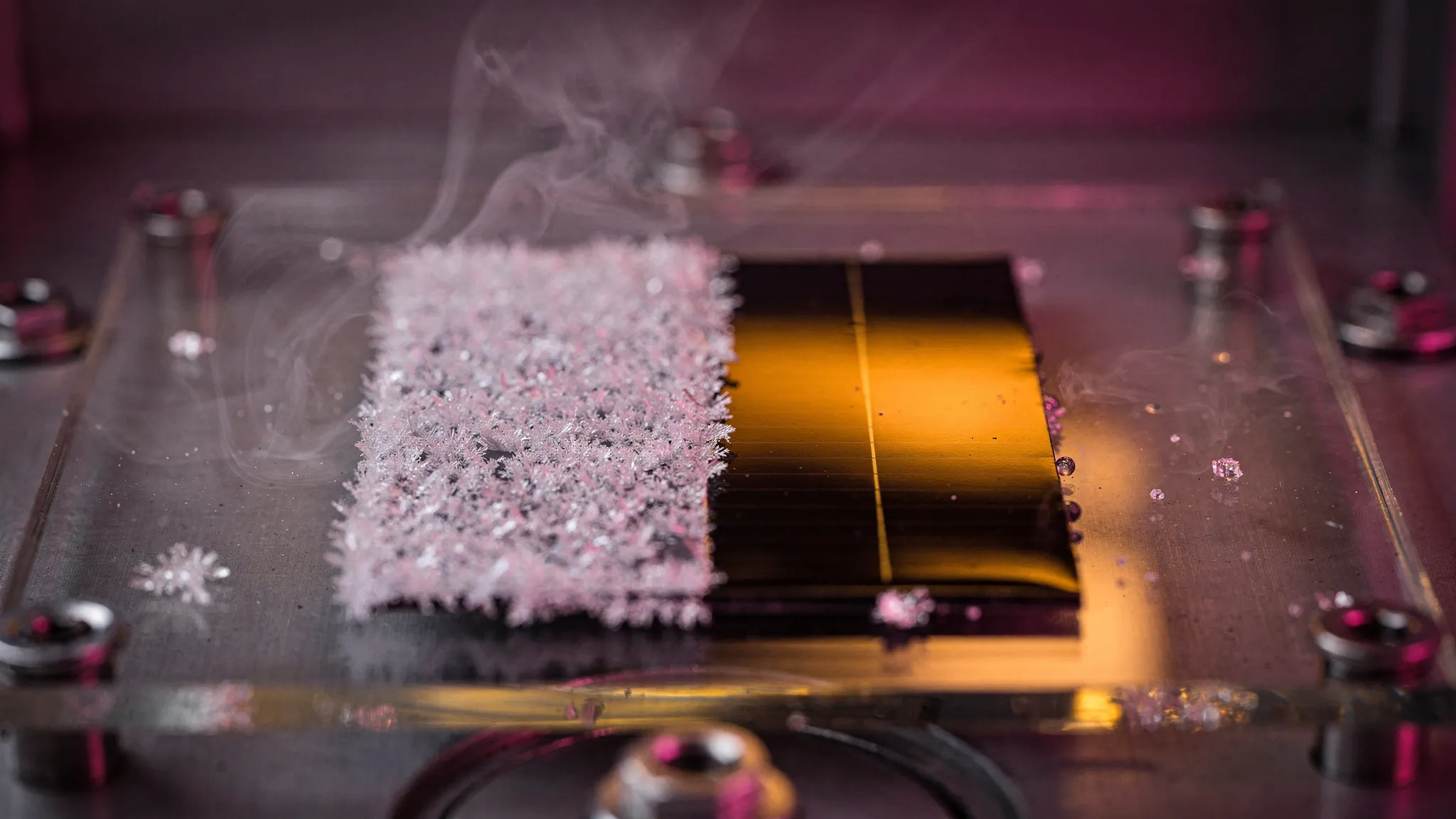
SOLAR CELLS THAT SURVIVE 400 FREEZE-AND-BAKE CYCLES
Perovskite solar cells are among the most promising candidates for the next generation of solar power. They are processed at low temperature, pair well with other cells, and their efficiencies, the share of sunlight turned into electricity, have passed 27%. The question now is whether they last.
Outdoors, a solar panel goes through endless swings of temperature, cold at night and hot under the sun. Each layer in a cell expands and contracts by a different amount. Over many cycles, this rubs and shears the interfaces between layers, builds up stress and can eventually make them peel apart, even when nothing has chemically gone wrong.
The weak joint
The “inverted” cells studied here are built on a glass plate coated with a transparent electrode made of indium tin oxide (ITO). On top of it sits a self-assembled monolayer: a single layer of molecules, each anchored to the oxide by a phosphorus-containing head, which pulls the positive charges out of the perovskite above.
A large team led by Meng Li (Henan University and the University of Cambridge), with Antonio Abate, Luca Sapienza and colleagues in China, the United Kingdom, Italy, Germany and Spain, put cells through a standard test: cycles between −40 °C and 85 °C. After 100 cycles, cross-sections showed the cells delaminating at this buried contact.
The broken surfaces told the story. After cycling, the molecular layer came away with the perovskite rather than staying on the electrode. Light-emission maps showed its molecules clumping together and leaving gaps. And mechanical tests, which pull the layers apart, showed the energy needed to break the joint dropping from 1.59 to 0.50 joules per square metre: 69% weaker.
More points to hold on to
The team’s fix is a pretreatment of the electrode with indium chloride. Indium is already part of the electrode, so the salt is chemically at home there. Once applied and heated, it reacts with water on the surface and leaves behind more hydroxyl groups (oxygen-hydrogen pairs) and chloride ions.
The molecules of the monolayer can then hold on in several ways at once. Their heads still bind strongly to indium atoms through oxygen, a rigid anchor. But they also form weaker hydrogen bonds with the chloride ions, a flexible anchor. Together, each molecule is held at three points instead of one or two. Computer simulations show the molecules sticking more strongly, by 0.61 and 1.28 electronvolts (a unit of energy suited to single atoms and molecules) for the two molecules tested.
The authors suggest an extra advantage. A rigid bond, once broken by stress, rarely re-forms by itself. A hydrogen bond can break and re-form as the temperature changes, which might let the interface repair local damage. They present this as a possibility, not a proven mechanism.
After 100 cycles, the treated layer barely changed: an X-ray index of how densely the molecules cover the electrode went only from 30.6 to 29.5 thousandths, and the light-emission maps showed no visible change.
The numbers
The treatment also made the cells better from the start:
- 27.3% efficiency for the best cell, 26.9% certified by a national photovoltaic metrology centre on a 7.81 square millimetre cell;
- a higher voltage, from 1.18 to 1.21 volts, and less hysteresis, the mismatch between measurements taken while raising the voltage and while lowering it;
- 25.7% on a 1 square centimetre cell and 22.7% on a 70 square centimetre module.
And they last:
- after 400 cycles between −40 and 85 °C, treated cells kept 94% of their initial efficiency, against 61% for untreated ones;
- 95% after 2,000 hours under continuous light;
- 95% after 1,000 hours of heating at 85 °C, while the untreated cells degraded markedly.
A design rule
According to the authors, the lesson goes beyond indium chloride: in cells exposed to real weather, interfaces should be designed to withstand repeated thermal stress, not only chemical ageing. Here, a few redundant, partly flexible bonds at a buried joint one molecule thick made the difference between a cell that lost almost 40% of its efficiency in 400 cycles and one that lost 6%.