MICROBES CHASING THE OCEAN'S SNOW
Every year, the ocean sends gigatonnes of carbon from its surface to its depths, carried by marine snow: flakes of organic matter that slowly sink. Scientists call this the biological carbon pump.
On the way down, the flakes cross a sea full of microbes, about a million bacteria per millilitre. Yet bacteria fill only about a ten-millionth of the water’s volume, so a flake and a microbe must actually meet before the microbe can start eating it and returning its carbon to the water. How often that happens decides how much carbon reaches the deep sea. Until now, it had never been watched directly in the open ocean, with wild microbes and fresh snow.
A microscope on a rolling ship
Rahul Chajwa and Manu Prakash, of Stanford University, set up a microscope aboard the research vessel Kilo Moana, in the California Current, during a campaign in the summer of 2024. They collected marine snow in a drifting trap at 80 metres, and seawater full of microbes from 20 metres, where chlorophyll is most concentrated.
They placed one flake in a thin channel, stained the microbes’ DNA so they glow, and pumped seawater past the flake to imitate its fall. Imaging started within 30 minutes of collection. A custom pipeline found the cells automatically, then a person checked every trajectory frame by frame: 2,657 tracks in all.
Swimmers that stop and start
The microbes, between 0.25 and 2.4 micrometres across, behaved nothing like the textbook laboratory bacterium E. coli. Some swam in straight lines, others in bursts with pauses, others reversed with a flick, hovered, or simply drifted. Many switched back and forth between swimming and resting, with runs of about 1.2 seconds and pauses of about 3.4, sometimes up to 25. At any given moment, roughly half of them were not swimming.
Their speeds ranged from 7 to 70 micrometres per second. From speed and size, the team estimates that swimming costs a typical microbe only about 0.17% of its energy budget, and at most about 10%: according to the authors, the first such measurement at sea.
The chemotactic horizon
A flake leaks chemicals, and many microbes can swim toward where a chemical is more concentrated, a behaviour called chemotaxis. With no flow, the attraction was weak. With flow, the swimmers gathered in a cloud downstream of the flake, a cloud that broke away when the flow became too fast.
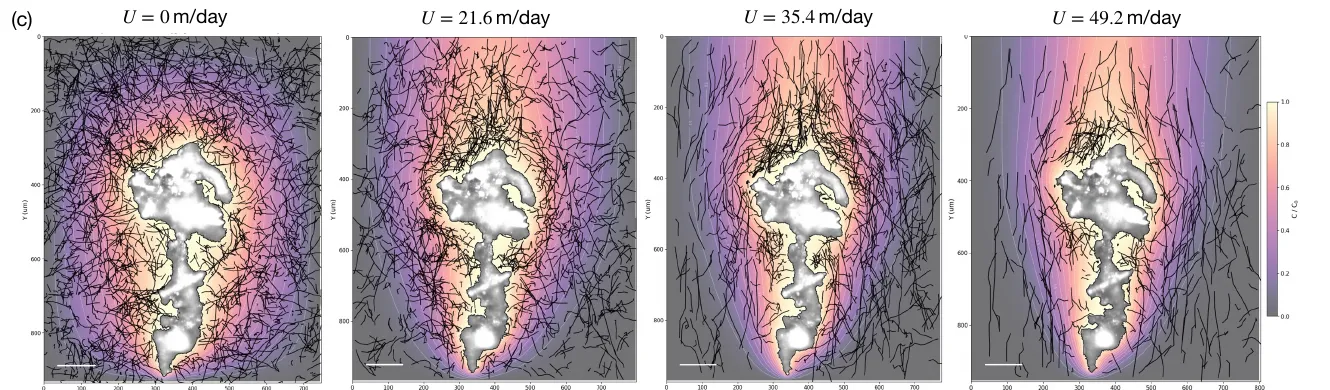
Microbe tracks (black) around one flake (grey) as the flow rises from 0 to 49.2 metres per day; colours show the computed chemical plume. — Figure 3c, Chajwa and Prakash (2026), arXiv:2611.13165.
The water flowing around a falling flake also spins the microbes, turning them away from their target. The authors define a chemotactic horizon: the zone around the flake where the pull of the chemical gradient beats this spinning. Its size depends on how strongly the microbes steer toward the chemicals, a strength the team measured on the 20% of swimmers that responded most. It does not exist around a flake that is not sinking: it only appears with flow.
A peak, then nothing
The team counted how many microbes reached the immediate surroundings of the flake at four flow speeds, from 0 to 49.2 metres per day. Encounters first rose, then fell. A curve fitted through these measurements peaks at 14.4 metres per day and drops to zero near 78.1 metres per day, well beyond the fastest flow tested, where microbes would behave like passive specks carried by the water. That is the opposite of classical theories, which predict more encounters the faster a particle falls.
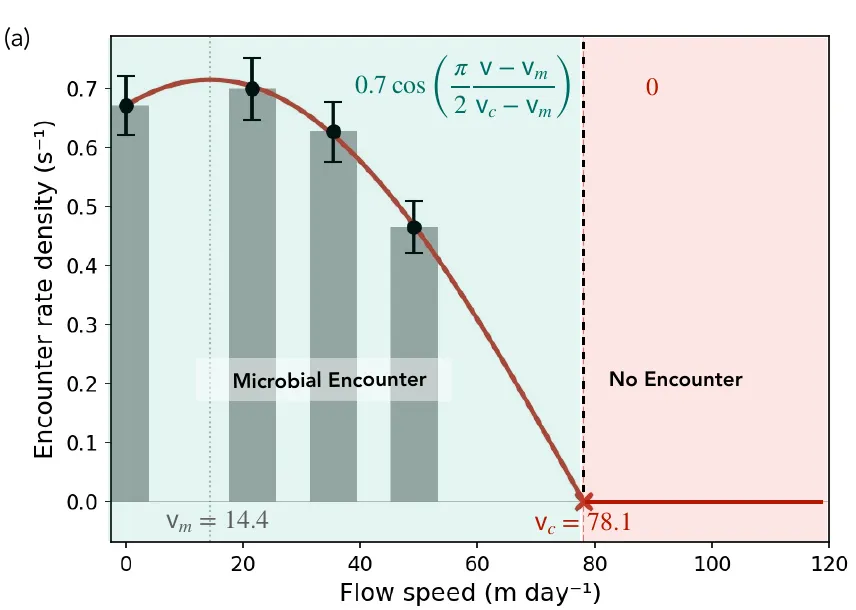
Encounter rate measured at four flow speeds (bars and points) and the fitted curve: a peak near 14.4 metres per day, zero beyond 78.1. — Figure 5a, Chajwa and Prakash (2026), arXiv:2611.13165.
Slow flakes stay, fast flakes fall
The authors then fed this curve into a simple model of a pulse of flakes released near the surface, each eaten at a rate that depends on its speed. A sharp boundary appears. Flakes slower than the threshold are progressively eaten and stall in the upper ocean. Flakes faster than it are barely touched and fall to the seafloor without being broken down. The population splits into two groups, at different depths.
This has a practical consequence. Sediment traps, which collect falling material over time, may gather flakes with very different histories and fates, so their averages can hide what is really happening. The authors caution that their model is minimal: it assumes degradation follows encounters, uses oxygen as a stand-in for the many chemicals a flake releases, and leaves out flakes breaking or merging. Still, it links what a single microbe does to how much carbon the ocean can lock away, at a time when models of the ocean’s carbon pump carry uncertainties of gigatonnes.