HALF A MILLION ROLLS OF LOADED DICE
Put a small weight inside a die, near one corner, and the die starts to cheat: the faces next to that corner tend to end up underneath, and the opposite faces show up more often. The question is not whether it cheats, but by how much, and why.
A classic experiment by E. M. Levin tossed seven plastic cubes with brass inserts at least 600 times each. Levin treated each resting position as an energy state, and the frequencies roughly followed a Boltzmann-like law: in physics, this is the rule by which states of lower energy are exponentially more likely than states of higher energy. A die resting with its weight low has a lower energy.
Twenty-three ways to load a cube
Nick Kinney and colleagues at Sweet Briar College in Virginia wanted far more data. A cube has eight corners, so there are 256 ways to fill some of them. Rotating the cube turns many of these into the same die, which leaves 23 genuinely different classes, from an empty die to one with all eight corners filled.
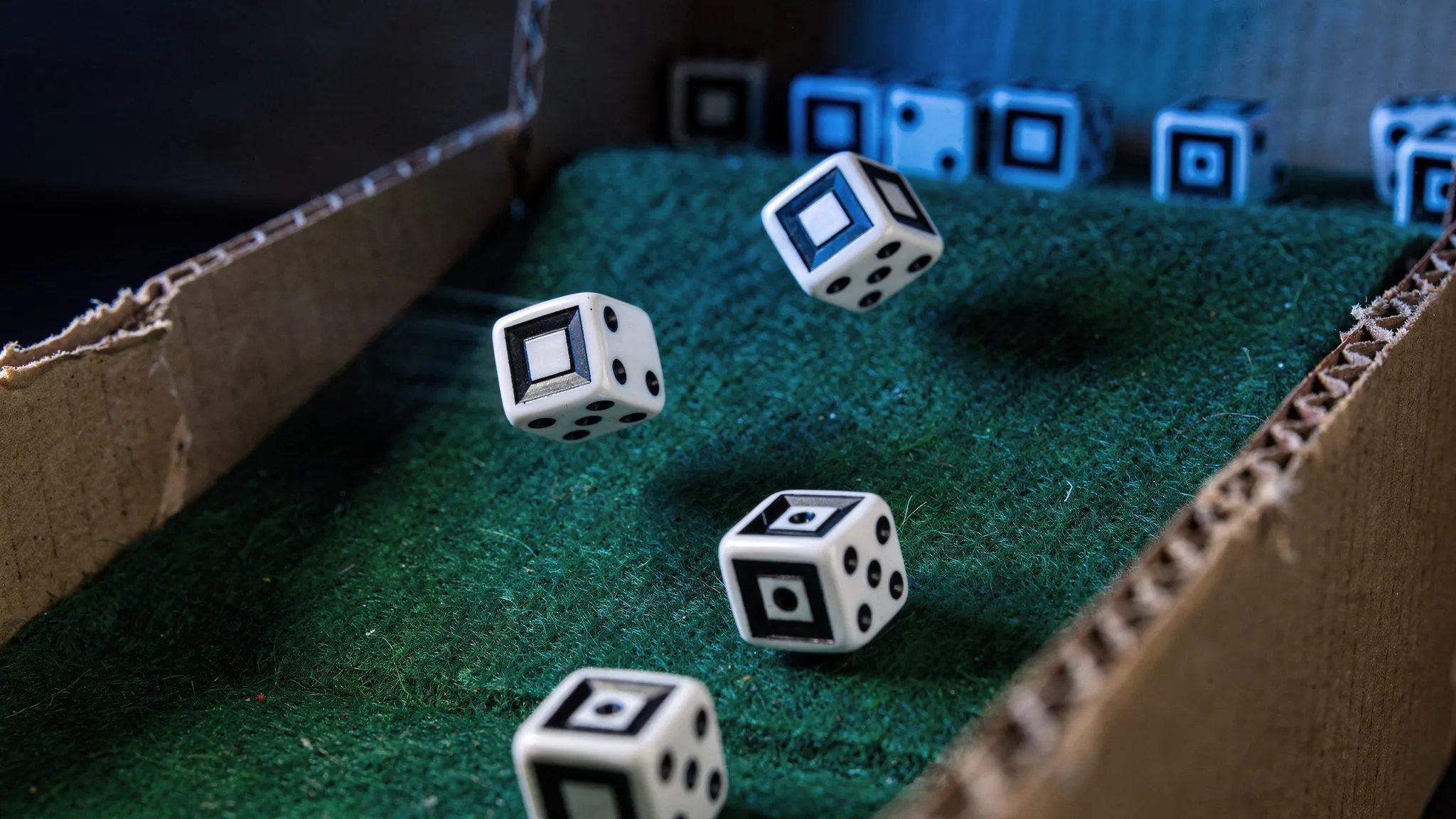
They 3D-printed every class, in three copies each, as two halves glued together. Each face carried a small printed square code that a camera can read.
For each face, the key number is the corner advantage: when that face is on top, the number of filled corners on the bottom face minus the number on the top face. A positive advantage means the added weight sits low when that face shows.
A cardboard seesaw that never sleeps
The rolling machine is a cardboard box with one side removed, turned into a seesaw by a servo motor and an Arduino board. The dice tumble through a maze of obstacles, run down a felt ramp, land, get photographed, and are tipped back to the start. One cycle takes about ten seconds, with six dice at a time: 30,000 to 40,000 rolls a day.
Balanced control dice landed on each face about equally often, and each roll did not depend on the one before. In total, the team collected 515,754 rolls.
An exponential law
The result reproduces Levin’s on a far larger scale: a face’s probability of showing grows exponentially with its corner advantage. A single number, called β, sets the steepness: the larger β, the more each extra point of advantage favours a face. For dice with four filled corners all on one face, the opposite face comes up about 36% of the time, more than twice the 1/6 of a fair die, and the loaded face about 6%.
But β is not constant. Dice with two filled corners have the steepest curve, about 0.30; dice with six filled corners the flattest, about 0.16. In other words, the more weight you add, the less each extra unit of imbalance matters.
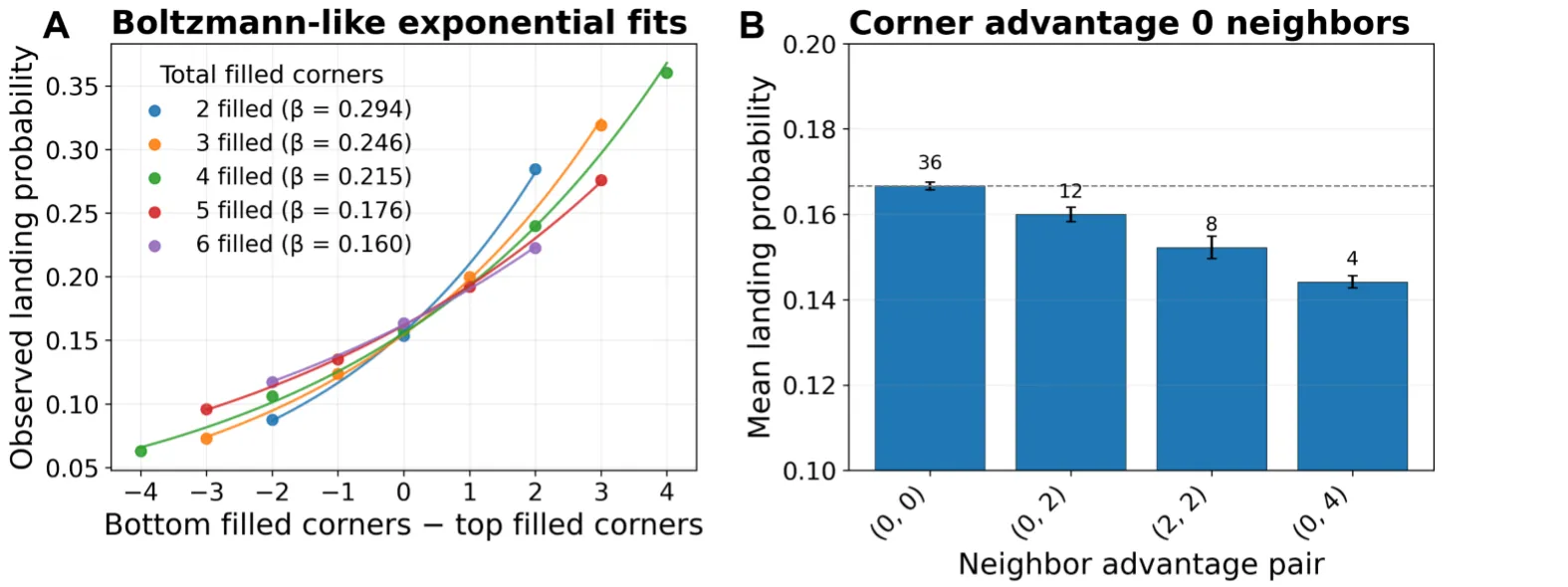
(A) Probability of a face against its corner advantage, for dice with 2 to 6 filled corners: the curves flatten as the load grows. (B) Faces with zero advantage land less often as their neighbours become more unbalanced; the dashed line is 1/6. — Figure 2, Kinney et al. (2026), arXiv:2611.13149.
The data reveal a subtler effect too. A face with zero advantage should, naively, land one time in six. It does, if its four neighbours are also neutral. But when the neighbouring faces are strongly unbalanced, the neutral face lands less often: about 14.4% of the time instead of 16.7% when one pair of neighbours sits at +4 and −4. No hidden force is needed: in a Boltzmann law, probabilities are shared out among all six faces, so when some faces become very favourable, the others lose out. The paper gives the exact formula, built from the advantages of the face and of its two pairs of neighbours.
The die that tumbles its own way
A weight also changes how easily a die spins around each axis. To test that alone, the team built a 24th die: balanced, with equal weights at the centres of two opposite faces, so that it spins most easily around one axis. Over 21,925 rolls, its faces were not quite equally likely, a small but statistically detectable departure from 1/6. Under these conditions, how easily the die spins matters, but far less than where the weight sits.
Less time to choose
Why would heavier dice care less about each corner? Computer simulations of the 23 classes reproduced the exponential law and the neighbour effect, but argued against a simple explanation based on how much energy goes into spinning.
High-speed video at 240 frames per second, on 116 rolls each of empty and fully loaded dice, gave a clue. Both flipped faces about as often. But the fully loaded dice came to rest sooner, usually 0.5 to 1 second after first being seen, while the empty dice often kept moving for 1 to 1.5 seconds.
A toy model with six states, one per face, captures the idea. If a die loses its energy slowly, it keeps hopping until it finds a low, favourable face. If it loses energy fast, it freezes wherever it happens to be, and all faces become equally likely. The authors sum it up: the weight sets the direction of the preference, and the rate at which energy drains away sets how strongly it shows.
The same idea could apply to anything that tumbles before settling into one of a few stable positions: grains carried by wind or water, seeds rolling over soil, parts in a sorting machine. And since the whole set-up costs little, from consumer 3D printers to free software, any classroom could build its own.