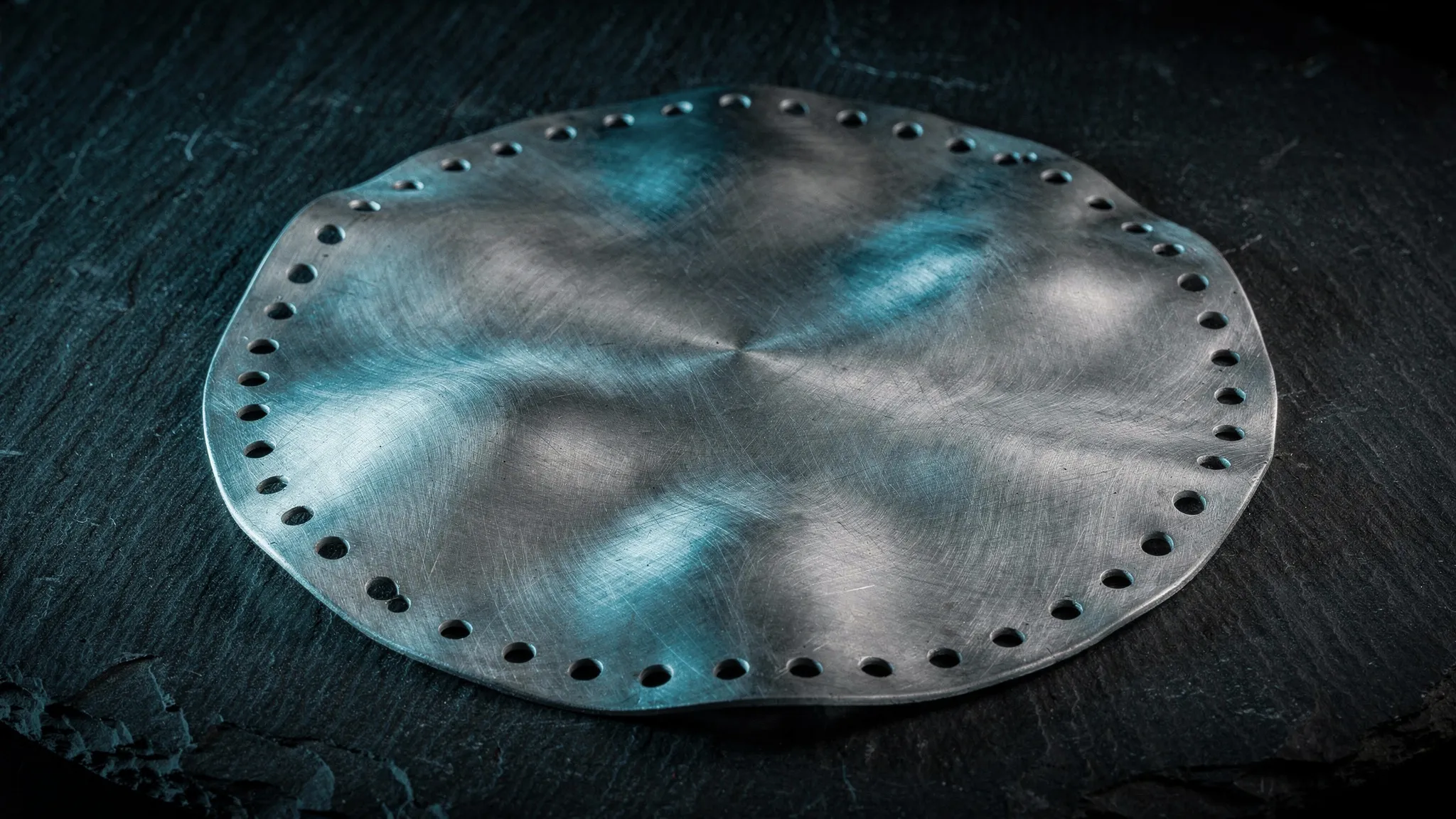
A BALL WITH HOLES BEATS THE PERFECT BALL
Push on the edges of a thin plate whose rim is clamped, and nothing happens at first. Then, at a precise critical load, the plate suddenly bends out of its plane: it buckles. Beyond that, a higher load brings a second way of buckling, then a third. Mathematicians call these thresholds the eigenvalues of the buckling problem: Λ₁, Λ₂, and so on.
The ratio Λ₂/Λ₁ says how far apart the first two thresholds are. It does not depend on the size of the plate, only on its shape. So a natural question arises: which shape spaces them furthest apart?
The drum and the plate
For a simpler object, a drumskin or membrane, the answer is known. The ratio of its first two eigenvalues, which here describe its first two ways of vibrating, is largest for a disc, or a ball in higher dimensions: a result proved by Ashbaugh and Benguria in every dimension, with the ball as the only champion. For a square drum, the ratio is 2.5, against about 2.54 for the disc.
In 1999, Ashbaugh proposed the same for the buckling plate: among all shapes, the ball should give the largest ratio Λ₂/Λ₁. Everything seemed to agree. Numerical computations put the square at about 1.76, below the disc at about 1.7964. Among triangles, quadrilaterals and octagons, the regular shape won, with the disc as the limit.
The proof for the membrane, however, did not carry over. It relies on a quantity that is always positive, and in the plate problem the corresponding quantity changes sign, even on the disc. The question stayed open for more than twenty-five years.
A circle where the plate must stay flat
Guowei Dai and Yingxin Sun (Dalian University of Technology) and Yong Zhang (Jiangsu University) now show that the conjecture is false in every dimension from 2 upwards.
Their first step is a thought experiment. Take the round plate and add one extra rule: along a circle very close to the edge, at a distance h from it (h counted as a fraction of the plate’s radius), the plate must not move up or down, although it may tilt there. Both buckling loads go up, since constraining a plate makes it harder to buckle.
The team computed exactly how much. To first order, that is keeping only the terms proportional to h, both loads rise by the same share, 3h/2 relative to their starting values, so the ratio does not change. A finer calculation, which keeps the terms in h², shows the second load rising slightly more: the ratio becomes the ball’s value multiplied by about 1 + h²/8. The gain is tiny, but it is strictly positive, and that is enough to beat the ball.
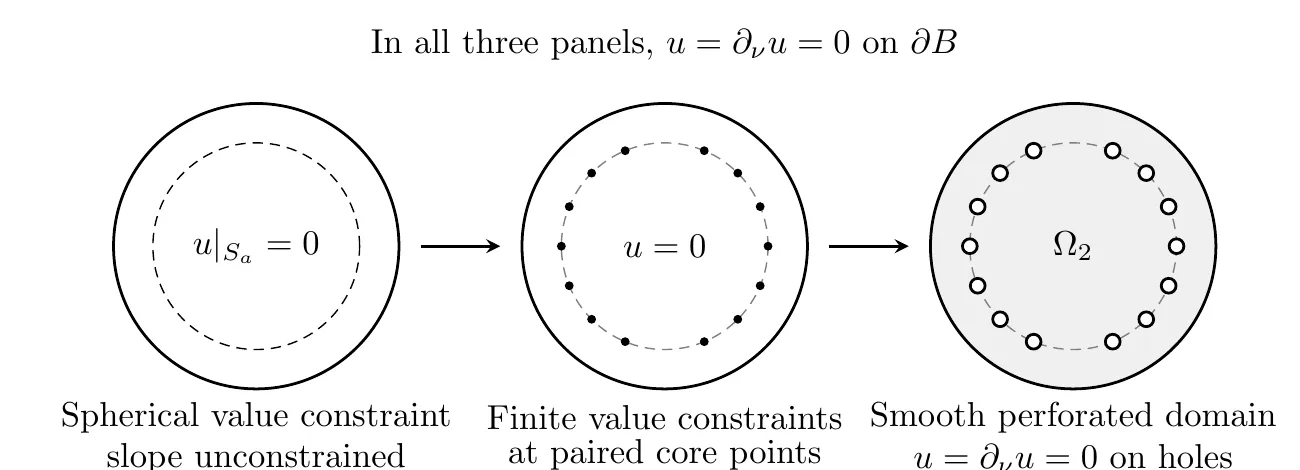
The construction in the plane: a constraint along a whole circle (left), replaced by finitely many points on that circle (middle), then by real small holes clamped at their rim (right). Spacing and hole sizes are exaggerated. — Figure 2, Dai et al. (2026), arXiv:2611.13018.
From a circle to real holes
A rule imposed along a circle is not a shape. The authors therefore replace the circle with a finite set of points spread along it; in three dimensions, the constraint lies on a sphere, replaced by a finite set of circles drawn on it like lines of latitude. Then they cut out a tiny hole around each one and clamp the plate along the rim of every hole. The difficulty is to make sure the holes cost less than the tiny gain. The authors control the cost precisely, with a mathematical device that makes the extra energy needed to clamp each hole as small as desired.
Everything is explicit and depends only on the dimension. In the plane, their recipe places a ring of small holes on a circle extraordinarily close to the edge, and the holes themselves are smaller still. The authors note that larger holes might work too, with better estimates. The final shape is smooth and in one piece.
What remains open
The result shows that among all smooth shapes, the ball is not the champion. It says nothing about shapes without holes, such as convex ones, where the ball may still win, and it does not give the best possible ratio. The team announces similar counterexamples for the vibrations of a clamped plate in a forthcoming paper.
The authors state that they used ChatGPT for language polishing, for some elementary but lengthy calculations and for the figures, and that they checked all of it themselves. In the end, the matter was settled by a single coefficient, 1/8: the gap between two second-order terms, invisible at first order.