A PLANET WHOSE TRANSITS VANISHED
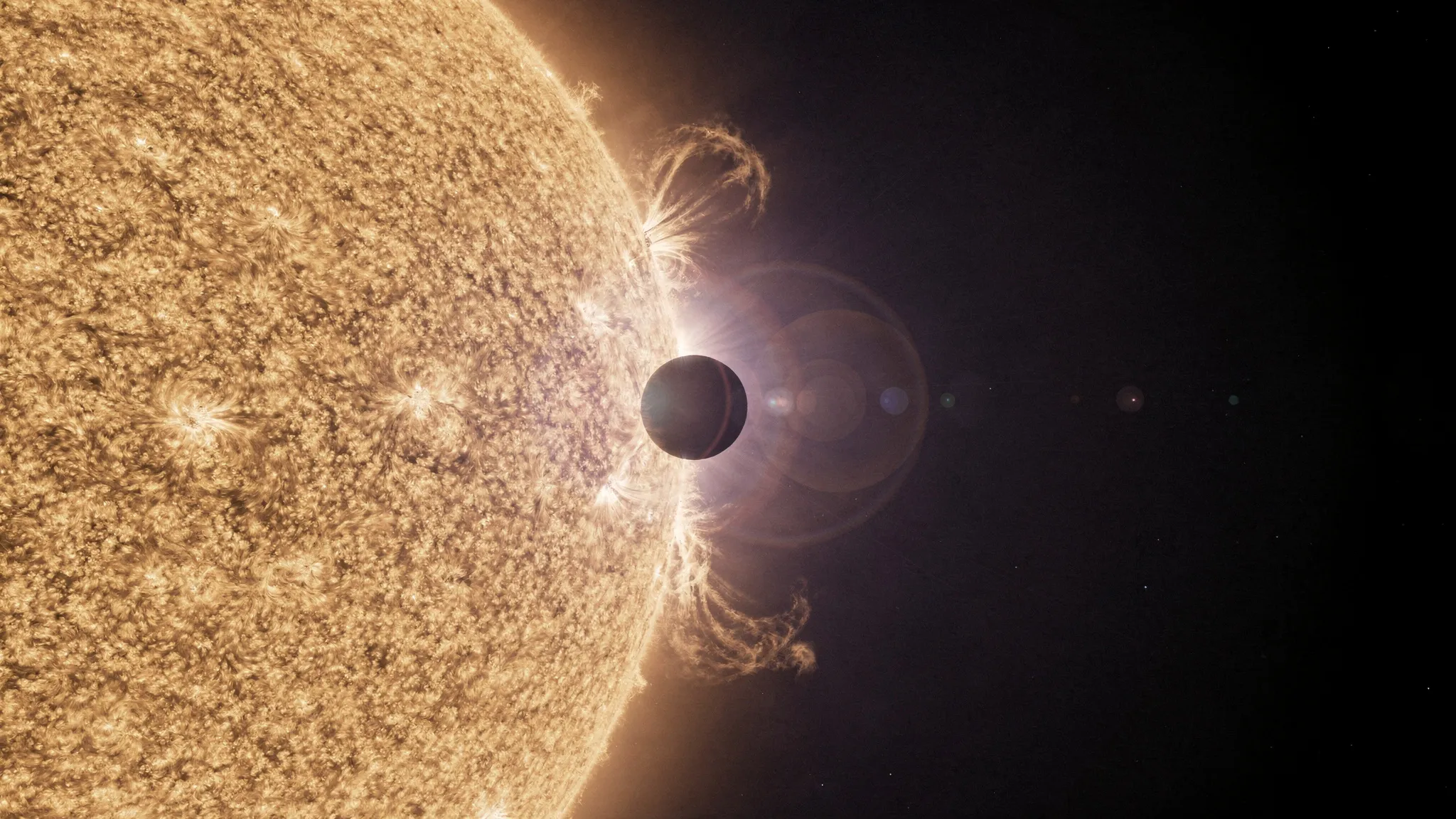
One way to find planets beyond the Solar System is to watch for transits: when a planet passes in front of its star, it blocks a little of its light, and a telescope sees the star dim for a few hours. But a transit needs luck. The planet’s orbit must line up almost exactly with our line of sight, within a few degrees.
So if an orbit tilts, even slightly, the transit changes shape. Tilt it enough and the planet stops passing in front of its star altogether.
A path that should stay put
Astronomers describe a transit by its impact parameter, b: how far the planet’s path, or “chord”, runs from the centre of the star’s disc, measured in star radii. A chord through the middle has b = 0; a chord that just grazes the edge has b close to 1.
Around a single star, b rarely changes much. One search of the Kepler mission’s data found significant long-term changes in only 15 of 561 systems. A few planets have been caught appearing: two went from grazing to full transits in 4.5 and 3 years, and a new planet in the TOI-4504 system started transiting three years after the system was first observed. But no planet had been caught disappearing.
Seven years of TESS
TOI-2535 b is a hot Jupiter, a giant planet on a tight orbit, circling an old star slightly smaller than the Sun in 8.236 days. NASA’s Transiting Exoplanet Survey Satellite (TESS) observed it in five stretches between April 2019 and March 2026.
Samuel Yee and Erik Petigura of the University of California, Los Angeles, with 26 colleagues from universities and observatories on several continents, chased the planet from the ground too. Of fifteen attempts, only six caught a transit, because the transits kept arriving at unexpected times. A spectrograph on a 3.5-metre telescope at Kitt Peak measured the star’s wobble: tugged by the planet, the star moves toward us and away from us at about 100 metres per second, a swing small enough to show that a planet, not a star, caused the dimming.
Gone in 2026
Fitting each transit one by one, the team watched the chord move steadily. A single transit tells how far the chord runs from the centre, not on which side: about 0.2 in 2019 and again in 2021, about 0.57 in 2023, about 0.87 in 2025. The dips grew shallower and shorter. In the last TESS stretch, in 2026, there was no transit at all. A careful search found nothing, although a transit as grazing as b = 0.991 would have been caught half the time.
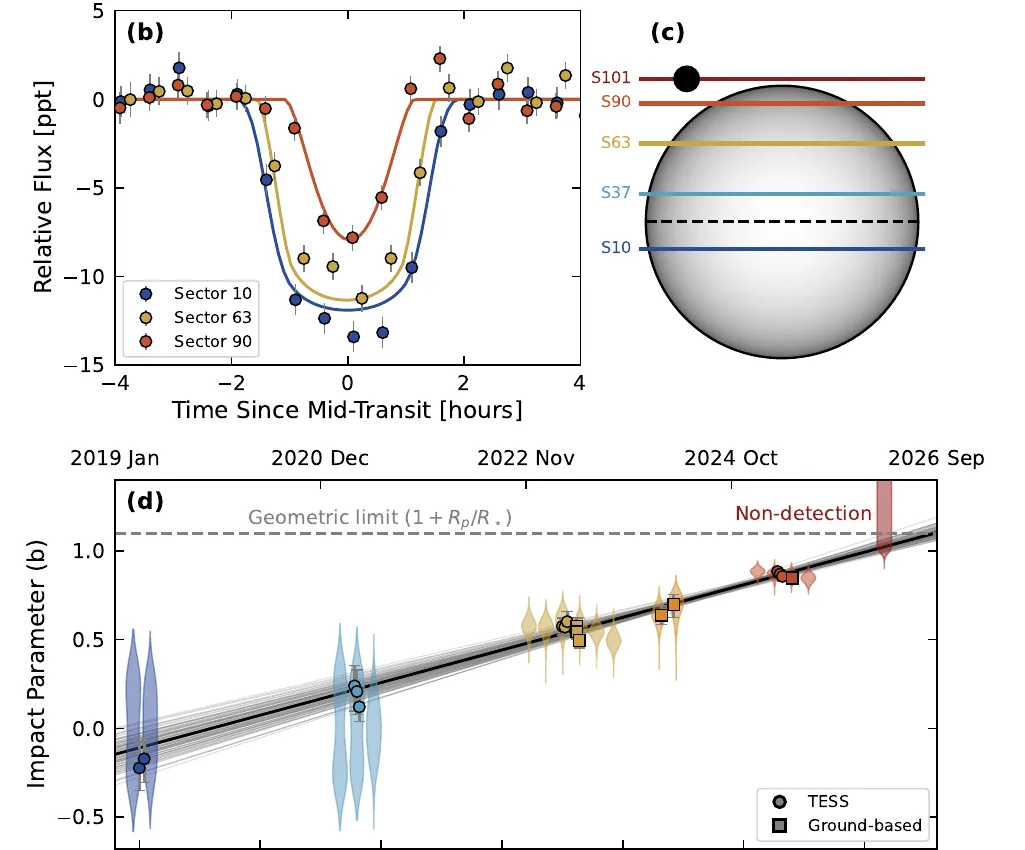
(b) Transits in 2019 (blue), 2023 (yellow) and 2025 (orange): the dip shrinks. (c) The chord moving across the star, observing stretch by observing stretch, until it misses it. (d) The impact parameter rising in a straight line toward the geometric limit (dashed). — Figure 1, Yee et al. (2026), arXiv:2611.13343.
A straight line fits the data surprisingly well: b grows by 0.16 star radii per year, give or take 0.01. That is the fastest change of tilt ever seen for a planet around a single star. In 97.6% of the model’s solutions, the chord started on one side of the star’s equator in 2019, crossed it, and kept going until it slid off the disc. The limit is reached when b passes 1 plus the planet’s radius divided by the star’s, about 1.099: beyond it, not even the edge of the planet overlaps the star.
The transits were also badly out of step: up to six hours early or late compared with a regular schedule, about 3% of the orbital period. That is among the largest timing shifts ever measured, and the largest for a hot Jupiter with a period under ten days.
A hidden companion
What tilts the orbit? The team ruled out an eccentric orbit swinging around, the star’s own shape, and a distant massive companion, which would have shaken the star far more than observed.
What remains is a second planet nearby, too tilted to transit, probably locked with TOI-2535 b in a resonance: their orbital periods form a simple ratio, such as 2:1 or 3:2. Its pull makes the planes of both orbits turn slowly around a common axis, a motion called precession. Computer simulations of many possible systems favour a companion of at least about a third of Jupiter’s mass, roughly Saturn’s, on an orbit tilted by more than 5 degrees relative to that of TOI-2535 b, with a full turn of precession taking 30 to 50 years. No single solution stands out: the data are too sparse to pin the companion down.
A pair that should not be tilted
If confirmed, the system is unusual twice over. Hot Jupiters rarely have close neighbours, and when they do, the neighbours are usually small. Here the neighbour is probably another giant.
Two giants locked in resonance suggest they migrated together through the disc of gas around the young star. But that disc would also have flattened their orbits. Something must have tilted them later, and the authors list candidate mechanisms that only work in specific setups.
With the transits gone, the clock-like timing measurements are gone too. The next step is a dense campaign measuring the star’s wobble, which should reveal the hidden planet, and perhaps others. The authors note that with only TESS’s first four years, the drift would not have been detected for certain: watching the same sky for longer is what caught a planet leaving our view.