
LIGHT THAT REFUSED TO FALL APART
Lorentz invariance, the rule that the laws of physics look the same whatever your speed, is a cornerstone of special relativity and of all modern particle physics. Yet several approaches to quantum gravity, the long-sought theory that would unite gravity with quantum physics, suggest it might break down at enormous energies, near the so-called Planck scale, about 1.22 × 10²⁸ electronvolts (the unit of energy used for particles).
At the energies we can reach, such effects would be tiny. But the universe produces particles of light, or photons, of extreme energy, and sends them across huge distances: that makes them a sensitive probe.
Light that should fall apart
In one family of scenarios, called superluminal because very energetic photons would travel slightly faster than expected, those photons become unstable. A photon could turn into an electron and its antiparticle, the positron, or split into three photons of lower energy. Either way, above a certain energy, photons would disappear before reaching us. The gamma-ray spectrum of a distant source, the count of its photons at each energy, would end in a sharp cutoff.
So the test is simple to state: find a source that sends photons of extreme energy from far away, and look for a cliff in its spectrum.
An observatory on a plateau
The Large High Altitude Air Shower Observatory (LHAASO) sits at 4,410 metres in Daocheng, in China’s Sichuan province. Gamma rays hitting the atmosphere create showers of particles, which its detectors catch on the ground. Its largest array, KM2A, covers about 1.3 square kilometres with 5,216 particle detectors and 1,188 muon detectors. Muons, heavy cousins of the electron, help tell gamma-ray showers from those caused by cosmic rays.
The LHAASO collaboration, hundreds of researchers mostly in China, with partners in Armenia, France, Germany, Russia and Thailand, had already reported photons of up to 3.7 petaelectronvolts (3.7 million billion electronvolts) from Cygnus X-3, a binary system about 9 kiloparsecs away (a unit for vast cosmic distances), during its flares. Here the team analysed 692.8 days of data taken during four flaring periods between December 2019 and July 2024.
No cliff in the spectrum
The team compared the measured spectrum with the same model cut off sharply at different energies. The data clearly prefer no cutoff at all: at 95% confidence, any cutoff must lie above 3.05 petaelectronvolts. A second, independent way of analysing the same data gave 3.06.
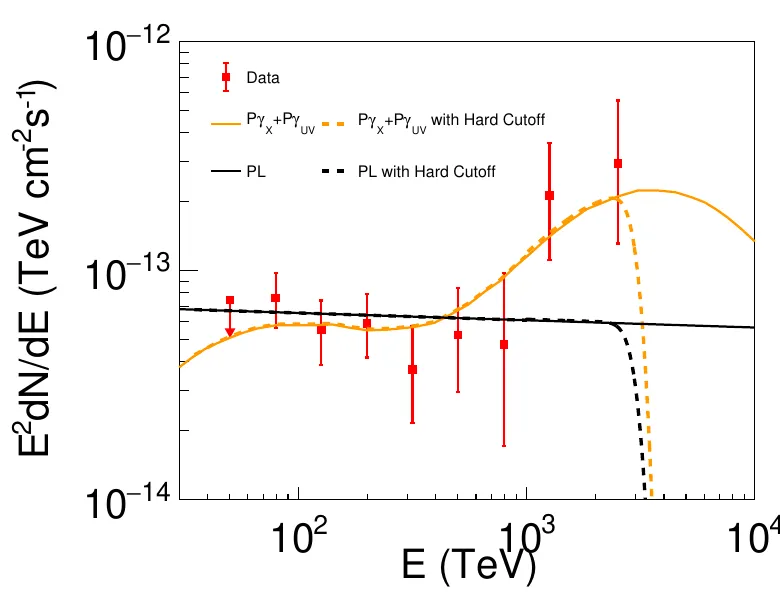
Spectrum of Cygnus X-3 measured by LHAASO (red) and two models of the source (solid lines); the dashed lines show what a hard cutoff at 3 PeV would look like. — Figure 1, LHAASO Collaboration (2026), arXiv:2611.14028.
Ten times stricter
Each limit is an energy scale: the energy at which such a violation would set in. If the violation exists, it can only appear above that scale. Theories come in two main variants, called first and second order, which differ in how fast the effect would grow with the photon’s energy. Turning the cutoff into limits uses formulas in which the limit grows steeply with that cutoff energy, as its square for one of them.
- For the simplest case (first order), the limit reaches about 2.7 × 10³⁴ electronvolts, around two million times the Planck scale, near which quantum gravity is expected to show up.
- For the subtler second-order case, photon splitting gives a limit of about 1.7 × 10²⁶ electronvolts, roughly one hundredth of the Planck scale. This limit barely depends on the source’s distance: in the formula, distance only enters with a power of 0.1.
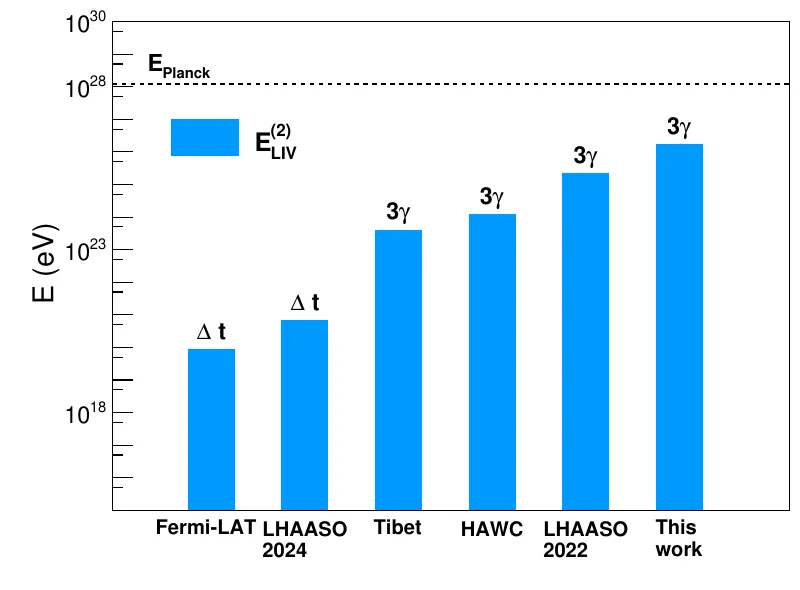
Limits on the second-order energy scale of Lorentz violation from earlier measurements and from this work (right); “3γ” marks photon splitting, “Δt” time-delay methods; dashed line: Planck energy. — Figure 4, LHAASO Collaboration (2026), arXiv:2611.14028.
Compared with earlier results from the Tibet and HAWC experiments, from LHAASO itself, and from time delays in gamma-ray bursts, the new second-order limit is nearly ten times stronger: among the most stringent ever set on this kind of violation.
Why the second order matters
The second-order case has a special symmetry that hides it from another classic test, based on the polarisation of light. Spectra like this one are therefore one of the few ways to probe it.
The main uncertainty comes from how Cygnus X-3 really produces its light. Using a simpler, generic spectrum shape (a “power law”) instead of the team’s preferred model shifts the cutoff limit by about 9.5%, for a total uncertainty of about 9.6%. Relativity, for now, passes this test, run with light from an object about 9 kiloparsecs away.