ICE THAT GROWS ON NEGATIVE IONS
Water ice is one of the most common solids in the universe. Yet nobody knows exactly how it first appears from vapour. The usual assumption is that water needs a seed: a speck of dust or some other particle on which molecules can stick. Forming ice from vapour alone is energetically hard.
Still, pure ice turns up in places where no seed is seen: in the night-shining clouds of Earth’s polar upper atmosphere, and in the cold outer regions of the disks of gas and dust where planets form. Electric charges have long been suspected. An ion attracts water molecules, which are slightly charged at each end, and helps a tiny cluster hold together. But no one had followed such clusters all the way to visible ice, and most experiments ran near normal air pressure, far from the near-vacuum of space.
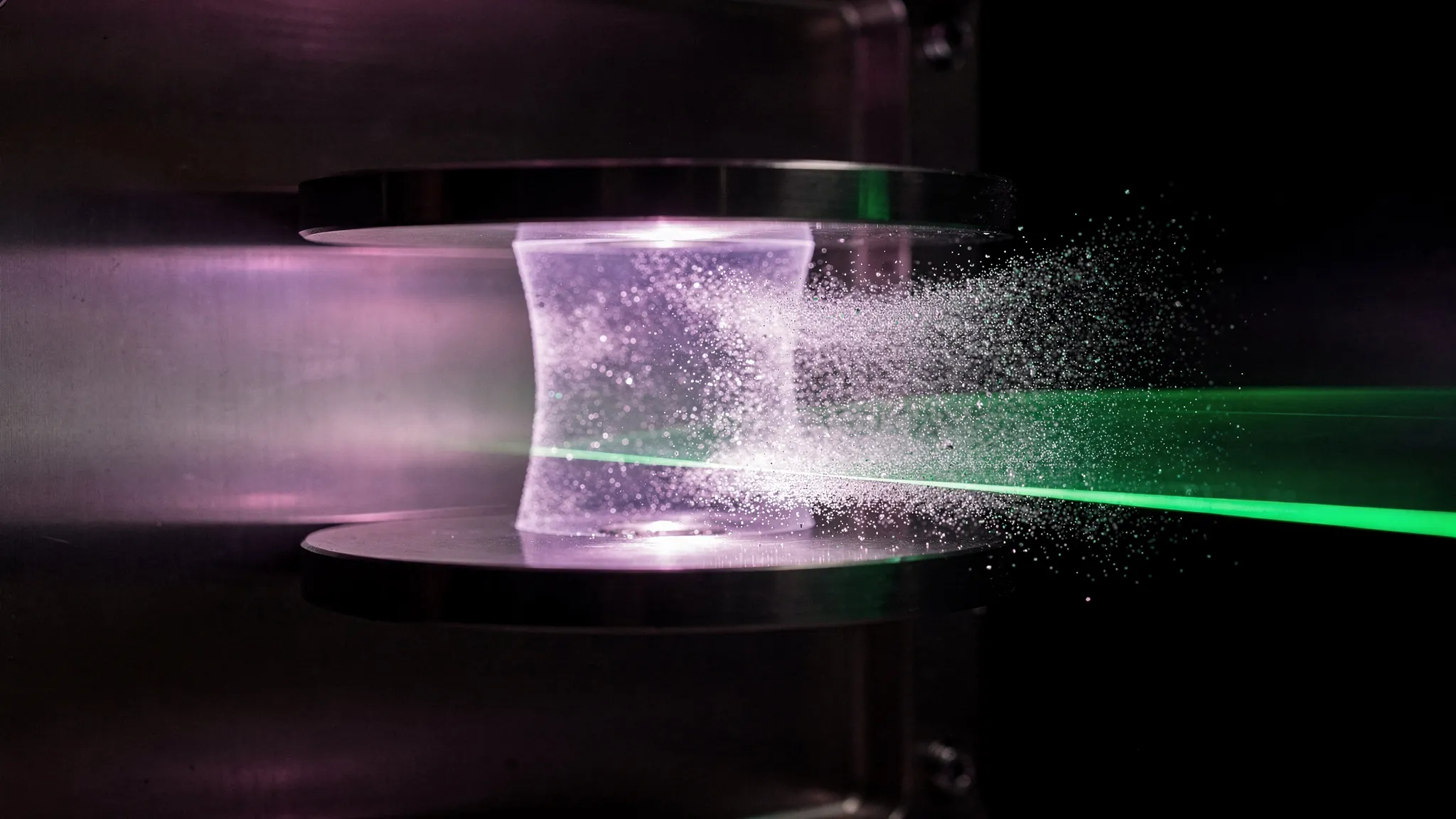
A cold plasma in a steel chamber
André Nicolov, Efstratios Kritikos, William Goddard and Paul Bellan, at the California Institute of Technology (Caltech), built a small replica of these environments. In a 3.8-litre steel chamber, they made a weakly ionised plasma — a gas in which a small fraction of atoms has lost or gained electrons — from argon with one part of water for ten parts of argon, at a pressure of only 40 pascals. That is below the pressure at which liquid water can exist, so ice must form straight from the vapour. Two metal plates, each on its own cooler, set the temperature anywhere from 50 to 300 kelvin (degrees counted up from absolute zero, the coldest possible temperature).
A thin green laser sheet crossed the plasma to reveal any grains. When the plates were colder than 190 kelvin, ice appeared: no dust, no seed. Without the plasma’s electric charges, no ice formed at all.
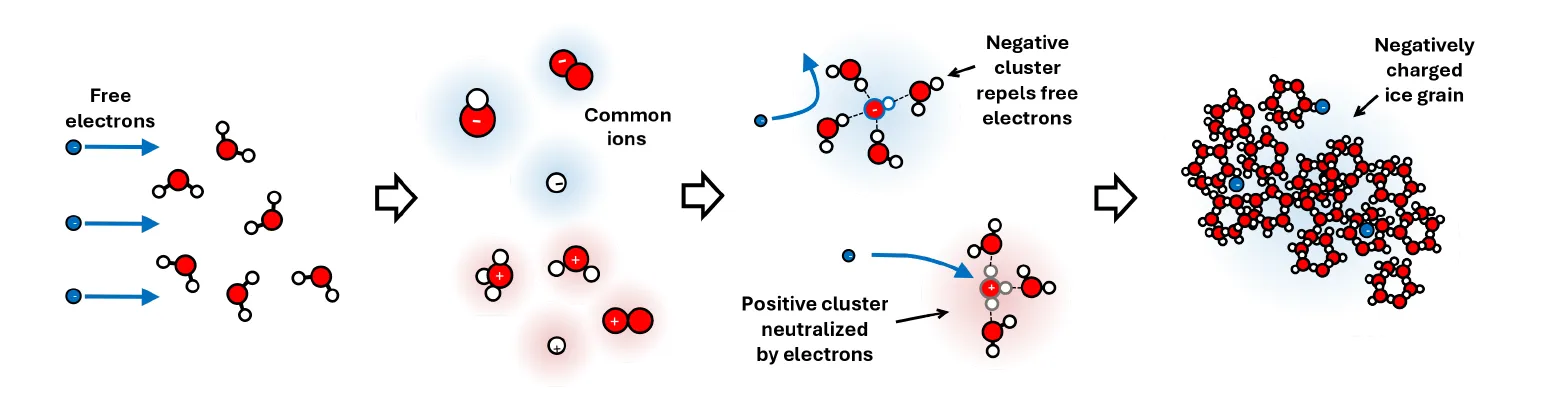
The proposed path: electrons break water into ions; water clusters on both; electrons neutralise the positive clusters, while the negative ones grow into ice grains. — Figure 1, Nicolov et al. (2026), arXiv:2611.14441.
Below 150 kelvin, the grains grew within minutes to hundreds of micrometres, in odd non-spherical shapes; at 130 kelvin they scattered the laser as bright separate dots. At 170 kelvin they stayed smaller and glowed as a diffuse haze.
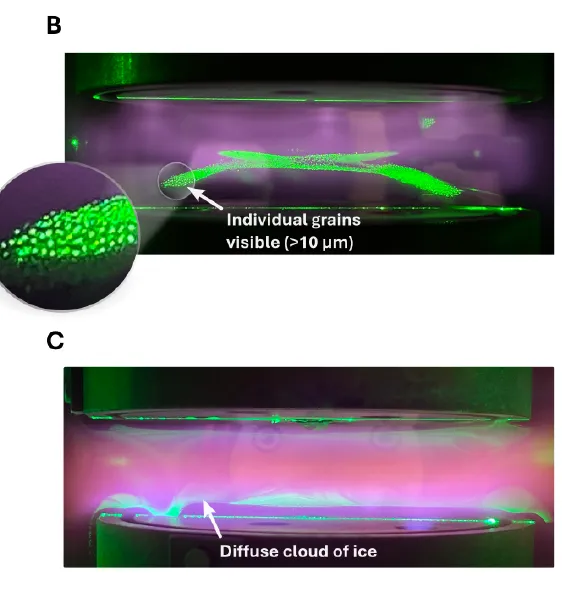
Laser light scattered by ice grains floating in the purple plasma: separate grains larger than 10 micrometres at 130 K (top), a diffuse cloud of much smaller grains at 170 K (bottom). — Figure 2B-C, Nicolov et al. (2026), arXiv:2611.14441.
Weighing the first clusters
To catch the very first step, the team weighed the ions with a mass spectrometer. The spectra showed regular peaks spaced by 18 atomic mass units, the mass of one water molecule: ions were picking up water one molecule at a time.
The two charges behaved very differently. Water clusters around negative ions, mostly hydroxide (OH⁻), reached the 250-mass-unit edge of the spectrum, more than ten water molecules. Clusters around positive ions stopped at about 100 mass units.
Then the team cooled the plasma slowly from 250 to 210 kelvin. The positive clusters barely changed. The negative ones grew step by step: one water molecule was the favourite size above 236 kelvin, two at 233, three at 230, four at 227. Below 225 kelvin, all of them suddenly became rare in the spectrum.
According to the team, they had not been destroyed: they had grown too big to weigh. Between 225 and 190 kelvin, clusters jump from about a hundred molecules to about ten billion, the smallest size the laser can see.
A hill that disappears
The classical theory of how droplets and crystals form explains the jump. Adding molecules to a cluster lowers its energy through the attraction to the ion and through freezing, but raises it through the cost of its surface. Once the vapour is cold enough to freeze, a cluster first settles at a few molecules, and must climb an energy hill to grow further. As the temperature drops, the hill shrinks, and near 210 kelvin it disappears: every cluster then rolls downhill into an ice grain. Detailed quantum calculations on clusters of up to 17 molecules agree with the trend.
Why do the positive ions lose? Not because of energy, but because of speed. A positive cluster is neutralised by an electron; a negative cluster only by a much heavier, slower positive ion. The authors estimate that positive clusters are neutralised thousands of times faster, and the plasma’s electric field also pushes them out toward the walls, while it traps the negative ones.
From the laboratory to the sky
The team then applied the same theory, written as one equation, to real places. In a young planet-forming disk, 20 times the Earth–Sun distance from its star and above the disk’s mid-plane, the gas is at about 70 kelvin, and the hill vanishes below about 85 kelvin: ice should nucleate spontaneously on hydroxide ions there. Comparing the two routes, they estimate dust grains offer about 300 times less useful surface than the same mass of dust would if it were broken up into single molecules, while each hydroxide ion attracts water over an area about 760 times its own size. Together, these would give ions an edge of about 200,000 if hydroxide were as abundant as dust; with about one hydroxide ion for every 100 water molecules, the ratio expected there, ions would still win over dust by a factor of about 2,000.
High above the poles, at 85 kilometres, the same equation puts the threshold for ice on hydroxide ions near 130 kelvin, about the temperature at which the night-shining clouds actually form.
The authors’ closing argument is one of economy: this route needs no foreign seed particles, no liquid phase and no exotic chemistry, only cold gas, a little water and a few charges.