WHAT A CELL PAYS TO FOLLOW A SCENT
Cells constantly follow chemical trails. Immune cells chase infections, embryonic cells find their place, microbes hunt for food. They do it by sensing a gradient: a concentration slightly higher on one side than on the other. To measure it, a cell must catch some of the molecules around it with receptors on its surface, and those catches are random. The fewer molecules it counts, the noisier its estimate.
Physicists have long known the best precision a cell can reach. A cell that captures and swallows every molecule that touches it, a perfect absorber, counts the most and estimates best. But swallowing and processing molecules costs energy. So how close to that limit do real cells get, and what does it cost them?
A cell that swallows part of what it senses
Albert Alonso (Aalborg University, Copenhagen), Julius Kirkegaard (University of Copenhagen) and Robert Endres (Imperial College London) modelled a cell as a sphere that absorbs only part of the molecules reaching its surface. At one extreme, a perfect reflector absorbs nothing, stays in balance with its surroundings, and learns nothing. At the other is the perfect absorber.
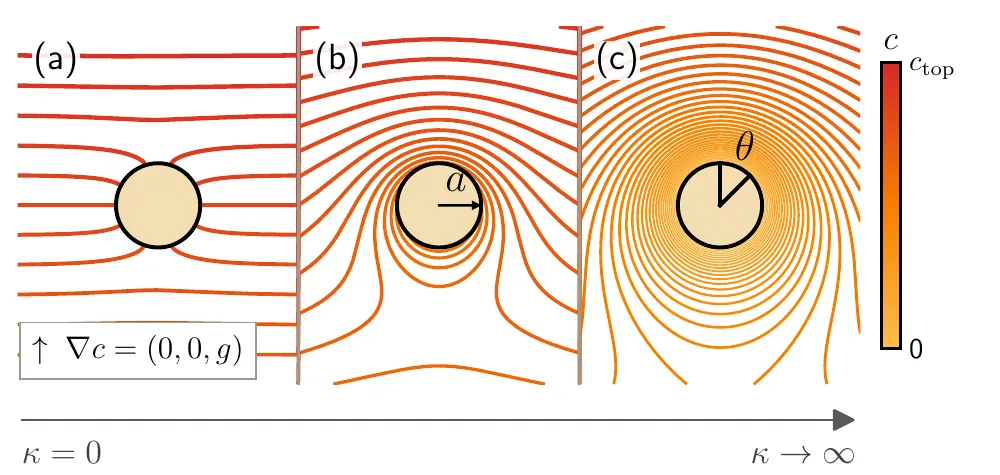
A cell (circle) in a concentration gradient, from a perfect reflector (a) to a partial absorber (b) to a perfect absorber (c): the more it absorbs, the more it depletes the molecules around it. — Figure 1, Alonso et al. (2026), arXiv:2611.14145.
They describe a cell by its uptake fraction: the share it absorbs of what a perfect absorber would. Their formulas link this fraction, the number of molecules absorbed and the accuracy of the gradient estimate, exactly.
The front-back problem
Measuring a concentration only requires counting. Measuring a gradient also requires telling the front from the back: comparing how many molecules arrive on each side. That adds a penalty factor, which depends on how strongly the cell absorbs. It is 4 for a weak absorber and falls to 1 for a perfect absorber, so a weakly absorbing cell needs up to four times more molecules for the same precision. In practice, at the uptake the authors infer for the cell studied below, the factor stays close to 4.
The price of each molecule
Every molecule a cell swallows and processes has an unavoidable cost, which physicists measure as the production of entropy, a measure of the energy irreversibly lost as heat. The authors split the cost in two. The first part is the chemical machinery inside the cell that registers each capture. The second is unavoidable: as the cell depletes its surroundings, each molecule has to “fall” from the richer medium into the depleted zone around it, like water running downhill, and that fall dissipates energy.
That second cost is small for a weak absorber, but it grows without limit as the cell approaches the perfect absorber, where the concentration at its surface drops to zero. The perfect absorber can therefore never be reached with a finite amount of energy. The growth is slow, though: for a modest signalling cost, one chemical reaction per capture, and even more so for a costlier one, transport stays under 10% of the bill until the cell absorbs 89% of the maximum.
A crawling cell far below the limit
The team then turned to Dictyostelium, a cell that crawls toward chemical signals. Fitting their formula to published measurements of how well these cells line up with gradients, they find an uptake fraction of 0.25%: Dictyostelium absorbs only a quarter of a percent of what it could.
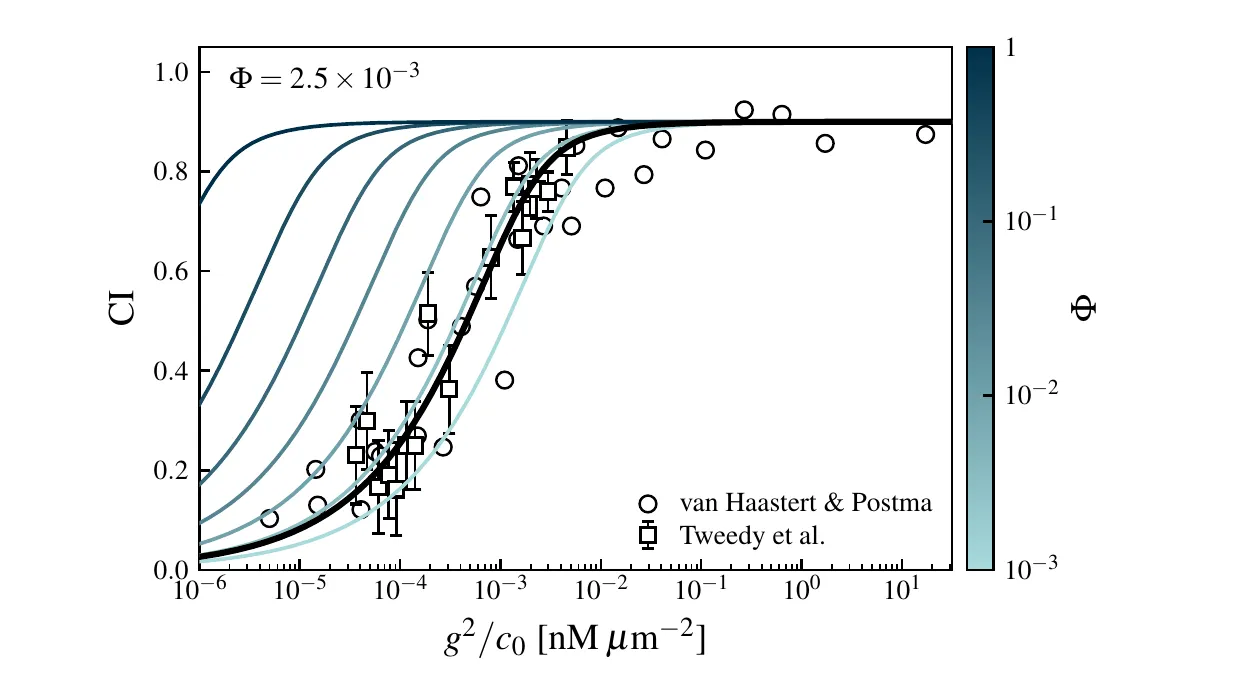
Measured alignment of Dictyostelium cells with the gradient (symbols, from two earlier studies) against the strength of the signal, with the best fit (black, uptake fraction 0.25%) and curves for higher uptakes (blue). — Figure 3, Alonso et al. (2026), arXiv:2611.14145.
At the detection thresholds of these experiments, that means tens to hundreds of molecules absorbed over a measurement lasting a few seconds, about 810 at the highest concentration. And the energy cost is small: such a cell runs on roughly 100 million to 1 billion molecules of ATP per second, the cell’s energy currency, with about 1 to 5% of that devoted to sensing. Even with expensive signalling, the molecules it absorbs cost at worst about 1% of that allowance. What limits Dictyostelium is the number of molecules it counts, not the energy it spends.
Halve the gradient, quadruple the count
How many molecules does a cell need to line up almost perfectly with a gradient? In strong signals, the answer depends only on the relative difference in concentration across the cell, not on how fast the molecules diffuse or how long the cell listens. Halve that difference and the cell needs four times more molecules. For the Dictyostelium experiments, that runs from a few hundred molecules in the steepest gradients to about 100,000 in the shallowest.
The authors suggest that what really stops cells from absorbing more is not energy but other consequences, such as using up a signal that their neighbours also rely on. They also predict that a swimming bacterium, which has less time to average its measurements than a crawling cell like Dictyostelium, should need a larger share of the maximum uptake to find its way.