A SPINNING STAR LEAVES A SLOWER BLACK HOLE
When two black holes spiral together with their spins aligned to their orbit, the black hole they form spins faster if its parents did. That rule was first measured almost twenty years ago and has become standard intuition. Filippo Camilloni, Konrad Topolski, Keneth Miler and Luciano Rezzolla, at Goethe University Frankfurt, the Hamburg Observatory and Trinity College Dublin, show that it fails in another kind of cosmic collision.
A star torn apart
Gravitational-wave detectors have already caught black holes merging with neutron stars. When the two are close in mass, the black hole does not swallow the star whole: its tides tear the star apart first. The black hole gulps most of the matter within about a millisecond. The rest forms a disk of gas around it and a stream of ejected matter, which can power jets, short gamma-ray bursts and a kilonova — the glow of the ejected material.
What about the black hole left behind? For pairs of black holes the answer is well known. For black hole–neutron star pairs, especially with a rapidly spinning star, it was still largely missing.
Sixteen virtual collisions
The team ran 16 simulations in full general relativity, today’s theory of gravity, solved without approximations and including magnetic fields, on supercomputers in Frankfurt and in Garching, Germany. In all of them, the neutron star weighs 1.35 times the Sun and the black hole starts without any spin. Two things change: the mass ratio, from a black hole as heavy as the star to one 2.5 times heavier, and the neutron star’s own spin, from zero to 0.6 on the dimensionless scale physicists use, where 0 means no rotation; for this kind of star, about 0.69 is the limit beyond which its equator would start shedding matter. The fastest case means about 760 turns per second — close to the upper limits inferred for some of the fastest-spinning pulsars.
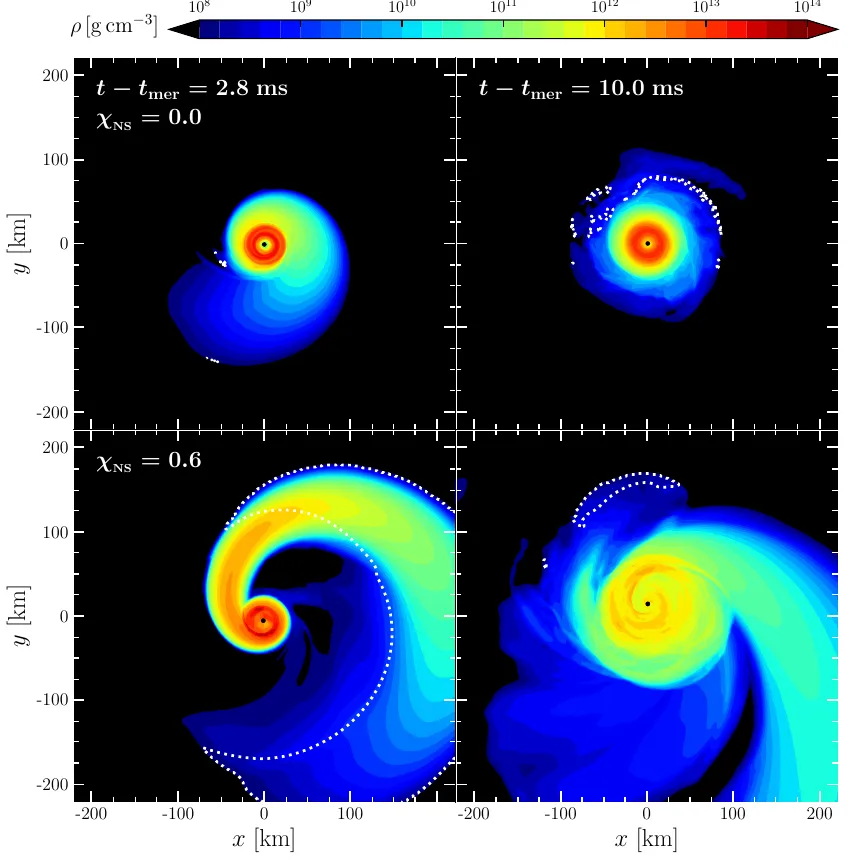
Matter density 2.8 ms (left) and 10 ms (right) after the merger of equal-mass binaries: a non-spinning neutron star (top) and a fast-spinning one (bottom), which sheds a long spiral arm. The dotted line separates bound matter from matter escaping the system. — Figure 1, Camilloni et al. (2026), arXiv:2611.14610.
The spin that vanishes
Ten milliseconds after the merger, the team measured the final black hole’s mass and spin. For equal masses, the final spin is 0.84 when the neutron star does not rotate, then 0.83, 0.80 and 0.76 as the star’s spin rises to 0.6. With a black hole 2.5 times heavier than the star, it falls from 0.60 to 0.53. The same holds for every mass ratio: the faster the star spins, the slower the black hole it leaves behind. The final spin is highest for a star that does not rotate at all.
There is a second twist. With a non-spinning star, these mixed pairs spin up their final black hole more efficiently than two black holes do. Two black holes radiate away more of their orbital angular momentum, the amount of rotation the pair carries, before merging, while a star torn apart far from the hole feeds it matter that still carries orbital motion.
Where the spin goes
A rapidly spinning star is less compact, and the coupling between its spin and the orbit pushes outwards. So the star breaks apart farther from the black hole, and its matter spreads over a much larger volume, in a spiral arm reaching the edge of the simulation.
Splitting the angular momentum between its possible homes shows where it ends up. For equal masses and the fastest star, 10 ms after the merger, the disk holds about 16.4% of the initial angular momentum, the ejected matter carries away about 13.6%, and gravitational waves about 13.2% — as much as the ejecta. For unequal masses, the ejecta’s share jumps from 2% or less at a spin of 0.2 to about 15% at 0.6.
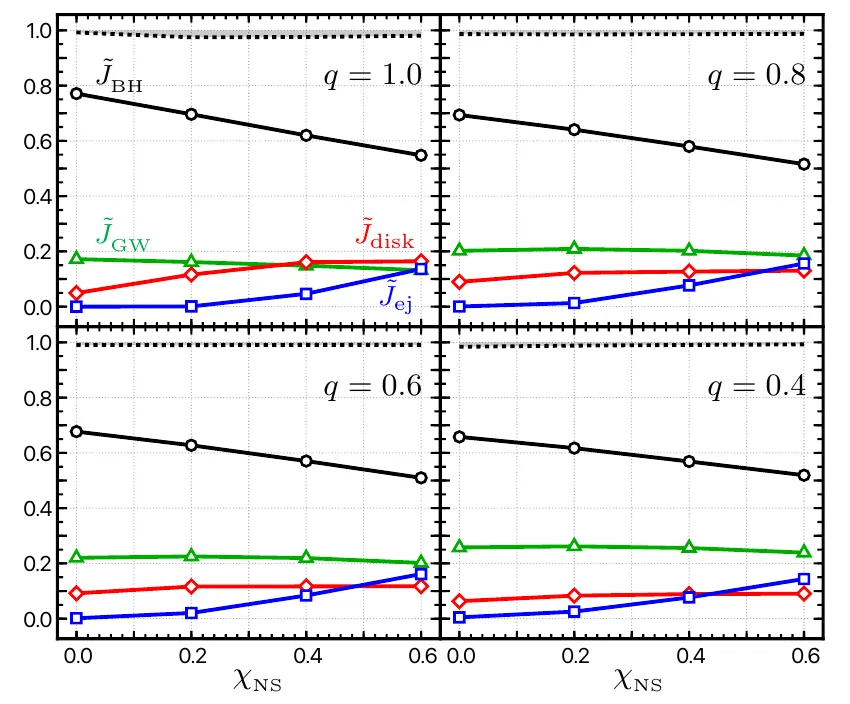
Share of the initial angular momentum held by the black hole (black), gravitational waves (green), the disk (red) and the ejecta (blue), 10 ms after the merger, as a function of the neutron star’s spin, for four mass ratios. — Figure 3, Camilloni et al. (2026), arXiv:2611.14610.
Brighter kilonovae, dimmer jets
The authors stress that this is “not a minor quantitative correction” but a reversal. It matters for what telescopes may see. A spinning star throws out far more matter: for equal masses, the ejecta grow from under 0.001 to about 0.08 solar masses, and spin is needed to push the ejecta well above the 0.001-solar-mass threshold for a detectable kilonova. They also build disks of more than 0.1 solar masses, enough to power jets and short gamma-ray bursts. But a slower final black hole would make any jet dimmer.
A simplified model of the next 1 to 10 seconds, as the black hole keeps eating its disk, preserves the ranking: holes born from non-spinning stars still spin faster. According to the authors, studies that model the whole population of such mergers have so far treated them like black-hole pairs, and models of their signals have misjudged the spin of the black holes they leave.
One question stays open, and the team plans to explore it: since the fastest final black holes come from non-spinning stars, a neutron star spinning against its orbit might leave behind a black hole spinning even faster.