A DARK MATTER HEART WIDER THAN ITS STARS
Galaxies rotate too fast at their edges for the mass we can see: their rotation curves — the speed of their gas plotted against distance from the centre — stay flat instead of falling off. Dark matter was proposed to supply the missing gravity. In the standard cosmological model, built on “cold” dark matter, computer simulations predict that it should pile up steeply towards the centre of every halo, the cloud of dark matter that envelops each galaxy, in a sharp peak called a cusp.
Many small galaxies disagree. Their rotation suggests a core: a central region where the density of dark matter levels off. This is the long-standing cusp-core problem. One proposed fix keeps cold dark matter but lets ordinary matter reshape it: repeated bursts of star formation, with supernovae blowing gas out, can stir the centre and flatten it. But such cores are generally expected to be no bigger than the visible body of stars.
A dwarf seen in two kinds of light
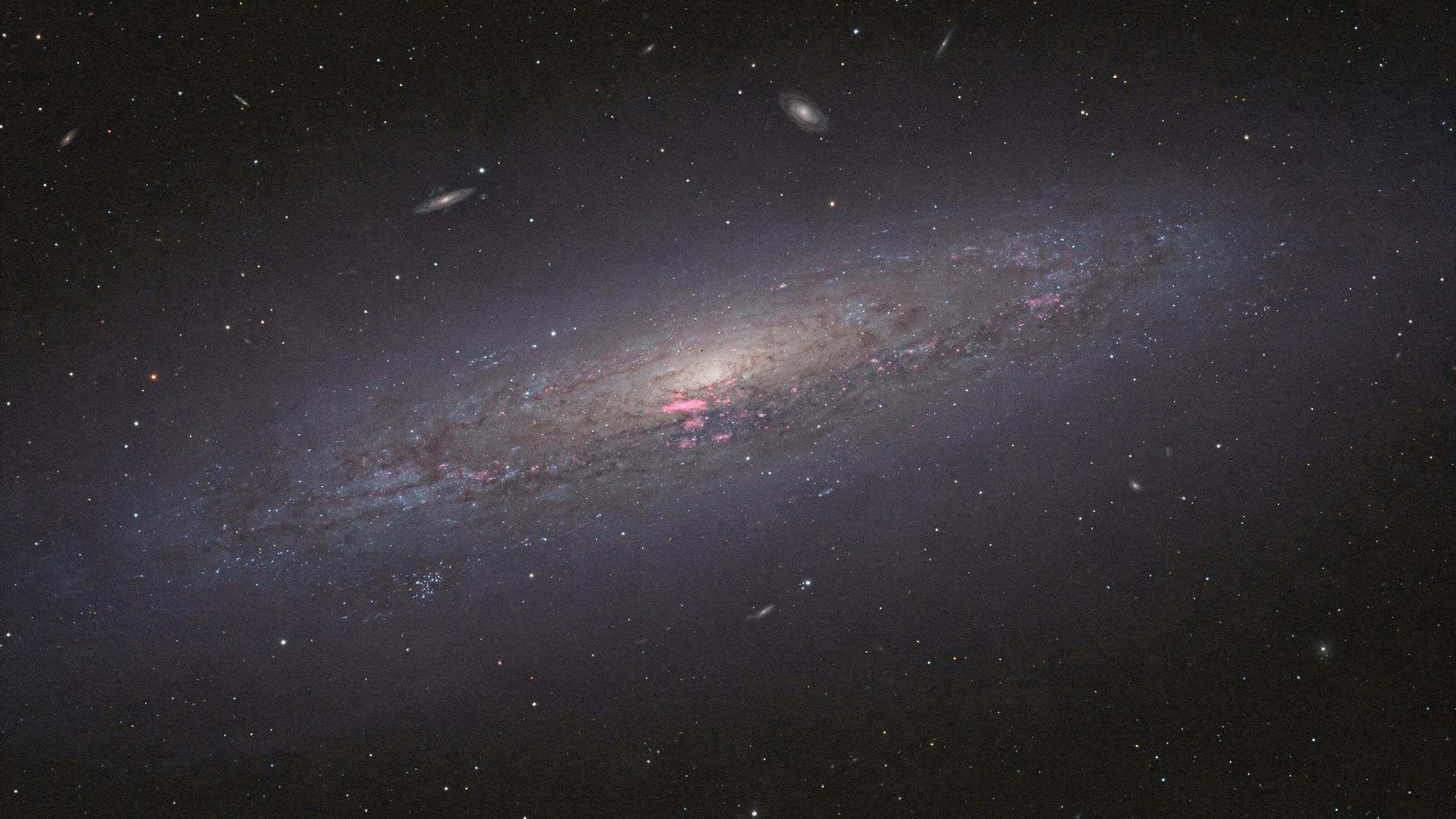
Qinwei Yuan, Yong Shi and colleagues at Nanjing University, Westlake University and other institutions in China and at the European Southern Observatory studied UGCA 320, a nearby dwarf galaxy rich in gas, about 6 megaparsecs away (the parsec is the astronomers’ unit of distance; a kiloparsec is a thousand of them, a megaparsec a million).
Its hydrogen gas was mapped by the MeerKAT radio telescope in South Africa, 64 dishes each 13.5 metres across, as part of the MHONGOOSE survey: 55 hours of observation, at three resolutions, tracing the gas out to more than 11 kiloparsecs from the centre. For the inner region, the team used the glow of ionised hydrogen recorded by the MUSE instrument on ESO’s Very Large Telescope, which is sharper. Infrared images from the Spitzer space telescope gave the distribution of stars.
Cleaning out a wind
The centre of UGCA 320 is messy. There, many hydrogen spectra show two peaks — two batches of gas moving at different speeds — which another team interpreted as an outflow driven by star formation. Gas pushed outward does not trace the galaxy’s gravity, so the team fitted each spectrum with one or two components and removed the one whose speed lay farther from the galaxy’s overall velocity. After that cleaning, the rotation looked smoother and more regular.
A flat-bottomed halo
The team then asked which shape of dark matter halo best reproduces the rotation curve, after subtracting the pull of the gas and stars. The cold-dark-matter profile with a cusp, called NFW, fits poorly: it predicts the inner gas should turn faster than it does. Two cored profiles fit well. A flexible version of NFW, which lets the inner slope vary — how steeply the density climbs towards the centre — settles at 0.36 ± 0.12, against 1 for a cusp and 0 for a perfectly flat core.
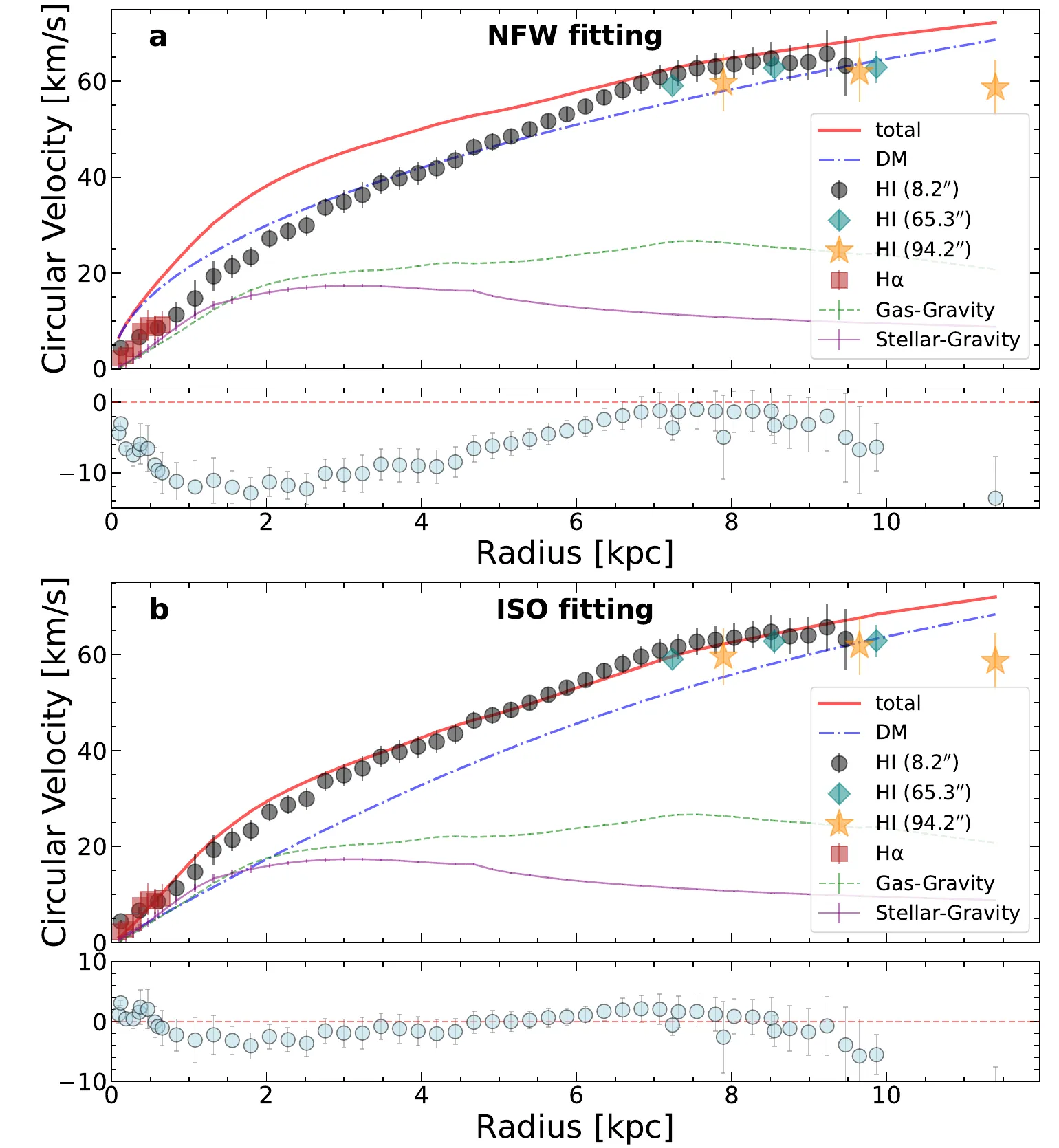
Rotation curve of UGCA 320 (points: hydrogen at three resolutions and ionised hydrogen in the centre) fitted with a cuspy NFW halo (a) and a cored pseudo-isothermal halo (b). Red: total model; blue dashed: dark matter; green and purple: gas and stars. Residuals below each panel. — Figure 9 (a–b), Yuan et al. (2026), arXiv:2611.15528.
The best cored model gives a core radius of 7.62 ± 0.80 kiloparsecs. The stars, by comparison, have half their light within 2.02 kiloparsecs: the dark matter core extends about four times farther than that.
Four times wider than the starlight
That is unusual. Compared with other dwarf galaxies of similar stellar mass in the SPARC catalogue, UGCA 320 has a markedly larger core than almost all of them. An earlier estimate from older radio data, covering about half the radius, gave about 3.8 kiloparsecs.
The team tested what could shrink the result: the tilt of the galaxy, its orientation, the position of its centre, the mass of its stars per unit of light, motions that are not circular, the thickness of its disks. The most conservative choices bring the core down to about 6 kiloparsecs, still within three standard deviations of the main result and still far larger than in other dwarfs.
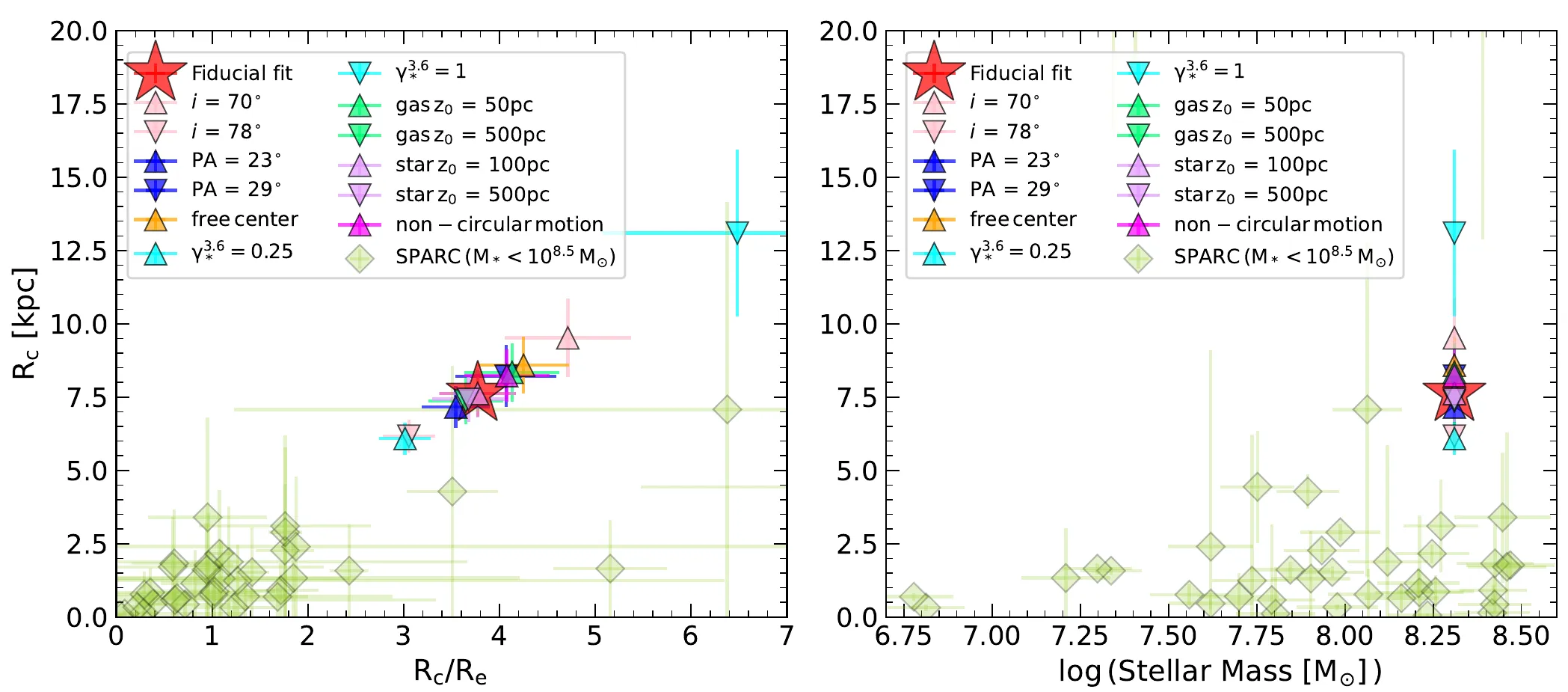
Core radius of UGCA 320 (red star; triangles: tests of systematic uncertainties) compared with dwarf galaxies of the SPARC database (green diamonds), against the core-to-stellar-radius ratio (left) and stellar mass (right). — Figure 10, Yuan et al. (2026), arXiv:2611.15528.
Which dark matter fits?
The authors then compare the core with alternatives. Stellar feedback (the stirring by star formation and supernovae described above) and the friction of infalling clumps of gas are generally found to make cores of no more than about 0.1 to 2 kiloparsecs in dwarfs. “Warm” dark matter would need particles with a mass of about 0.003 keV (kiloelectronvolts, the energy unit physicists also use for particle masses), far below the limits set by other observations, around 6 keV. “Fuzzy” dark matter, made of an ultralight particle, would need a mass of about 0.38 × 10⁻²³ eV, which various methods exclude.
Dark matter whose particles can collide with each other fares better. The core implies an interaction strength, a cross-section per unit mass — the effective target area each gram of particles offers to the others — of about 4.27 cm² per gram, in line with values proposed elsewhere. For now, the authors write, UGCA 320 “may pose a challenge” to cold dark matter — one dwarf galaxy, but one whose dark heart reaches far past its last stars.