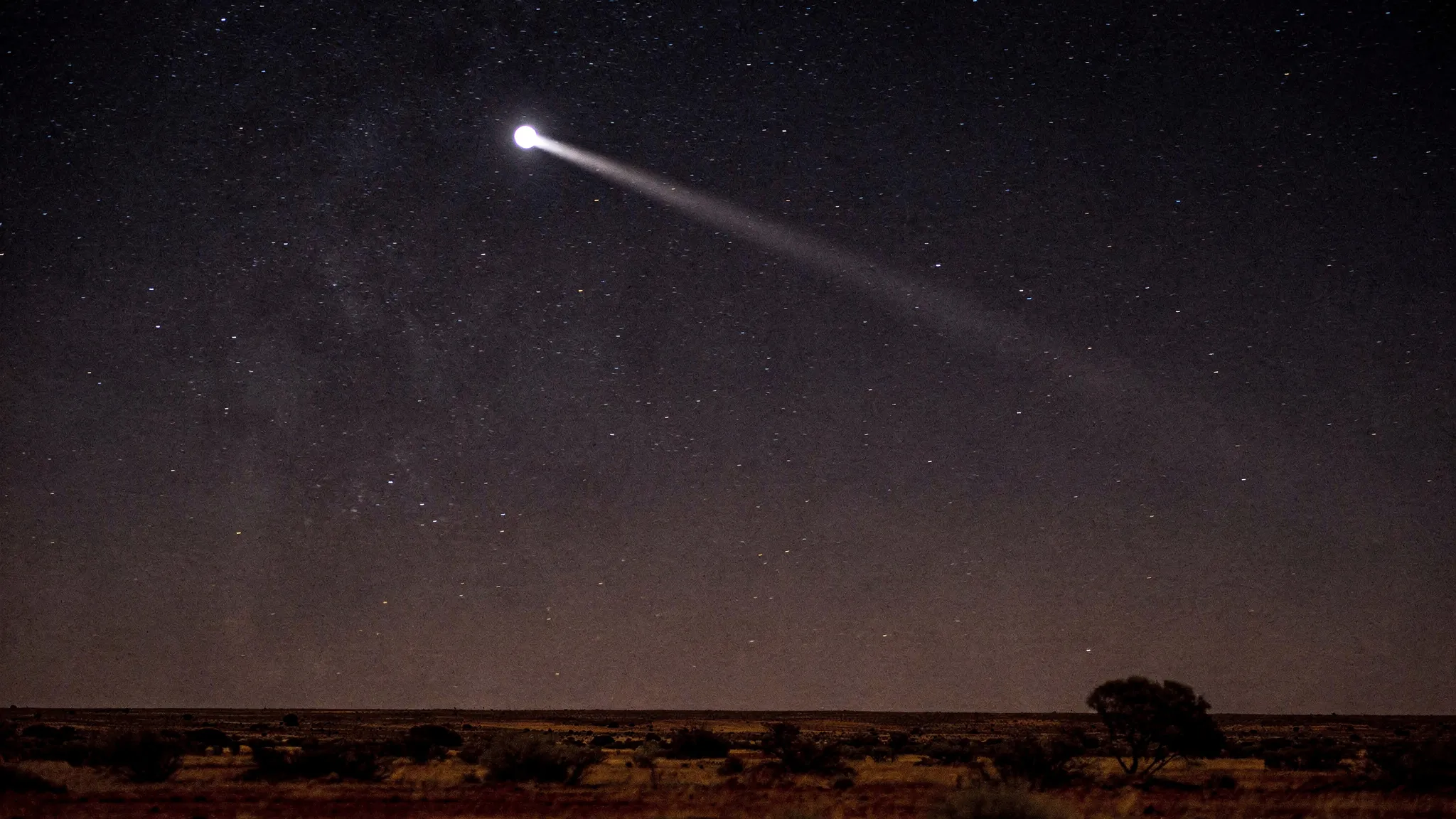
THE SPECTRUM OF A FALLING CAPSULE
At about 17:28 UTC on 5 December 2020, the sample-return capsule of the Japanese Hayabusa2 mission, carrying material from asteroid Ryugu, entered the atmosphere over South Australia at about 12 kilometres per second. It was a small blunt body, 0.41 metres across, protected by a heat shield of carbon-fibre-reinforced plastic that chars and decomposes as it heats. A coordinated international campaign watched it with cameras, spectrographs, sound and seismic sensors on the ground, and two instrumented aircraft.
One of the ground cameras, near Coober Pedy, was unusual. Shinsuke Abe of Nihon University and some twenty colleagues from Japan, Australia and France now present the first detailed analysis of what it recorded.
A consumer camera turned spectrograph
The camera was a Sony α7S II, a consumer model whose filters had been removed, with a 24-millimetre lens and a diffraction grating in front of it: a plate ruled with 600 lines per millimetre that spreads light into its colours, turning the video into a spectrum. It recorded 4K video at 25 frames per second, each quarter-second exposure repeated over seven frames — and it was moved by hand to follow the capsule.
That made the data hard to use. During each quarter-second exposure, the capsule moved by tens of pixels, smearing its spectrum. The team built a model of how the grating bends light across the whole field, used the capsule’s own image to undo the smear, identified the camera’s tone curve, and calibrated the brightness on Sirius, which appeared in some of the frames. Because Hayabusa2’s capsule fell without the breaking-up spacecraft body that had confused observations of the first Hayabusa capsule in 2010, the spectrum shows the capsule alone, from 80 kilometres down to 49, from the very start of its heating.
Carbon in the shock layer
The capsule’s brightest moment came at 60.8 kilometres, with an apparent magnitude of −5.0 (on the astronomers’ brightness scale, the more negative the number, the brighter the object). But the most distinctive light came earlier. High up, the hot gas in front of the capsule glowed with molecular bands, the sets of colours each kind of molecule emits like a fingerprint: CN, the band usually seen for carbon-based heat shields, but also the CH band and the Swan bands of the C2 molecule. According to the authors, this is the first time C2 has been identified in remote observations of a sample-return capsule; it had been recorded only by an instrument on board another capsule. Fitted with a model of the molecule, the C2 bands give a rotational temperature of about 9,200 K and a vibrational temperature of about 7,800 K — temperatures read from how fast the molecules spin and how hard they vibrate, which shape the pattern of their bands. CN comes out at about 7,000 K. Both are far hotter than the capsule’s surface.
The C2 bands vanish near 69 kilometres and CH below 72, while CN persists. The heat flux, though, was still rising, so the heat shield had not stopped decomposing. The authors link C2 and CH to the early stage of that decomposition, when the gas reaching the surface is rich in hydrocarbons, as in wind-tunnel tests of similar materials; later, the gas changes as it seeps through the charred layer, and the carbon shows up as CN instead.
A heat shield at 3,000 K
The smooth background of the spectrum is the glow of the heat shield. Its colour temperature — the temperature deduced from the colour of its glow — rises from about 2,720 K at 70 kilometres to 3,080 K at 64 to 60 kilometres, then stays near 3,010 K; at peak brightness it is 3,042 K, give or take about 120 K. That agrees with the temperatures measured from aircraft. A simple model of the heating puts its peak, 12 megawatts per square metre, at 58.2 kilometres, two seconds after the brightest moment.
Ten to a hundred times dimmer than a fireball
From the capsule’s known mass of 16 kilograms and its trajectory, the team computed how much of the energy it lost was turned into light. Between 80 and 49 kilometres it radiated 480,000 joules in visible light, about 0.09% of the 560 million joules of kinetic energy it shed as it slowed from 11.6 to 8.1 kilometres per second.
That makes it one to two orders of magnitude less luminous than natural fireballs of similar energy, for which 0.5 to 6% is expected. The reason, according to the authors, is that a meteor’s light comes largely from vaporised material, while the capsule’s comes from its hot surface alone. Such a calibrated value for a slow, large body is rare and useful for meteor physics.
A delayed afterglow
No glowing wake travelled with the capsule. But videos released by JAXA show something else: a faint trail fixed in the air, which lit up 0.5 to 0.9 seconds after the capsule passed, peaked after 1 to 2 seconds and faded within a few seconds, over more than 30 kilometres of the path. Because it starts late, it cannot be the heat of the wake itself; the authors propose a chemical glow, perhaps nitric oxide reacting with atomic oxygen as the wake cools and mixes with the air. A spectrum of that trail, they note, would settle which molecule is shining.