ONE KAON IN TEN BILLION
Every so often, a positively charged kaon turns into a charged pion and a pair of particles that no detector catches: a neutrino and an antineutrino. Physicists write it K⁺ → π⁺νν̄. At the BEAUTY 2026 conference in Maastricht, Silvia Martellotti, of the Frascati National Laboratories of Italy’s INFN, presented the newest measurement of how often it happens, on behalf of the NA62 Collaboration at CERN.
A decay theory can price to within 8%
This decay is extremely rare. It is dominated by a quantum loop involving the top quark, with only small corrections from other effects, which makes it unusually “clean” for theorists. The Standard Model, today’s theory of particles, predicts a branching ratio — the fraction of kaons that decay this way — of about 8 × 10⁻¹¹, some 8 kaons in 100 billion, with a precision better than 8%.
Such a small and well-known number is a sharp test. According to the paper, it is sensitive to new physics at mass scales up to about 100 TeV (teraelectronvolts, an energy unit physicists also use for particle masses), and several theories beyond the Standard Model predict large changes to it.
One track in, one track out
NA62, at CERN’s SPS accelerator, has been taking physics data since 2016 and holds the world’s largest sample of charged-kaon decays. Its beam carries particles with a momentum of 75 GeV/c (a measure of how much motion each particle carries), and 6% of them are kaons. A gas-filled detector (a Cherenkov counter) tags each kaon, a silicon pixel spectrometer measures its momentum, and the kaon then decays inside a vacuum tank holding a 65-metre decay volume.
The signature is spare: one track coming in, one track going out, and nothing else, because the neutrinos escape. From the momenta of the kaon and the pion, the team computes the “missing mass”: the mass of whatever escaped unseen (in practice its square, as in the figure below). Two windows of this quantity are kept as signal regions, chosen to avoid the three common kaon decays that could mimic it: into a muon and a neutrino, into a charged pion and a neutral pion, and into three charged pions.
Everything else must be rejected with brutal efficiency. Muons are suppressed by a factor of 10 million while 75% of pions are kept, thanks to a second Cherenkov detector, calorimeters and a muon veto behind an 80-centimetre iron wall. Only 1.24 in 100 million decays into a pion and a neutral pion slip past the photon vetoes, 30% better than in 2021–2022.
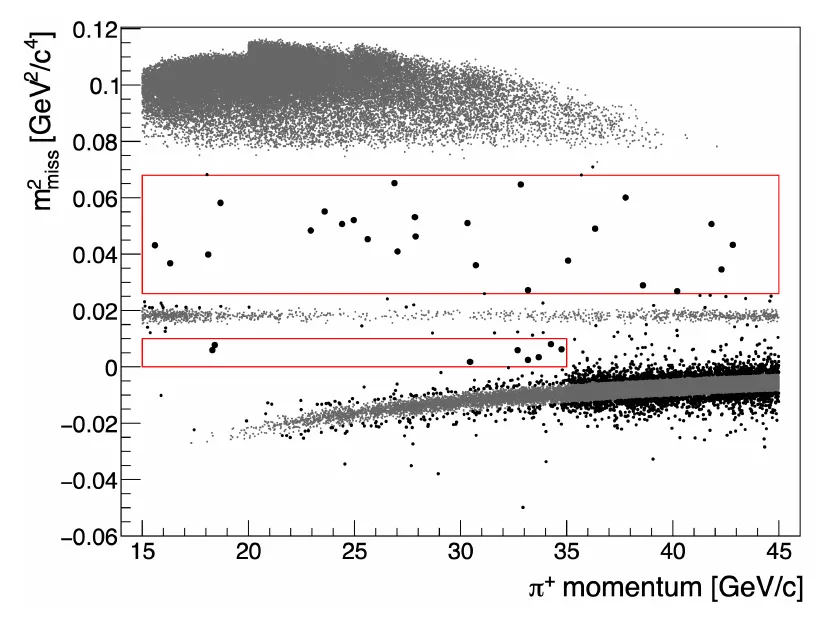
Events from 2023–2024 passing the selection, plotted by pion momentum and missing mass squared. The red boxes show the two signal regions. — Figure 3 (left), Martellotti for the NA62 Collaboration (2026), arXiv:2611.16530.
A better beam, a better count
Since August 2023, NA62 has run at its optimal beam intensity, about 75% of the design value, which reduces events lost to random activity in the vetoes. The kaon tagger was replaced by one filled with hydrogen instead of nitrogen, to put less material in the beam’s path, and machine-learning algorithms now help reconstruct beam tracks and identify particles.
For 2023–2024 alone, the Standard Model predicted 22.9 signal events (genuine decays of this kind), 2.3 times more than expected from the 2021–2022 data, against about 12 background events: other processes that pass the selection and mimic the signal. The team found 33 candidates, giving a branching ratio of 7.2 (+2.3/−2.1) × 10⁻¹¹.
84 candidates
Combining all data from 2016 to 2024, NA62 expected about 30 background events and 43 signal events. For the first time, the dataset is large enough that, if the Standard Model is right, its signal should stand out from the background at more than 5 sigma, the level physicists require to claim an observation. This is an expected figure, not a measured one. In total, 84 candidate events were observed.
The combined result: 9.6 (+1.9/−1.8) × 10⁻¹¹, compatible with the Standard Model prediction. The paper calls it “one of the rarest decays ever observed”. The overall relative uncertainty is now 20%.
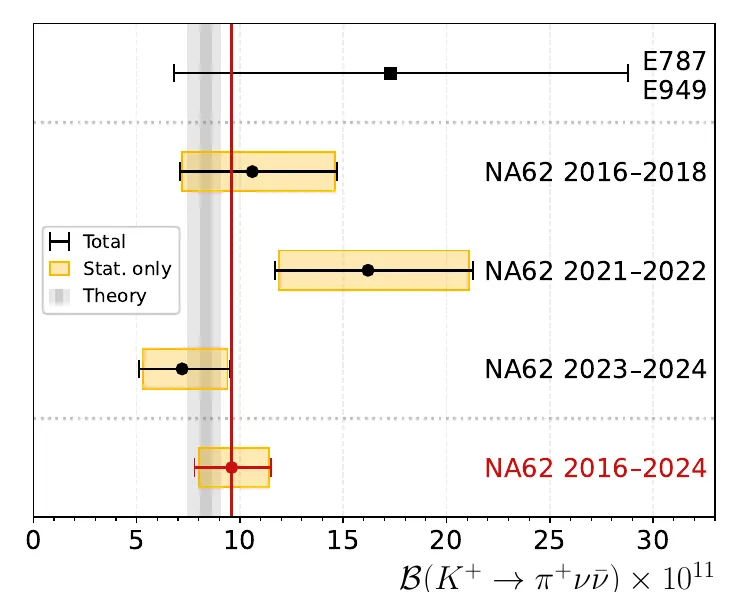
Successive measurements of the K⁺ → π⁺νν̄ branching ratio, from the E787/E949 experiments to NA62’s combined 2016–2024 result (red), compared with the Standard Model prediction (grey band). — Figure 4 (right), Martellotti for the NA62 Collaboration (2026), arXiv:2611.16530.
The final stretch
The 2023–2024 data doubled the effective size of the sample while lowering the share of background. And the experiment is nearing its end: 2026 is NA62’s last year of data taking. Analysis of the complete dataset is under way, and should tighten the precision from 20% to 15%, leaving any hidden physics less room to hide.