MOST PLANETS ORBIT FLAT ON THEIR DUST BELTS
In the Solar System, things are remarkably flat. The orbits of the planets all lie within 7 degrees of a common reference plane, set by their combined orbital motion. Far beyond Neptune, the Kuiper Belt — a broad population of icy bodies whose main part sits about 40 to 48 times the Earth-Sun distance from the Sun — has a mean plane within about 0.7 degree of that same plane. This near-alignment fits the classic picture of planet birth: planets form inside a flattened, rotating disk of gas and dust around a young star.
Tilted worlds
Other planetary systems are not always so tidy. Some planets orbit at an angle to the spin axis of their star; some neighbouring planets orbit in different planes. Two explanations compete. Either the tilts are there from birth, inherited from a warped or misaligned disk, or they appear later, when planets scatter each other, when a companion pulls on them, or when another star passes by.
One way to decide is to compare the orbits of planets with the plane of their system’s outer debris disk. These cold, distant belts are the counterparts of the Kuiper Belt: dust kept supplied by collisions between larger bodies. Until now, that comparison existed for only a handful of systems, mostly with planets imaged directly far from their star.
Sixteen systems, 32 planets
Jingwen Zhang and colleagues, at the University of California, Santa Barbara, with researchers in Ireland, the United Kingdom and Canada, built the first sample large enough to speak of a population. They cross-matched known planets with debris disks that telescopes have resolved, and kept 16 systems with 32 planets, the Solar System included.
The planets span almost a thousandfold range of distances, from 0.1 to 100 times the Earth-Sun distance. The closest are seen as they pass in front of their star, which fixes their tilt — among them the three planets of AU Mic, a star 22 million years old. The farthest are photographed directly. In between are giant planets betrayed by the back-and-forth motion they impose on their star. For those, the team combined that wobble with the star’s measured motion across the sky in the Hipparcos and Gaia catalogues, which reveals the full three-dimensional orbit. The disks themselves lie tens to hundreds of times the Earth-Sun distance from their stars.
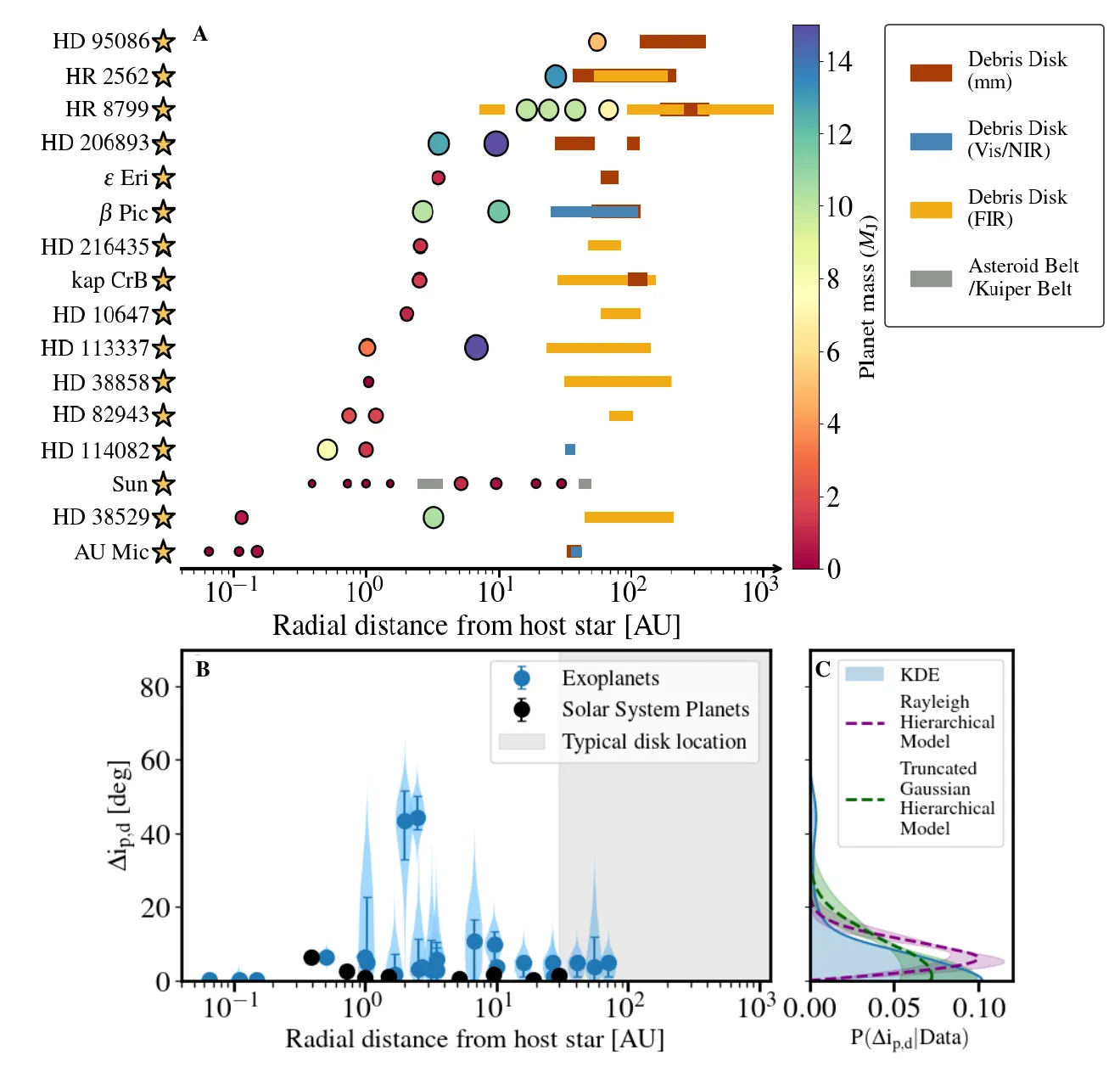
A: planets (circles) and debris disks (bars) in each system. B: minimum tilt between each planet and its disk, against distance from the star. C: the combined distribution, peaked at zero. — Figure 1, Zhang et al. (2026), arXiv:2611.17423.
Flat, with small wobbles
The measured angle is the difference between how the planet’s orbit and the disk are tilted as seen from Earth. It is a lower limit on the true angle between the two planes: two planes that lean equally towards us can still be turned in different directions on the sky. Using a cautious threshold of 10 degrees, 30 planets out of 32 are aligned with their debris disk, and 14 systems out of 16. The typical value of this minimum angle in the population comes out at about 6 degrees.
Look closer, with a strict 1-degree threshold, and about 5 systems out of 16 show a small tilt of a few degrees. The star β Pic is one: its two planets are tilted by 3.9 and 3.6 degrees relative to the disk, matching a 3 to 4-degree warp seen in the disk itself. Even the Kuiper Belt, so close to the planets’ plane, can be told apart from it.
For 12 systems, the tilt of the star’s spin axis is also known. In 11 of them, the planets lie within 10 degrees both of the disk and of the star’s equator.
Could the alignment be an illusion created by which systems are easiest to observe? The team reshuffled disks and planets between systems 20,000 times, keeping every observational bias but breaking any physical link. Only 0.3% of the shuffled samples came out as well aligned as the real one.
Two rebels
Two systems break the pattern. Around the stars HD 10647 and κ CrB, a giant planet orbits at about 2 and 2.6 times the Earth-Sun distance, with a debris disk at about 100 times the Earth-Sun distance — and the planet is tilted by more than 40 degrees relative to the disk. In HD 10647, the star’s spin is nearly aligned with the disk; only the planet is off.
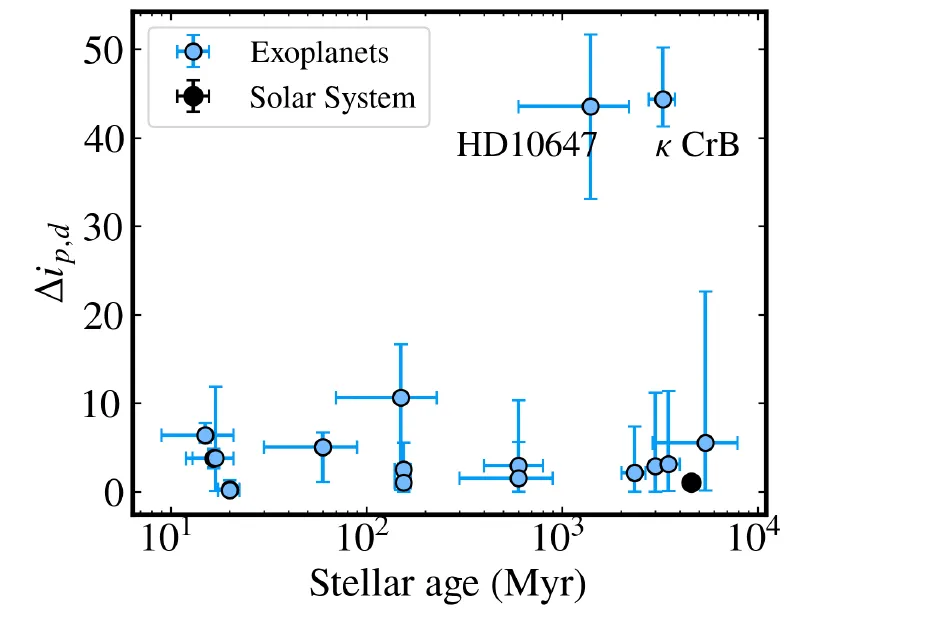
Minimum planet-disk tilt against stellar age, from tens of millions to billions of years. The two misaligned systems are labelled. — Figure 3, Zhang et al. (2026), arXiv:2611.17423.
Both are among the oldest stars in the sample, while younger systems are aligned. If tilts were inherited at birth, the authors argue, they should show up at all ages. Their rarity, and their presence only in old systems, may favour a later upheaval. For HD 10647, an asymmetry in the disk could betray another planet, farther out, that once pushed the known one off its plane. For any single system, though, a birth origin cannot be ruled out.
A small sample, for now
Sixteen systems is a small sample, the measured angles are only lower limits, and this version of the paper is the one originally submitted to the journal Science Advances, before the reviewers’ revisions. The next Gaia data release should reveal the orbits of thousands more giant planets — enough to test whether our flat Solar System is as ordinary as these 16 systems suggest.