A LASER TUNED BY ITS ATOMS, NOW NONSTOP
Optical atomic clocks are the most precise measuring devices ever built, with relative uncertainties below 10⁻¹⁸ — an error of less than one part in a billion billion. They are used for precision tests of fundamental physics. Their secret: a laser locked onto an atomic transition — the precise frequency of light an atom emits when it leaves an excited state. That frequency shows up as a “line”, and the narrower the line, the more sharply it is defined.
To keep that laser steady from one instant to the next, it is first stabilised on an ultrastable optical cavity, two mirrors held at a fixed distance. But the slightest mechanical or thermal change in that distance passes straight into the laser’s frequency. Such cavities are hard to keep quiet outside a well-controlled laboratory.
Let the atoms set the pitch
The alternative is to let the atoms emit the light themselves, at their own frequency. Hydrogen masers have done this for decades with microwaves. In the optical domain, it takes a “bad cavity”, one whose resonance is far broader than the atomic line, so that the atoms rather than the mirrors fix the frequency.
On a very narrow atomic line, the atoms are too slow to emit on their own. They have to radiate together, their tiny antennas in step: this collective emission is called superradiance, and it is much faster than that of independent atoms. Theory predicts that such superradiant lasers could reach linewidths down to the millihertz. But until now they only worked in pulses, or almost continuously, for less than a second: the atoms got lost along the way.
A conveyor belt of atoms
Benedikt Heizenreder, Florian Schreck and colleagues at the University of Amsterdam, with partners in Bonn, Turin and Copenhagen, solved the supply problem. A beam of strontium-88 atoms flies from an oven through the light trapped between two mirrors 26.65 millimetres apart. On the way, the atoms are slowed sideways and parked in long-lived states, then pushed into the right excited state just before entering the cavity.
Each atom spends only about 0.45 microseconds in the light, 50 times less than the natural lifetime of its excited state. Alone, it would almost never emit there. Together, up to 157,000 excited atoms in the cavity at once, they lase — and new atoms keep replacing those that leave.
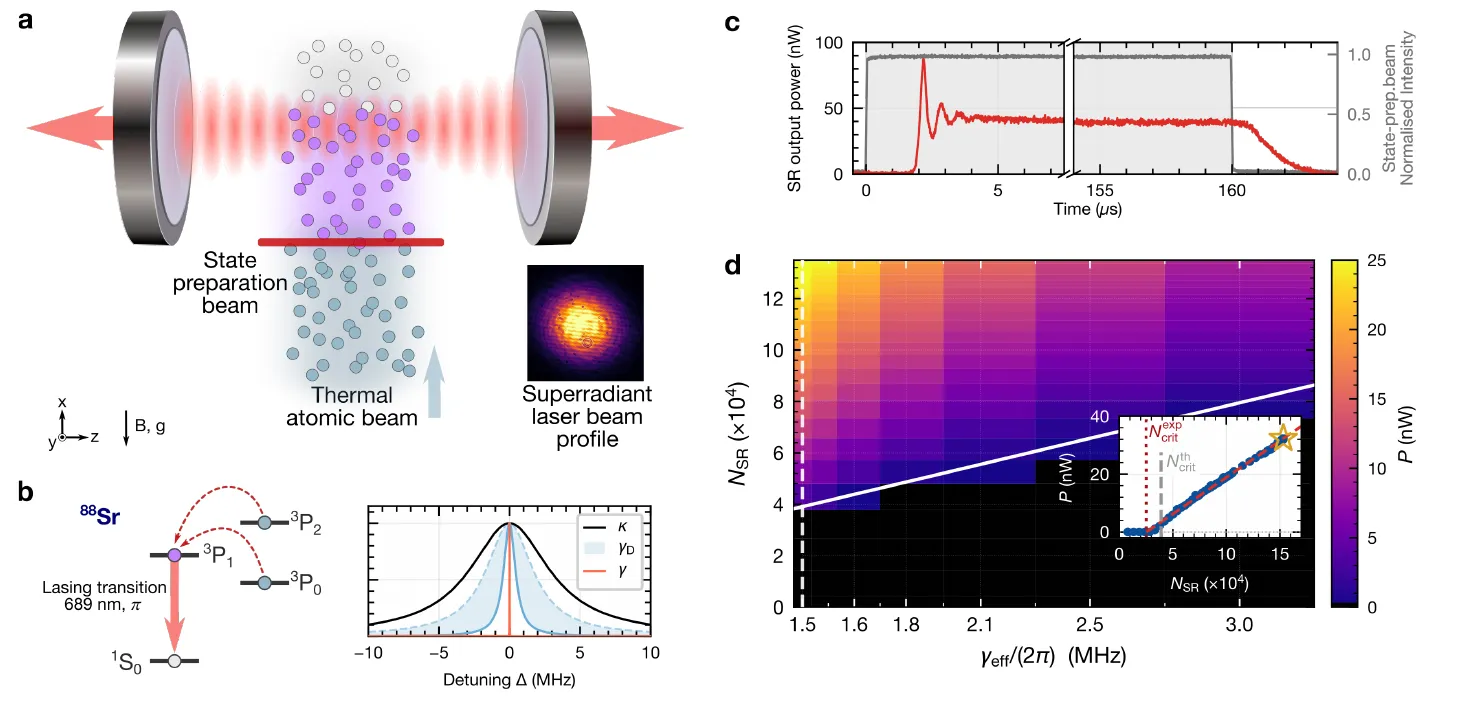
The set-up (a), the strontium levels involved (b), lasing that starts within microseconds and lasts as long as atoms are prepared (c), and output power versus atom number and broadening (d). — Figure 1, Heizenreder et al. (2026), arXiv:2611.21386.
Eight hours without a break
The laser emits at 689 nanometres, a red line of strontium whose natural width — the spread of frequencies the atoms emit on their own — is 7.48 kilohertz. It ran for more than eight hours without interruption, with a steady power of 65 nanowatts.
The laser’s own light spreads over only 320 hertz (its measured linewidth) — an upper bound, so the true width may be even smaller — more than 20 times narrower than the atoms’ natural line and more than 3,000 times narrower than the spread caused by the atoms’ motion, the main source of disorder in the system. A simple model predicts about 90 hertz; the team attributes the difference to technical noise that could still be reduced.
To keep the cavity on the atomic line, the team locks the cavity length to the superradiant light itself. Over 500 minutes, the laser was compared with two others: one locked to a reference cavity, which drifted by more than 4 kilohertz per hour, and one locked to strontium atoms in a vapour cell. Against the vapour-cell laser, the superradiant laser stayed nearly constant: its typical scatter around the mean was 2.3 kilohertz.
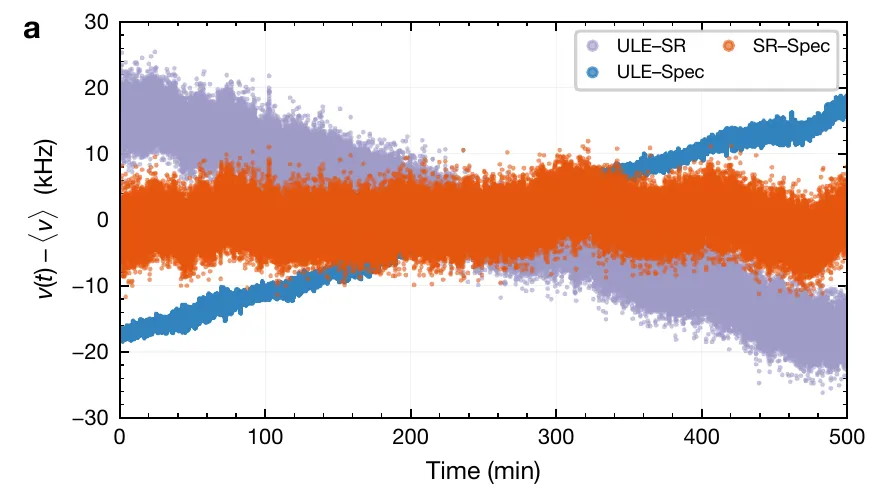
Frequency differences between three lasers over 500 minutes: superradiant laser against vapour-cell laser (orange) stays flat, while both comparisons with the reference-cavity laser drift. — Figure 3a, Heizenreder et al. (2026), arXiv:2611.21386.
A cavity that barely counts
In an ordinary laser, moving the mirrors drags the frequency along. Here, a shift of the cavity moves the laser’s frequency by only 0.165 of that shift, about a sixth. Averaged over 400 seconds, its frequency wanders by only about 3 parts in 10 million million (a relative instability of 2.9 × 10⁻¹³).
Pushed further, with more agitated atoms, the laser leaves this quiet regime. Its light begins to pulse in amplitude, a collective oscillation known as multi-component superradiance — a door, the authors say, to studying chaos and other non-equilibrium phenomena.
Towards clocks that travel
The same design should work with other atoms with similarly narrow lines, such as calcium-40 and ytterbium-174. Applied to the even narrower lines used by true optical clocks, it could match the short-term stability of the best reference cavities while staying tied to the atoms. Because superradiant lasers are less sensitive to mechanical and thermal noise, the authors see them as natural candidates for transportable optical clocks.