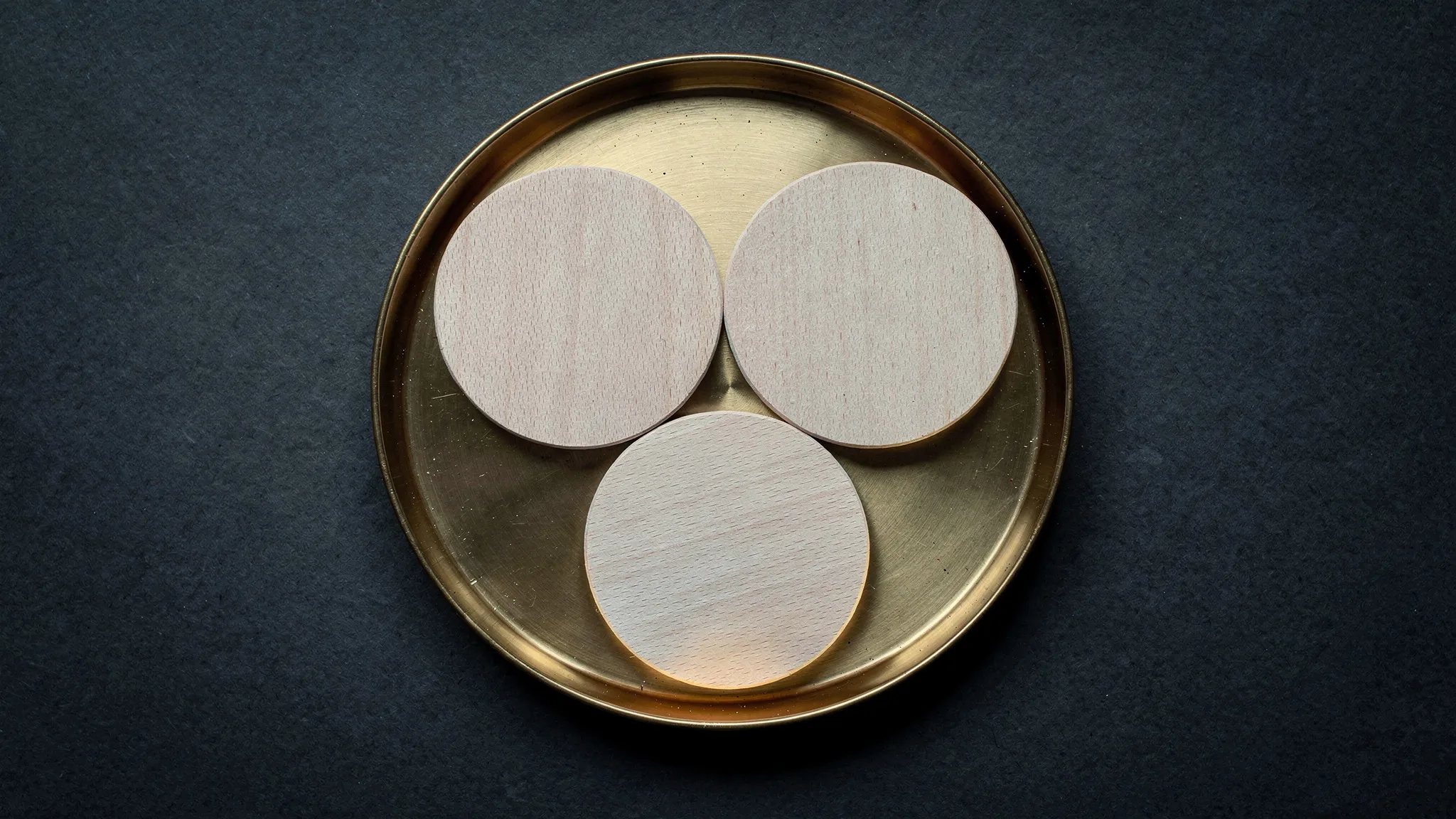
THREE DISCS IN A CIRCLE, AND A LOPSIDED MINIMUM
Here is a puzzle you can draw with a compass. Take a circle of radius 1. Inside it, place two discs of any sizes, as long as they touch each other and both touch the big circle from the inside. Now insert a third disc, as large as possible, without overlapping the first two — and require that it touch them both. Add up the areas of the three discs. How small can that total be?
Anatoly Eydelzon, of the University of Texas at Dallas, settles the question in a short paper. As far as the author knows, this precise “sequential” problem — place two discs, then the largest third one — has not appeared in the literature before.
The answer: 11π/18
The smallest possible sum of the three areas is 11π/18, about 1.92. Since the big circle has area π, the three discs then fill about 61% of it.
The radii that achieve it are 1/2, 1/2 and 1/3. In one version, the two first discs both have radius 1/2 — together they span the whole diameter — and the largest disc that fits beside them has radius 1/3. Their areas add up to π/4 + π/4 + π/9 = 11π/18.
The trap of symmetry
The paper flags the surprise itself: “At first glance, one might expect the minimum sum of areas to occur when all three disks have the same radius. Surprisingly, this is not the case.” Despite the symmetry of the problem, the best configuration is lopsided.
Stranger still, the same minimum can be reached in a second way: start with discs of radii 1/3 and 1/2, and the largest disc you can then insert has radius 1/2. The three radii are the same set, {1/3, 1/2, 1/2}, but the order of placement differs.
Is it really the largest disc?
The main difficulty is not computing areas. It is making sure that the third disc is the largest of all the discs that fit, and not only the largest of those that touch the first two. Two circles always touch both original discs and the big circle; picking the bigger of the two “is not enough”, the paper warns.
A first lemma sorts this out. When the smaller original disc is too small compared with the larger one — below a threshold that the paper writes down exactly — the largest disc that fits no longer touches it at all: it sits on the opposite side, touching only the larger disc and the big circle. Those configurations fall outside the problem. Every proof has to respect this boundary.
Three roads to the same number
The paper proves the result three times, each from a different angle.
- Descartes’ circle theorem. Four mutually touching circles obey an algebraic relation between their curvatures — a relation that, according to the bibliography, goes back to letters from Descartes to Princess Elisabeth of Bohemia in 1643, and was rediscovered by Soddy in a 1936 note in Nature. Here, the big circle counts with a negative curvature. The problem becomes the minimization of a² + b² + c² on that relation, checked at its stationary points and along its boundaries.
- Inversion. A classic transformation that turns circles into circles or lines. Inverting around the point where one original disc touches the big circle turns those two circles into two parallel lines, and the two other discs into two equal discs wedged between them. In these coordinates, the minimum always sits at one end of the allowed range.
- Contact points. Describing each disc by where it touches the first one turns tangency into a simple rule: two discs of the family touch exactly when their parameters differ by a fixed amount.
All three arrive at 11π/18 and at the same two equality cases. The paper closes with a reminder of how much hangs on the rules: drop the requirement that the inserted disc touch both originals, and you get a different problem altogether.