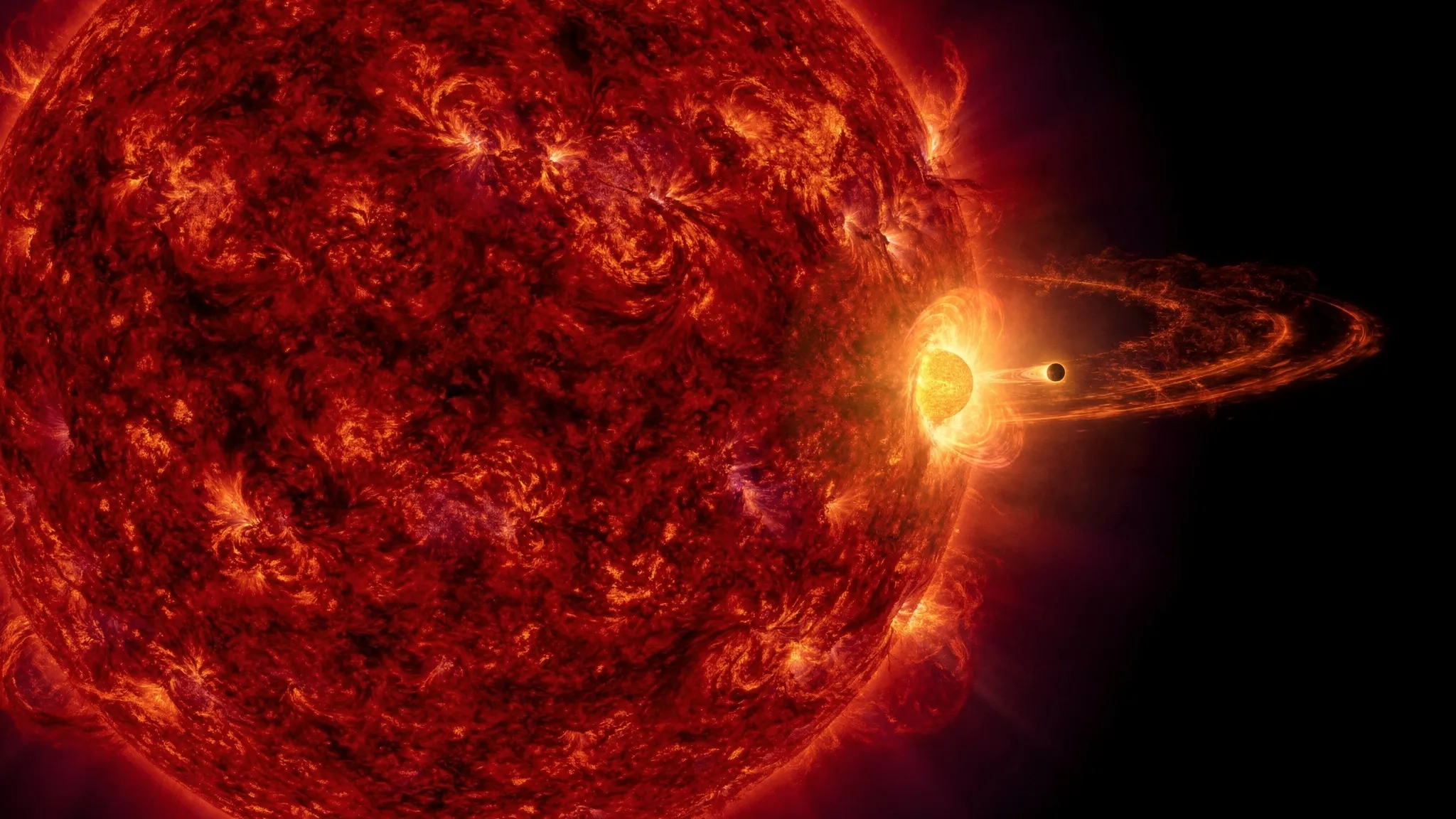
A STAR CAUGHT SPIRALLING INSIDE ITS GIANT COMPANION
Compact pairs of stars, such as close pairs of white dwarfs, can only form if the orbit of the original pair shrinks fast at some point. The textbook answer is the common envelope: the two stars end up orbiting inside one shared, loosely bound envelope of gas, and friction makes the smaller one spiral inward.
The idea has been worked out in theory, but, as the authors write, “this inspiral in such a system has never been observed directly.” Until AT 2025abao, an eruption in the Andromeda Galaxy.
Thirty quiet years, then a slow rise
The star sits in the Andromeda Galaxy. Archive images show it unchanged from 1989 to 2018: a giant of about 7 solar masses in a late stage of its life, an “asymptotic giant branch” star, some 350 times the Sun’s radius. It was already shedding mass about a hundred times faster than expected for such a star alone, wrapping itself in dust.
From 2018, it began to brighten — slowly. In two episodes, its visible light doubled or tripled over about 1,000 to 1,500 days, while its temperature hardly changed (about 3,800 K). By chance, NASA’s SPHEREx space telescope caught it in July 2025: it had swollen to about 860 solar radii.
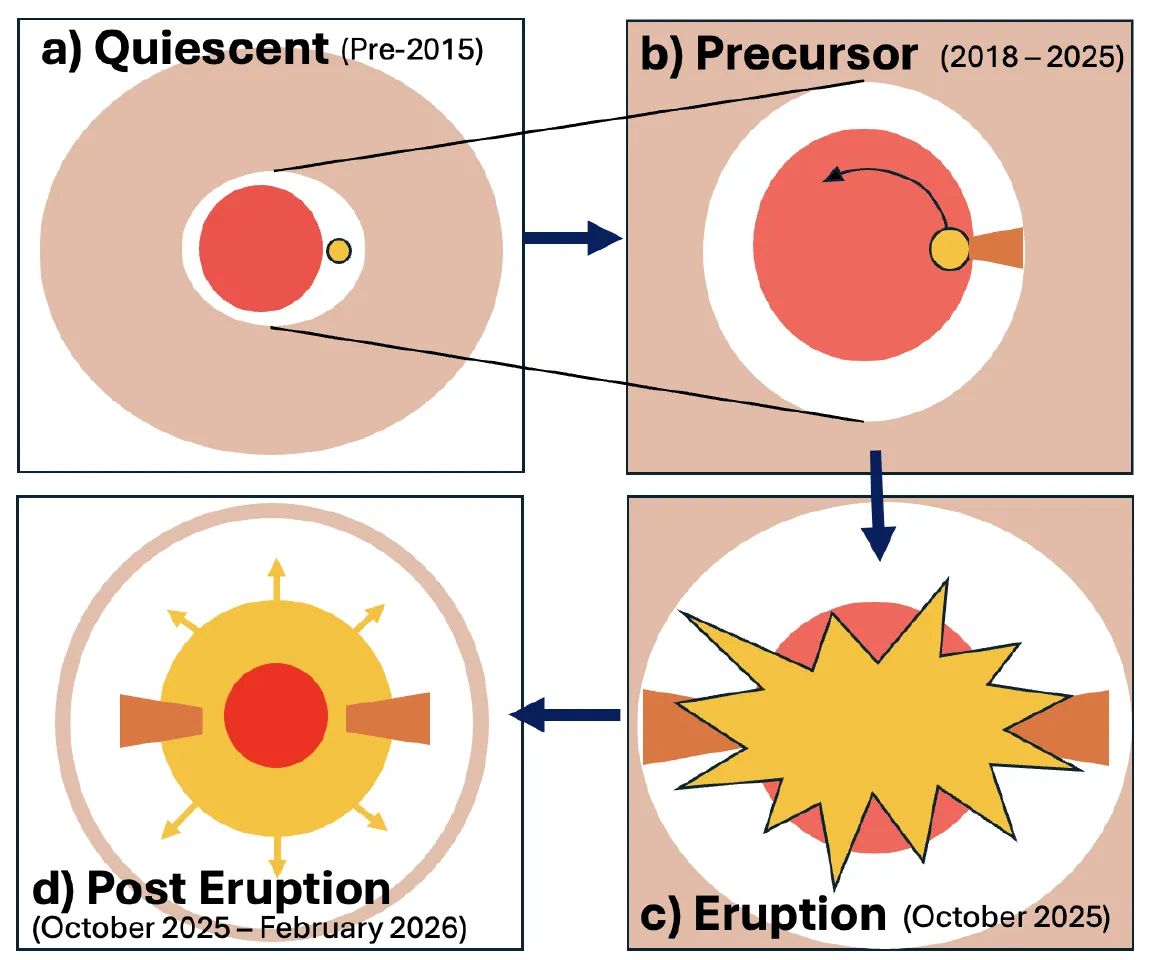
The four phases of AT 2025abao as the authors see them: quiet binary before 2015, slow brightening from 2018 to 2025 as the companion spirals in, the October 2025 eruption, and the expanding debris afterwards. — Extended Data Figure 10, Karambelkar et al. (2026), arXiv:2611.23470, CC BY 4.0.
Friction you can see
Viraj Karambelkar, at Columbia University, and 44 colleagues argue that this slow rise is the inspiral itself. Their reasoning:
- The usual explanation for the slow brightening before such eruptions — gas streaming out of the pair — falls short. Gas leaving such a puffed-up star moves too slowly: those outflows would carry about 10³⁷ erg per second (the erg is the paper’s unit of energy), against about 10³⁸ observed — ten times too little.
- Friction on a companion of about 0.7 solar masses skimming the giant’s surface would release about 3 × 10³⁸ erg per second — the right amount.
- The companion’s mass comes out the same two independent ways: from the dust shed before 2018, and from the gas lost during the brightening.
- Seven years is fewer than ten orbits at the giant’s surface — too short for outflows, which brighten a pair over several hundred orbits. The best-studied earlier events of this kind brightened over more than a hundred.
During this slow phase, most of the heat from friction escaped as light. Then, over the last 300 days or so, the star cooled: the companion was probably plunging deeper.
The eruption
In October 2025, the star flared by a factor of about 100 in red light in 25 days, and its surface jumped to about 8,000 K. It then stayed bright for about 80 days while cooling to about 3,000 K, peaking at about 1.5 million times the Sun’s luminosity. Its spectra tick every box of a luminous red nova, a known type of eruption from two stars merging.
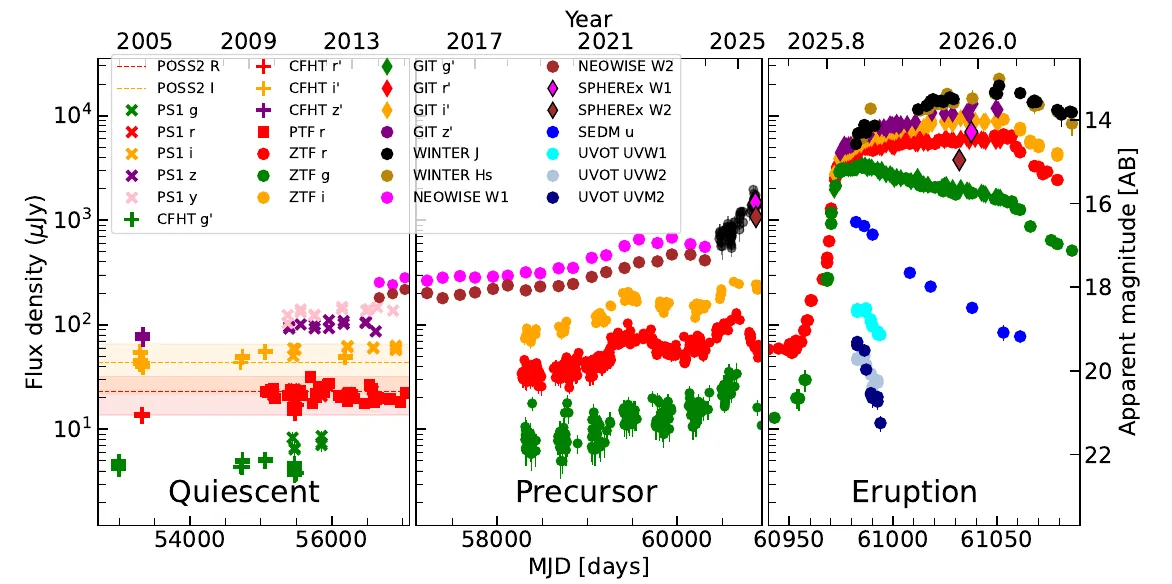
Brightness of AT 2025abao in many colours: quiet before 2015 (left), 2015 to early 2025, with the slow rise from 2018 (centre), the eruption of late 2025 (right). The three panels use different time scales. — Figure 1, Karambelkar et al. (2026), arXiv:2611.23470, CC BY 4.0.
What sets this one apart is the giant itself. Every previously known source of a luminous red nova was a less evolved star, with a tightly bound envelope. This is the first with an evolved giant and a loose, churning (convective) envelope — the very setup of the classic common-envelope theory.
Where the energy went
The fast debris carries about 10⁴⁸ erg of motion. For the orbit to release that much, the companion must have sunk to about 3 solar radii from the centre — the size of the giant’s helium core. Only 0.2 to 0.4 solar masses broke free of the star’s gravity, roughly 10% of the envelope. Both point to the companion merging with the core rather than escaping as a tight pair.
Of the energy released in that plunge, only about 1% left as light. A similarly small share went into freeing the gas. Nearly all of it launched a little gas at high speed.
That is a problem for the formula astronomers use to predict whether a pair survives. It assumes the orbital energy mainly lifts the envelope away. Its key number, the efficiency — the share of the released orbital energy that goes into lifting the envelope — comes out here between 0.01 and 0.4, in line with other estimates, but the formula “fails to capture all the underlying physics,” the authors write.
Not quite closed
The merger is the authors’ best reading, and they list ways to test it: watching how the dust shell expands, and whether a surviving pair would keep the remnant glowing for decades. They expect the Vera Rubin Observatory and the Nancy Grace Roman Space Telescope to find such events in about 100 galaxies like the Milky Way, out to a distance of 15 megaparsecs.