Aún sin traducir: versión original en inglés.
IN 2025, THE LAND BREATHED IN AGAIN
Every year, humanity adds carbon dioxide to the atmosphere, and every year land and ocean take part of it back. The difference shows up as the growth rate of CO₂ in the air, measured in parts per million (ppm) per year.
In 2024, that rate hit a record: 3.76 ppm per year, according to the NOAA network of marine stations. Land ecosystems had absorbed unusually little carbon in 2023–2024. Then, in 2025, the growth rate dropped to 2.06 ppm per year — a fall of 45%, and below the 2015–2022 average of 2.47. Two satellite-based estimates confirm the drop.
What makes this puzzling is that fossil emissions did not fall. They rose by 0.7%, to an estimated 10.38 billion tonnes of carbon (GtC) in 2025.
A budget in months, not a year
The official Global Carbon Budget arrives about a year after the fact. Philippe Ciais and Piyu Ke, of France’s Laboratory for Climate and Environmental Sciences, Xiangjun Tian, of the Chinese Academy of Sciences, and colleagues built a faster version for 2025 using two independent approaches:
- Bottom-up: three computer models of global vegetation, driven by recent weather data, plus machine-learning emulators of the ocean models used in the official budget, and satellite records of fires.
- Top-down: four “inversions” that work backwards from measurements of CO₂ in the whole column of air by NASA’s OCO-2 satellite, whose data are available within about six weeks and cover the tropics well.
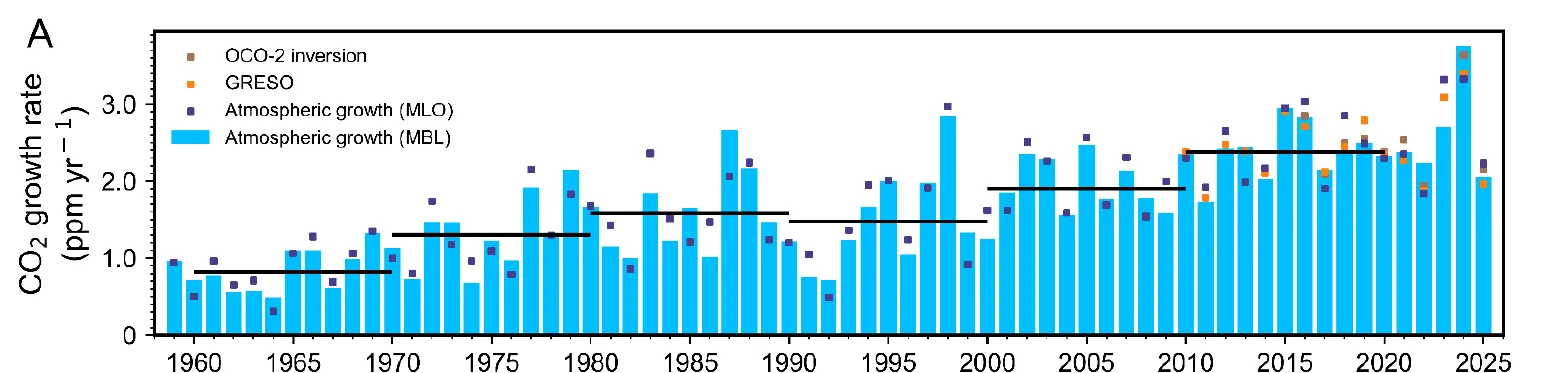
Annual growth of atmospheric CO₂ since 1959: the record 2024 bar is followed by a sharp drop in 2025. — Figure 1a, Ciais, Ke, Tian et al. (2026), arXiv:2609.34226.
The land did it
The two approaches agree on the main story. Averaged, the net land sink reached 2.36 ± 0.16 GtC per year in 2025 — 2.81 GtC more than in 2024, and 0.71 GtC above the 2015–2022 average. In 2024, the vegetation models had even found land to be a net source of carbon, while the inversions found only a tiny sink.
The ocean, by contrast, took up 3.11 GtC, about the same as in 2024. The rebound of land uptake is therefore the dominant reason the CO₂ growth rate fell. According to the satellite record, most of the drop happened between late 2024 and early 2025, after the end of the 2023/24 El Niño and as the exceptional global temperature anomaly eased.
A patchy recovery
Where did the land recover? Tropical lands switched from net sources in 2024 to net sinks in 2025, with stronger uptake across much of Africa and northern Eurasia in both approaches. In tropical South America, losses from the drought and fires of late 2024 lingered into early 2025 before fading. Uptake followed water: in regions where satellites measured wetter soils, ecosystems absorbed more.
The team then focused on areas that had lost a lot of uptake in 2023–2024:
- about 80% of that area showed some recovery in 2025;
- overall recovery reached 87% (models) to 99.5% (inversions);
- in the tropics, it exceeded 100% — uptake went above the old average;
- in the northern extratropics, it stayed incomplete (60% to 91%).
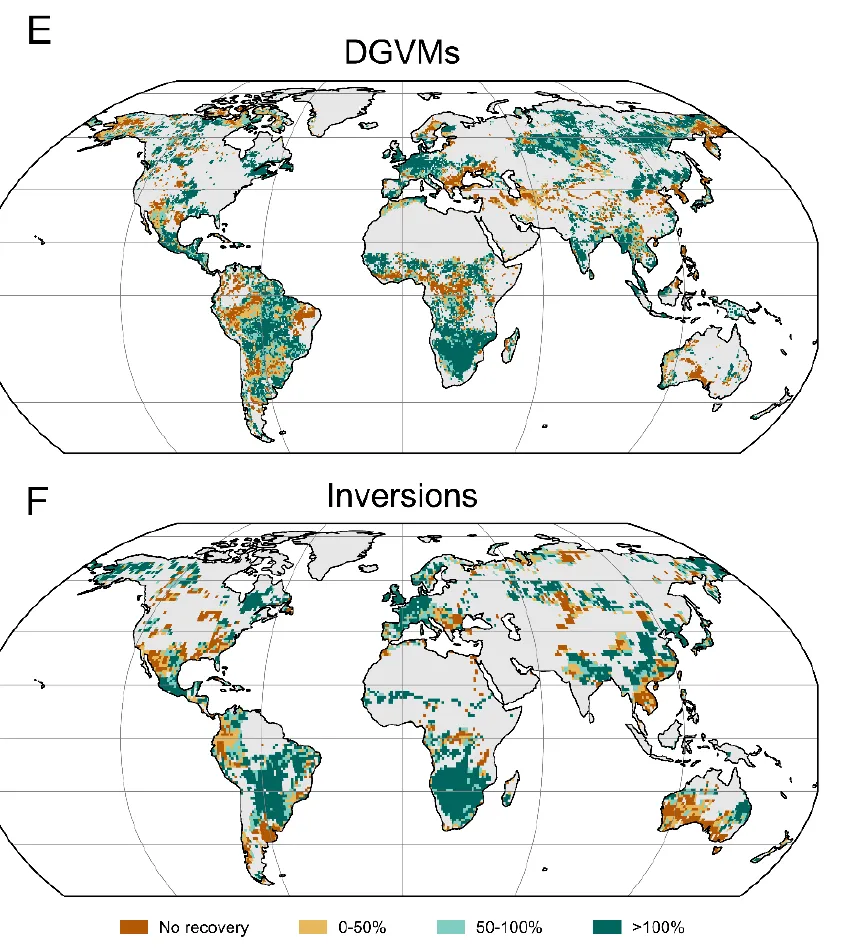
Recovery of the 2023–2024 land sink losses in 2025, from vegetation models (top) and satellite inversions (bottom): dark green means more than full recovery, brown none. — Figure 1e–f, Ciais, Ke, Tian et al. (2026), arXiv:2609.34226.
Fast pools, fast swings
The authors suggest that much of the rebound refilled carbon stores that turn over quickly, such as leaves and litter. That also means the land will keep driving the year-to-year ups and downs of CO₂ growth. The 2025 drop is a slower rise, not a fall: the concentration of carbon dioxide kept climbing, just less steeply than in a record year.