未翻訳:英語の原文を表示しています。
EARTHQUAKES IN A LAB: THE WATER THAT FLIPS
An earthquake happens when the stress on a fault exceeds its strength: the two blocks suddenly slip. In faults soaked with water, the pressure of the water in the rock’s pores plays a central role. The higher it is, the less the blocks are pressed together — and the more easily the fault slides.
Two mechanisms compete during a slip:
- Thermal pressurisation. Friction heats the fault. Water expands far more than rock, so its pressure rises, “lifting” the fault and weakening it. It is widely thought to drive large earthquakes — but it has rarely been observed directly in the lab.
- Dilatant strengthening. As the rock shears and cracks, it creates empty space. Water pressure drops, the blocks press harder together, and the fault strengthens — possibly braking the rupture.
In the field, water levels dropped quickly in wells near the fault after the 2018 Hualien earthquake in Taiwan (magnitude 6.3) and the 2016 Kumamoto earthquake in Japan (magnitude 7.0). So which effect wins, and when?
Miniature earthquakes
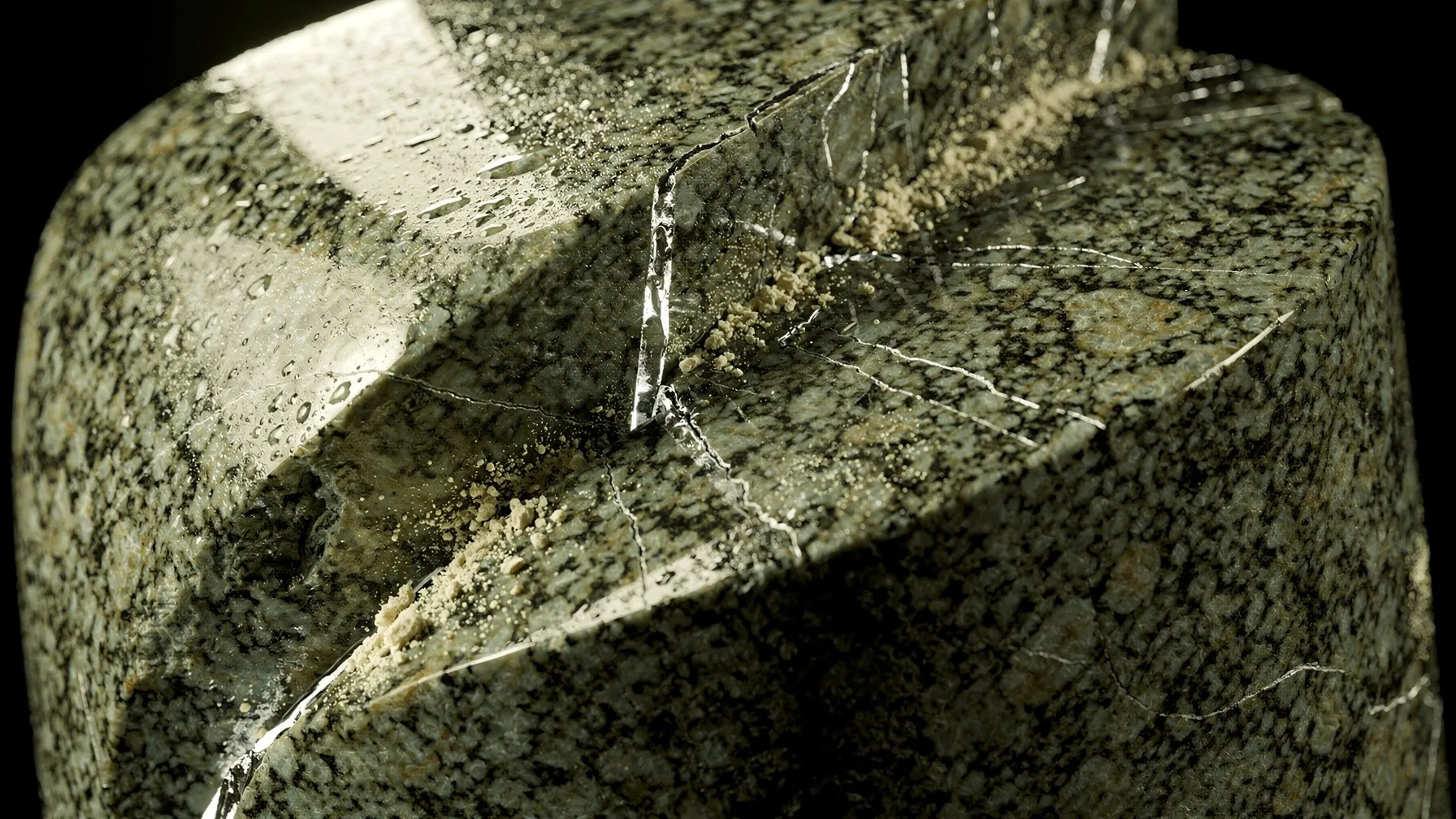
The team of Caiyuan Fan, Harsha Bhat and Alexandre Schubnel at the Geology Laboratory of the École normale supérieure in Paris used cylinders of Westerly granite, 85 mm long and 40 mm wide. The rock was heated to 450 °C to crack it, then sawn at 30° to create a fault, whose faces were polished with diamond paste.
- Six water-pressure sensors: four right at the edge of the fault (within half a millimetre), two further away in the rock.
- A high-pressure press squeezed the samples at effective confining pressures of 30, 45 and 60 megapascals, with water at 25 or 45 MPa.
- Loading was very slow (0.3 micrometres per second). The fault builds up stress, then slips all at once — a laboratory earthquake. One experiment produced more than 100 of them.
What they saw
First, thermal pressurisation — observed directly.
- In the first earthquakes, water pressure rose during the slip, at the same moment as the stress dropped.
- In the first event: a stress drop of about 2.2 MPa, a pressure rise of about 7 MPa, a slip of about 0.05 mm, and a pressure rise rate of up to 180 MPa per second.
- The theoretical model of thermal pressurisation reproduces these rises well.
- A precursor: water pressure began to rise more than 50 seconds before the rupture, while the stress barely changed.
Then, the flip to dilatancy.
- Earthquake after earthquake, the pressure started to fall instead of rise — by up to about 15 MPa, at up to 380 MPa per second. In one experiment, it came close to zero.
- Here too, a precursor: pressure started dropping 10 seconds before the rupture.
- The flip was seen in all four experiments.
Fast, slow, fast. Between the two phases came slow earthquakes, one to three orders of magnitude slower than the fast ones. They were absent in the most permeable sample.
Why the fault changed
The shearing zone grew about ten times thicker, from about 0.05 mm to about 0.4 mm. The heat was spread over more rock, and the estimated warming fell from about 10 degrees to 0.2 degrees. Under the electron microscope, the fault showed patches of crushed rock, threads of rock melted by friction, and a damaged zone about 60 micrometres deep on average.
A surprise: in the late phase, dilatancy was stronger, and yet the ruptures were faster. Dilatancy alone does not stabilise the fault; other weakening processes are at work.
Limits
The authors urge caution when comparing with natural faults: these experiments do not include the healing of faults between earthquakes. They also averaged the four sensors, which reveal an uneven pressure field.
A window on the state of a fault
According to the authors, this is the first experimental demonstration of both opposite water-pressure responses, and of a range of fast and slow earthquakes, on a single evolving fault. It challenges the idea that thermal pressurisation always dominates large, fast earthquakes. And water-pressure signals could become a window on the state of a fault.