未翻訳:英語の原文を表示しています。
WHEN THE FINGER CLIP IS FOOLED BY SKIN COLOUR
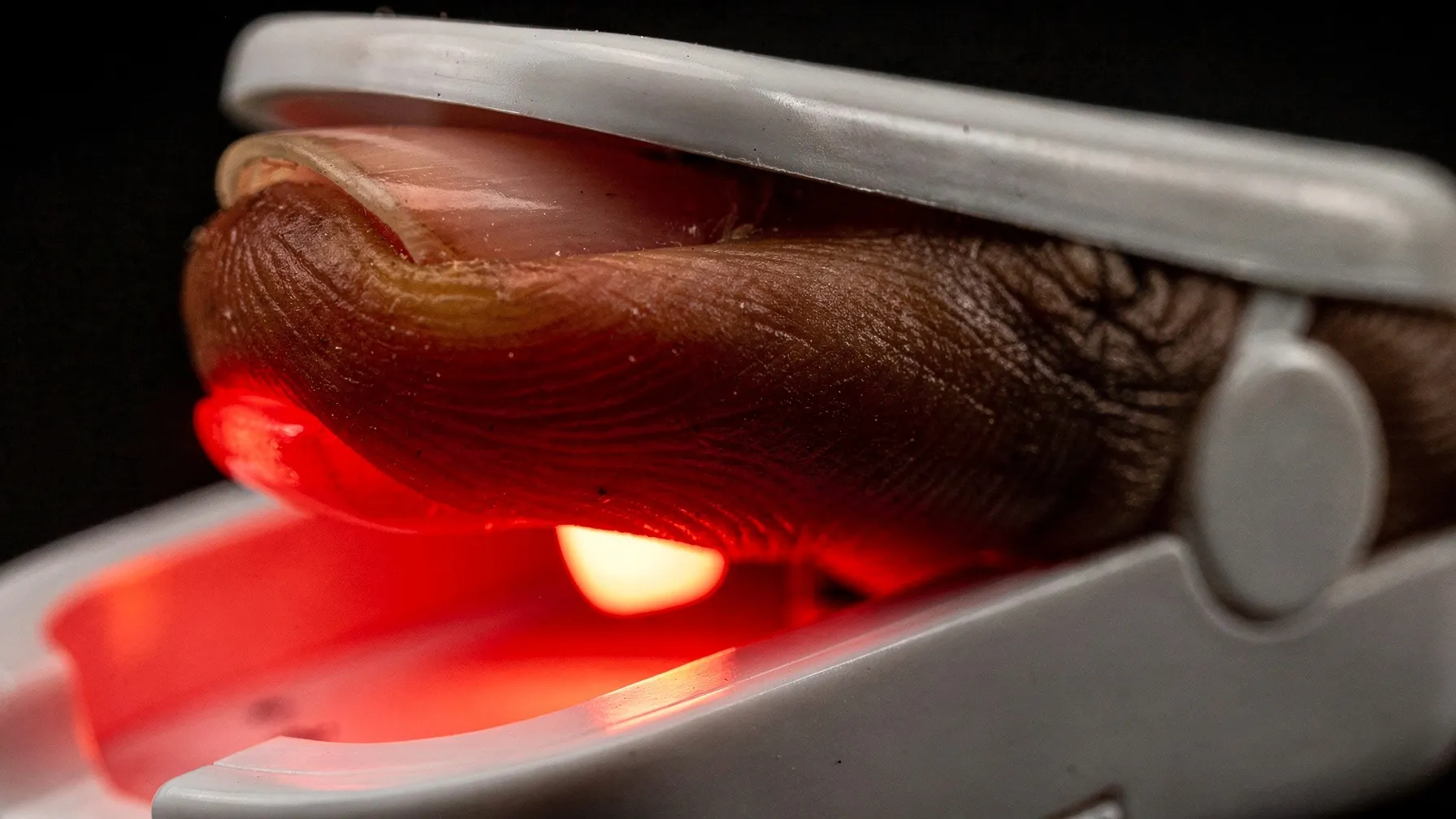
A pulse oximeter — the clip on a patient’s finger — estimates how much oxygen the arterial blood carries. It shines red and infrared light through the finger, measures how each pulses with the heartbeat, and computes a ratio. A calibration, done empirically on about ten volunteers, turns that ratio into an oxygen saturation.
A known bias
These devices overestimate oxygen levels in patients with darker skin. The consequence is more occult hypoxaemia: the real oxygen level is low enough to call for treatment, but the monitor shows a reassuring number and the treatment is not given.
The US rule for calibration (FDA, 2013) asks for at least two darkly pigmented subjects, or 15 % of the group. It is under review — an FDA advisory panel examined it in 2024.
One proposed explanation is called spectral colouring. Oximeters use LEDs, whose light covers a fairly broad band of colours — unlike a laser. Melanin in the skin absorbs some colours of that band more than others. So the colour the sensor actually receives shifts with skin tone, while the calibration assumes a fixed colour. There is recent experimental support: replacing the LEDs with narrow-band laser diodes removed the bias, on the bench and in a clinical study of 18 participants. Other mechanisms have also been proposed, and the bias may combine several.
The test
Giles Blaney and colleagues at Tufts University used the public OpenOximetry database, collected at the University of California, San Francisco: healthy volunteers whose oxygen level is lowered step by step (from about 100 % to 70 %) by controlling the gas they breathe. At each step, arterial blood is drawn as the reference, while the raw oximeter signal and the reflection spectrum of the skin are recorded.
From that data, 98 volunteers and 2,991 blood samples were usable. For each person, the team computed the melanin content of the skin from its spectrum. They then compared three calibrations, each with only two free parameters, for a fair comparison:
- the classic straight-line calibration;
- a formula derived from physics (the modified Beer–Lambert law), which ignores melanin;
- the same formula, corrected for melanin and for the width of the LED colour band — proposed on paper before, never tested on real data.
The results
- Overall accuracy is the same for all three: about 2.42 % root-mean-square error, all within the FDA limit of 3 %.
- Dependence on skin tone — how much the error grows with melanin:
- classic calibration: +2.8 points of saturation per unit of melanin;
- physics formula: +1.2;
- melanin-corrected formula: +0.1 — almost zero.
The ranking goes in the direction predicted by the spectral-colouring theory.
What this does not prove
The authors are explicit: none of these slopes is statistically significant — the uncertainty ranges all include zero. They do not claim to have measured the bias or removed it. About ten times more patients would be needed; the clinical studies that established the bias involved 1,565 and 8,392 patients.
The correction also needs a measurement of each patient’s skin tone, and knowledge of the LEDs’ colour band. And these are calibration methods: they cannot be applied directly to oximeters already in use.
A first test on real data
This is the first test on real data of a calibration that accounts for melanin. The authors’ practical advice for future calibration studies: adopt at least the physics-based formula, which replaces the straight line with no extra measurement. Their code is public.