Bado haijatafsiriwa: toleo asili la Kiingereza.
TINY WHIRLPOOLS ON THE SUN
The visible surface of the Sun, the photosphere, is never still. It is covered with granules: cells of hot plasma that rise in the middle, cool, then sink back down along darker lanes between them. In this churning, the gas also swirls.
Whirlpools of every size
Rotating plasma structures have been seen on the Sun across a wide range of scales, from several thousand kilometres down to a few hundred. They are thought to carry energy and twisted magnetic field from the surface up to the chromosphere and the corona, and may help heat these upper layers.
State-of-the-art computer simulations (the MURaM code) went further. They predicted a rich population of much smaller whirlpools, 50 to 100 kilometres across, hidden in the lanes between granules. One 2021 study even suggested that electric current sheets at their edges could efficiently heat the chromosphere. But no instrument was sharp enough to see them: the best previous observations reached structures of about 150 kilometres.
The sharpest eye on the Sun
The Daniel K. Inouye Solar Telescope (DKIST), on Haleakalā in Hawaii, has a 4-metre mirror. On 14 April 2025, a test camera from the Max Planck Institute in Göttingen recorded a small magnetic region near a dark pore, at a wavelength of 416 nanometres, at 740 images per second.
The team combined batches of 2,000 raw images into each sharp final image. The result: 143 images, one every 1.35 seconds, covering about 3.2 minutes, with a resolution of 12.3 kilometres. The field of view measured about 4,900 by 4,100 kilometres.
They then tracked how the pattern moved from one image to the next and used a mathematical test that picks out genuinely rotating flows.
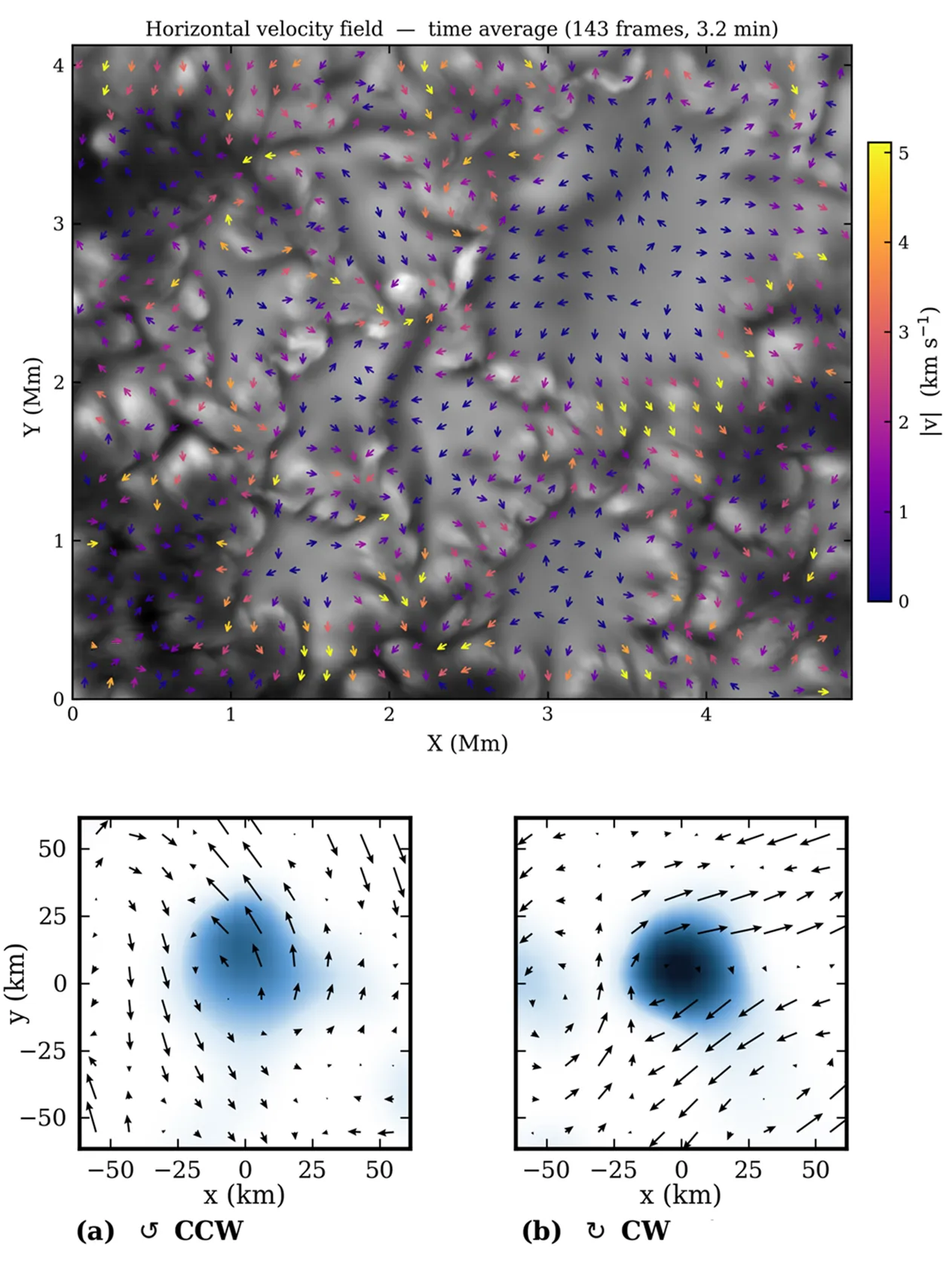
Average motion of the plasma over 3.2 minutes, with close-ups of two whirlpools turning in opposite directions. — Figure 2, Vargas Domínguez et al. (2026), arXiv:2609.30051.
What they saw
- 201 whirlpools detected, up to 7 at the same time.
- Their typical (median) diameter: 38.6 kilometres. More than 99% are smaller than 50 kilometres.
- Typical rotation period: 37.3 seconds, as the simulations predicted.
- No preferred direction: 54% turn one way, 46% the other — at these scales, the Coriolis force linked to the Sun’s rotation plays no role.
- They sit mostly in the lanes between granules, again as predicted.
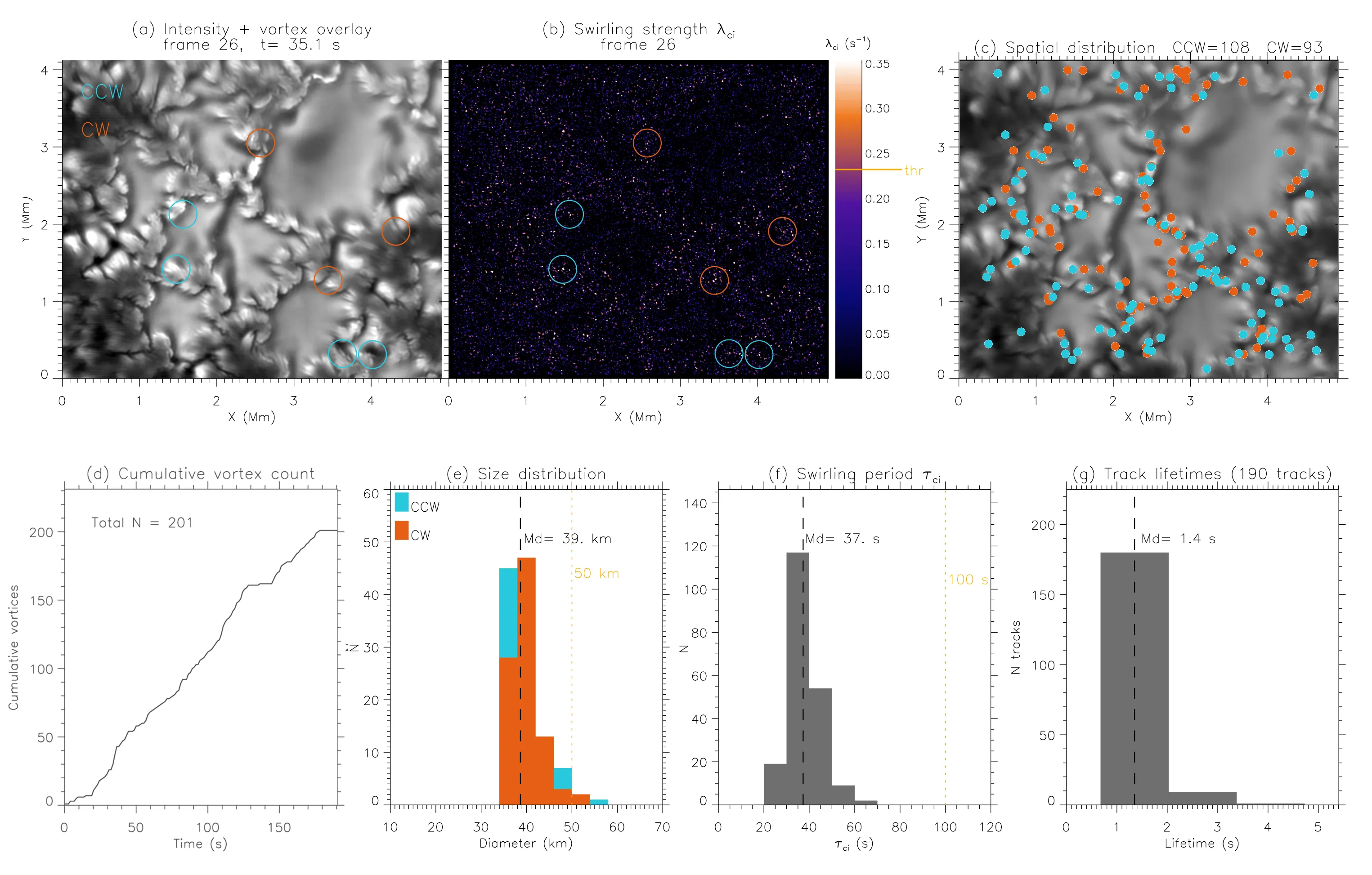
Detection summary: whirlpools found in each image, their sizes (median 38.6 km), rotation periods and lifetimes. — Figure 3, Vargas Domínguez et al. (2026), arXiv:2609.30051.
According to the authors, this is the first direct observation of these sub-granular vortices — about ten times smaller in diameter than whirlpools observed in 2008.
Next: follow them up
Simulations predict that such whirlpools launch twisting waves into the atmosphere above. The team now plans to look for their counterparts higher up, in the chromosphere. That would directly test whether these tiny vortices help heat the Sun’s atmosphere.
Limits
The data cover only 3.2 minutes and one region. The detection threshold was deliberately strict: it keeps only the most intense, compact whirlpools. Larger, slower ones visible in the movie are not counted — so there are certainly more.