Chưa có bản dịch: bản gốc tiếng Anh.
A HIDDEN GIANT NEXT DOOR?
At 3.5 parsecs, the double star 61 Cygni is one of the Sun’s nearest neighbours. Its two orange dwarfs, 61 Cyg A and 61 Cyg B, are a little smaller than the Sun and circle each other every 707 years or so. The pair also has a place in history: its large motion across the sky, first measured by G. Piazzi in 1806, led F. Bessel to the first measurement of a star’s parallax — the first distance to a star — in 1838.
Today, 61 Cygni matters for another reason. It is among the most favourable targets for future missions designed to photograph Earth-like planets in the habitable zone of nearby stars, such as the proposed SHERA, the Habitable Worlds Observatory and LIFE. Yet decades of searches, from the 1940s onward, have never confirmed a single planet there.
A wobble no star explains
In 2019 and 2022, Pierre Kervella and colleagues spotted a clue. If only the two stars were present, their motions on the sky would mirror each other exactly, scaled by their masses. Combining data from the Hipparcos and Gaia satellites, they found a mismatch: an “orbital velocity anomaly” of 88.5 ± 19.8 metres per second, significant at 4.4 sigma. Something unseen is pulling on one of the stars.
That measurement alone cannot say which star the companion orbits, nor pin down its mass: a lighter object close in or a heavier one farther out could produce the same tug.
Eliminating the impossible
Aniket Sanghi, of Caltech, and a team spanning the United States, France, the United Kingdom and India took the opposite approach to a direct detection. They generated a million possible orbits matching the wobble, then threw out every one that conflicts with what has already been observed:
- Gaia’s fit quality. A massive companion very close in would have made the stars jiggle during Gaia’s three-year survey. It did not.
- Imaging. Infrared images taken with the MMT telescope in 2006 saw nothing, which rules out bright, massive companions at wide separations.
- Radial velocities. Spectrographs have measured the stars’ back-and-forth motion since 1987. The team added about two years of new, very precise data from the NEID instrument, reaching 37 years of coverage for both stars. No planetary signal shows up — only a 49-day signal on 61 Cyg B that matches the star’s rotation.
- Stability. Each surviving orbit was simulated for a million years with both stars. Orbits tilted near 90 degrees to the stars’ own orbit, or too far out, fall apart.
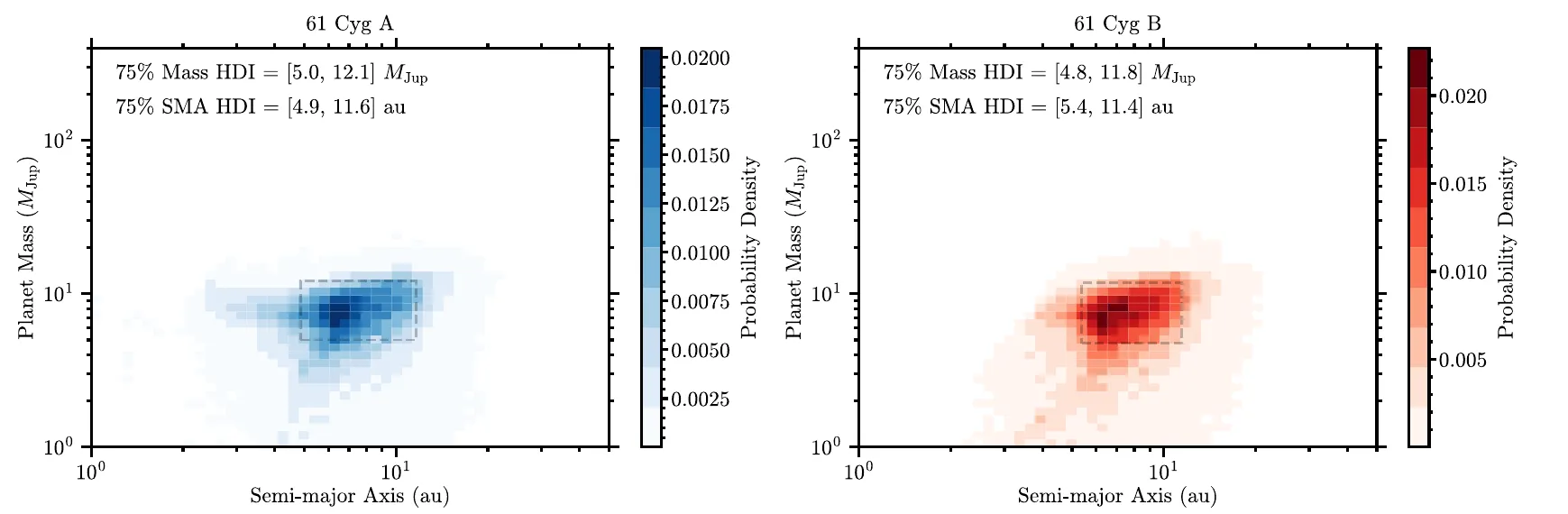
After all filters, the allowed companion clusters around 8 Jupiter masses and 8 astronomical units, whichever star it orbits. — Figure 4 (top), Sanghi et al. (2026), arXiv:2609.32893.
What survives: a cold super-Jupiter
Everything left is consistent with a super-Jupiter of about 8 ± 3 Jupiter masses, orbiting at about 8 ± 3 astronomical units — a scale similar to that of the giant planets in our own Solar System. Its orbit would take more than ten years. It could circle either star.
Since the system is about six billion years old, models of how giant planets cool give it a temperature of 282 ± 55 kelvins and a radius almost exactly that of Jupiter. It would be a dim, cold world, shining mainly by its own leftover heat.
Bad news for Earth twins — maybe
Giant planets can make or break their smaller neighbours. The team filled the habitable zone of 61 Cyg A — between 0.28 and 0.68 astronomical units, where a planet would receive between the sunlight of Venus and that of Mars — with 100 test particles, and let them evolve alongside the giant and the second star.
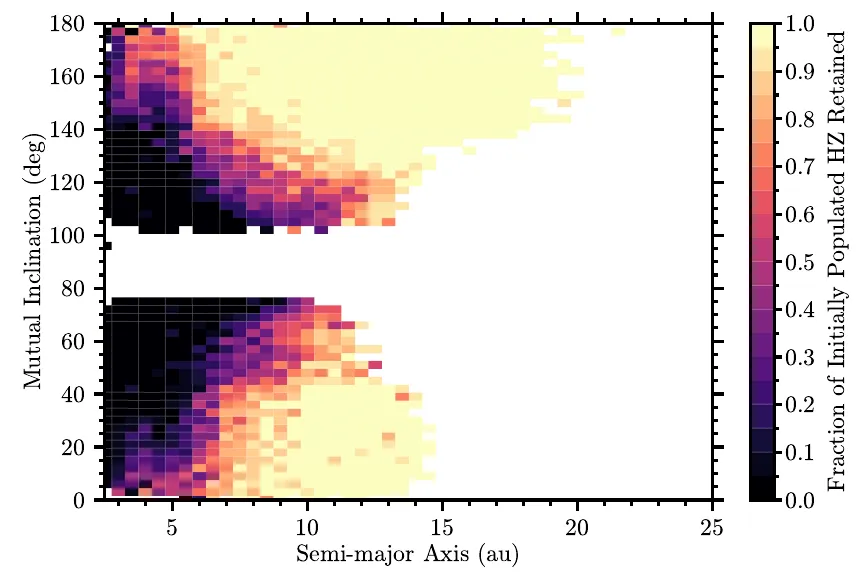
Dark regions: the giant empties the habitable zone. Close-in or strongly tilted orbits are destructive; distant, aligned ones are not. — Figure 6, Sanghi et al. (2026), arXiv:2609.32893.
If the giant orbits within about 5 astronomical units, the habitable zone is heavily disrupted whatever its tilt. Between 5 and 10, it is destabilised only if its orbit is strongly inclined, through a slow see-saw known as the von Zeipel–Lidov–Kozai effect.
A candidate, not yet a planet
The authors stress that this remains a candidate. The next Gaia data release should measure the stars’ motion three to four times more precisely, but it covers only 5.5 years — less than one orbit. Confirming or ruling out the giant will also need more radial velocities or direct imaging. For a system that future missions may scan for a second Earth, knowing whether a giant is lurking nearby comes first.