COSMIC RAYS THAT FEEL THE TIDE
When cosmic rays from space strike the atmosphere, they produce particles called muons, which rain down to the ground. Muons are tough enough to cross thick layers of rock or water. Tough, but not invincible: the more matter they have to cross, the fewer make it through. Count the muons that arrive under a mountain, a pyramid or a volcano, and you can work out how much mass sits above you. This is muography.
Following a big static object is one thing. Following a mass that changes by only a few metres, hour by hour, demands far more precision — and the muon flux also wobbles with the temperature and pressure of the air. A team from Chung-Ang University in Seoul found an ideal test: the sea itself.
A tunnel under the tide
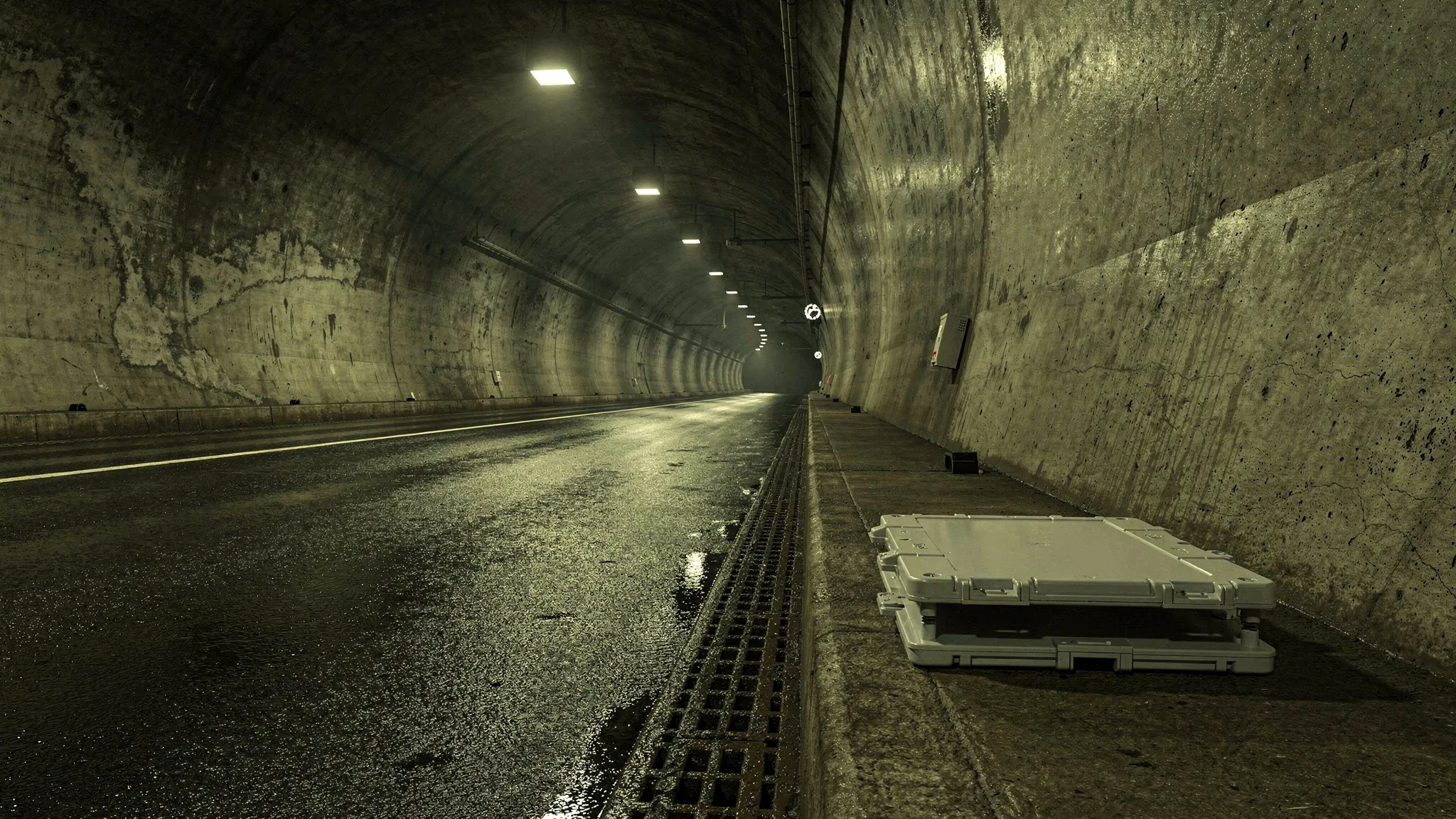
The Boryeong Undersea Tunnel, in South Korea, runs 6.9 kilometres beneath the sea off the west coast of Korea. The tides there swing by about 4 metres up and down. At one point along the tunnel, station 5593, the rock overhead is at its thinnest — 26 metres — and the seawater at its deepest, 33.8 metres. That is where the team set down their detector.
It is simple: two plastic panels, one metre by half a metre, stacked 42 centimetres apart. A muon that crosses both panels leaves a flash of light in each. The detector ran non-stop for 31.6 days, from 11 August to 12 September 2025, and recorded about 1.9 million muons — roughly 2,500 per hour.
The count follows the sea
The hourly muon count rises and falls in step with the tide, the mirror image of the sea level: high water, fewer muons; low water, more. The correlation with the official tide gauge, 6.6 kilometres away, is strong (r = −0.85).
- Each extra metre of sea above the detector cuts the muon count by 1.72 percent. A computer simulation of the tunnel predicted 1.89 percent per metre, close to the measurement.
- The dominant rhythm repeats roughly every 12 and a half hours — the main tide driven by the Moon. The two-week cycle between strong and weak tides shows up too.
- During the strongest tide of the month, the count climbed almost 9 percent above average: about 5 metres less water overhead, for a few hours.
- Adding air pressure and temperature to the model changed nothing measurable. The signal comes from the water.
The team also walked the same portable detector through the whole tunnel, ten times. The muon count drops under the deepest central section and recovers toward both entrances. A model with rock only cannot reproduce that profile; the seawater has to be included.
Seven minutes ahead
One detail surprised the analysis: the detector registers each tide about 7 minutes before the Boryeong tide gauge (a 2.6-sigma offset). Compared with six gauges along the coast, the delay follows latitude. Spread over 6.6 kilometres, it corresponds to a tide travelling at about 16 metres per second, which the authors find consistent with tides moving through shallow coastal water.
Weighing rather than measuring
A tide gauge records the height of the water at one point. Muons do something different: they weigh the whole column of matter above the detector. The authors suggest the next step — reconstructing the direction of each muon to tell a change in the total mass from a change in where that mass sits. Beyond tides, any natural system whose load shifts over time could be watched the same way, from below, without touching it.