100 MILLION DEGREES FOR THE ELECTRONS OF A COMPACT FUSION MACHINE
In a future fusion reactor that “burns” on its own, the alpha particles produced by fusion will give most of their energy to the electrons of the plasma, through collisions. How hot those electrons get, and how fast their heat leaks away, will largely decide how well the reactor works.
One way to heat electrons directly is with microwaves: electron cyclotron resonance heating, or ECRH. It is expected to matter more and more in future compact fusion devices. Yet experiments on spherical tori — very compact devices that confine plasma in a magnetic field — have mostly been heated by beams of fast neutral particles, and studied with hot ions. Plasmas in which hot electrons are heated almost only by microwaves remain, the authors write, largely unexplored.
Shot 18325
Guang Yang, Yuejiang Shi and the team of EXL-50U, a spherical torus run by the company ENN Fusion in Beijing, report one such discharge. During shot 18325, the plasma carried about 500 kiloamperes and was heated only by microwaves at 50 gigahertz, from two systems used one after the other: a first launcher of about 230 kilowatts until 0.5 seconds, then a second of about 200 kilowatts.
- While the first launcher was on, the core electrons stayed near 2 keV.
- After the switch, their temperature rose quickly. At 0.60 seconds, a laser diagnostic (Thomson scattering) measured about 10 keV at the centre. Because the error bars are large, the team keeps 8.6 keV — 100 million kelvins — as a cautious lower bound.
- The hot phase lasted about 150 milliseconds, at a very low core density of about 0.4 × 10¹⁹ particles per cubic metre, before collapsing as the current ramped down and the density rose.
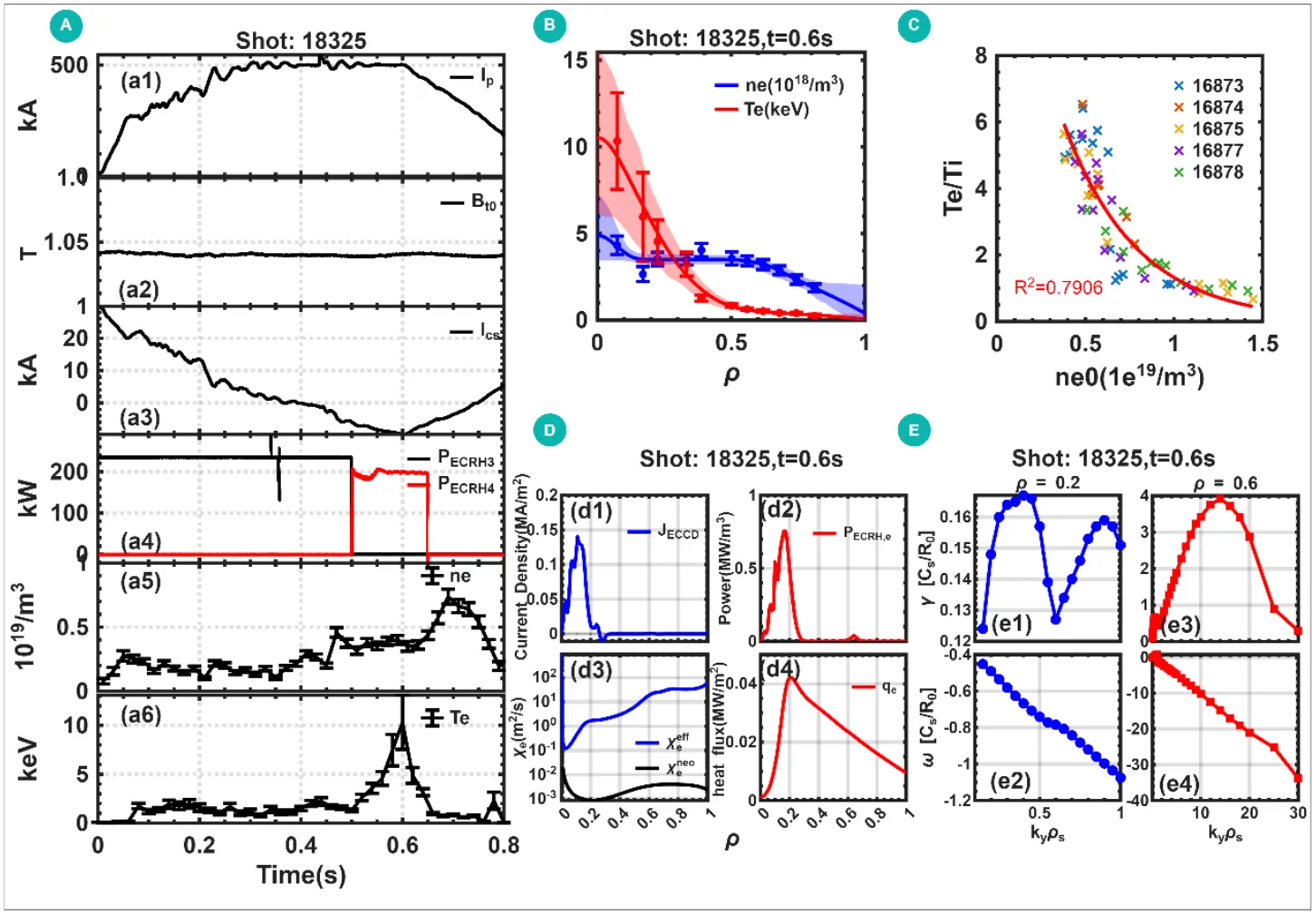
Shot 18325 on EXL-50U: the core electron temperature (panel a6) peaks near 0.6 s after the switch to the second microwave system; panel B shows the sharply peaked temperature profile. — Figure 1, Yang et al. (2026), arXiv:2610.14684.
Since the injected power barely changed at the switch, the authors attribute the jump to a change in where the second launcher deposits its energy — off the axis, according to their ray-tracing model. The exact mechanism, and whether the different polarisation of the two waves is the decisive cause, remain open.
Hot electrons, cold ions
The temperature profile is strongly peaked: it falls to about 1 keV halfway to the edge, while the density stays nearly flat. The heat is packed close to the axis.
The ions were not measured during the hot window. On the same day, an X-ray spectrometer found core ions clustered near 0.5 keV, and on nearby shots the electron-to-ion temperature ratio grew as density fell. In other words, at low density the electrons and ions of this plasma are strongly decoupled: the 100 million degrees belong to the electrons alone.
The team also modelled how heat escapes. The electrons’ heat leaks out 100 to 10,000 times faster than the simplest collisional theory predicts — what physicists call anomalous transport — but less so very close to the axis. Simulations point to two kinds of small-scale instability, one in the core and one at mid-radius; the authors stress that these are not a quantitative prediction of the heat loss.
What to keep in mind
The central temperature comes with caveats the authors spell out. The measurement is noisy at such low density; it assumes the electrons follow a normal thermal distribution, and possible “non-thermal” fast electrons produced by the microwaves are not resolved. The impurity level of the plasma was assumed, not measured.
There is also a conflict of interest to note. The authors are affiliated with ENN Fusion, the private company that operates EXL-50U, and the work was funded by an ENN company. They declare no conflicts and state that the funder had no role in the study. Still, this is a company reporting a performance milestone of its own machine, in a short preprint that has not been peer reviewed.