ELEVEN COSMIC MIRAGES WEIGH IN ON THE HUBBLE TENSION
The Hubble constant, H0, says how fast the Universe is expanding today. The most recent measurement from nearby galaxies gives 73.5 kilometres per second per megaparsec. The prediction drawn from the cosmic microwave background, the afterglow of the young Universe, gives 67.4. The two disagree by 8 to 9%. If this Hubble tension is real, the standard model of cosmology is incomplete.
The way out is a third, independent measurement precise enough to take sides.
Clocks made of light
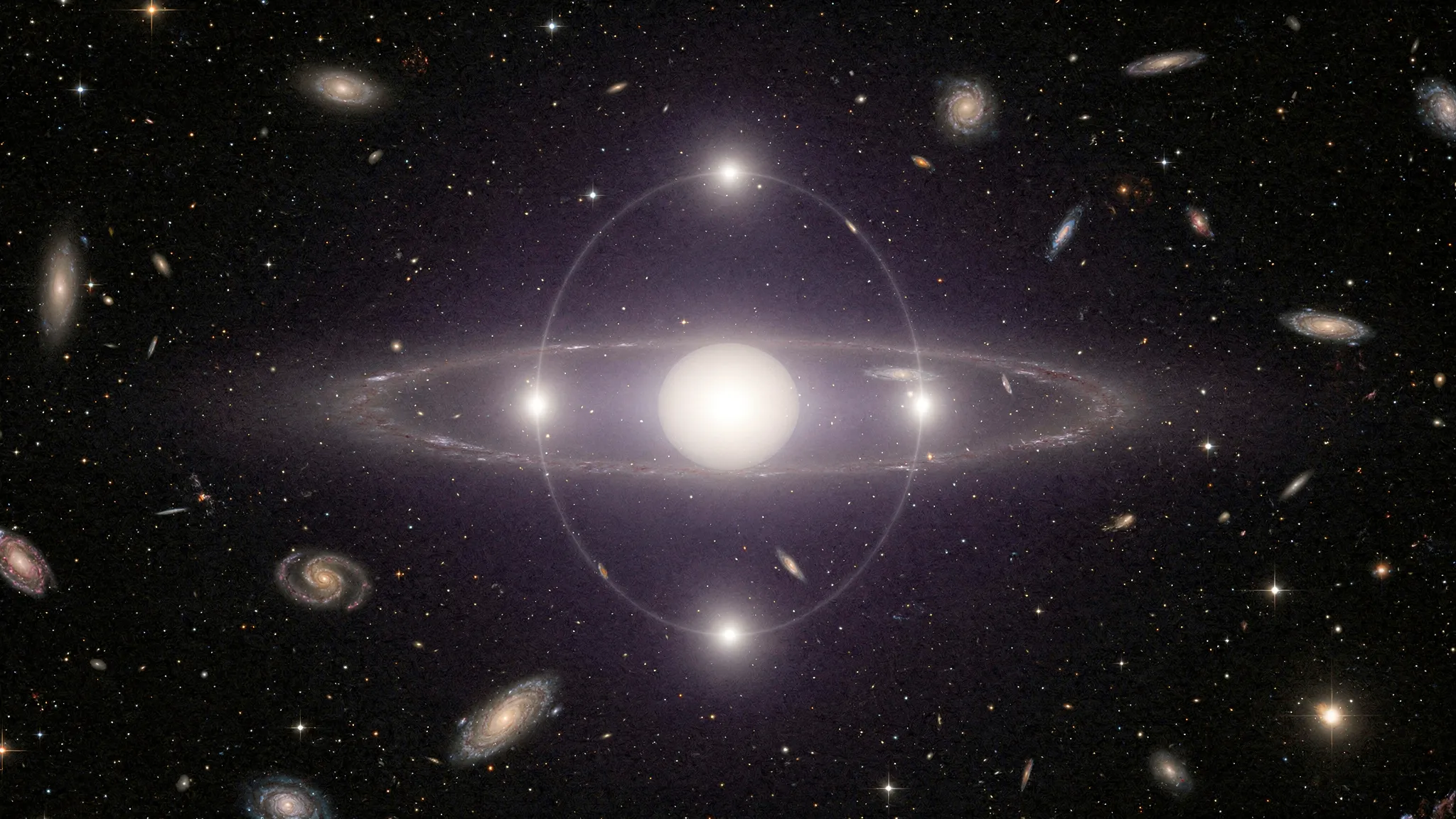
When a massive galaxy sits in front of a distant quasar — the bright core of a far-off galaxy — its gravity bends the quasar’s light into two or four images. The light rays follow paths of different lengths, so they reach us at different times. Quasars flicker; the same flicker shows up in each image after a time delay.
Those delays, together with a model of the lensing galaxy’s mass, give an absolute distance and, from it, H0. The method needs no ladder of intermediate distances and is barely affected by dust.
The degeneracy that hides in the mass
There is a catch. Many different mass profiles can produce exactly the same images while changing the delays — and therefore H0. Astronomers call it the mass-sheet degeneracy. Earlier measurements reached 2% by assuming a simple profile. When that assumption was dropped in 2020, the uncertainty jumped to 8%.
The only way to pin the mass without assuming its shape is to measure how fast the stars move inside the lensing galaxy. That is what the TDCOSMO collaboration, 28 researchers in ten countries, has been doing.
What changed in a year
Compared with their 2025 result, they have:
- 11 lensed quasars instead of 8 (nine with four images, two with two);
- maps of star motions resolved across the galaxy for 9 of them, six made with the James Webb Space Telescope’s NIRSpec spectrograph;
- sharper Webb images for three lenses;
- full two-dimensional models of the galaxies’ stellar motions, instead of spherical approximations;
- new estimates of the matter lying along each line of sight, based on simulations prepared for the Euclid mission.
The analysis was done blind: the cosmological values were masked until an internal review was complete. The result was revealed on 23 September 2026 and published without changes.
71.1, at 3.3%
Combined with a supernova sample that fixes the amount of matter in the Universe, the eleven lenses give:
- H0 = 71.1 km/s/Mpc, uncertainty 3.3% — 35% tighter than in 2025;
- 71.3 at 3.0% when 23 other lens galaxies without time delays are added;
- 72.2 at 3.0% when the supernovae are replaced by the DESI galaxy survey’s distance measurements.
With the lenses alone and no outside data, the value is 70.6 at 4.9%. Varying the analysis choices one by one shifts H0 by less than one standard deviation. According to the authors, only the local distance ladder is more precise among late-Universe probes.
Which side?
The result lies within one standard deviation of the nearby-galaxy measurements and 1.6 sigma above the early-Universe prediction — 2.2 sigma in the most precise combination. A companion paper, not covered here, combines it with other late-Universe probes and reports a tension with the microwave background of about 2.7 sigma or more.
The lenses can even calibrate the DESI survey’s cosmic ruler without the microwave background. They give a sound horizon of 140.7 ± 4.3 megaparsecs, about 1.5 sigma below the value inferred from the Planck satellite.
A nudge on dark energy
Repeating the analysis with dark energy allowed to vary, H0 barely moves. Combined with DESI and the supernovae, the data mildly disfavour a dark energy that stays perfectly constant, by 2.3 to 2.5 sigma — suggestive, well short of a discovery. Measuring dark energy properly with this method will need far more lenses, expected from Euclid, the Rubin Observatory and the Roman telescope.
The authors note that the new value agrees with all their earlier blind measurements, despite new data, new methods and new people. The paper has been submitted to Physical Review D; the data will be released once it is accepted.