ULTRASOUND READS A CHEESE SLICE WITHOUT TOUCHING IT
Texture is what makes a cheese: its firmness, its springiness, the way it melts. In dairy cheese, it comes from a complex inner structure, a ripened network of milk protein filled with fat droplets and water. Most plant-based cheeses are built differently, from starches, coconut oil and thickeners set into a gel, often with little or no protein. Consumers keep naming texture as the main reason they do not switch.
The authors give the stakes: dairy cheese emits about 24 kg of CO₂-equivalent per kilogram, against less than 2.5 kg for the ingredients of typical plant-based alternatives, and US retail sales of plant-based cheese grew by more than 70% between 2018 and 2020. Yet improving their texture is slow. The standard test, texture profile analysis, squeezes a sample twice like two bites, and destroys it. Testing dozens of recipes that way takes time and money.
Listening through a slice
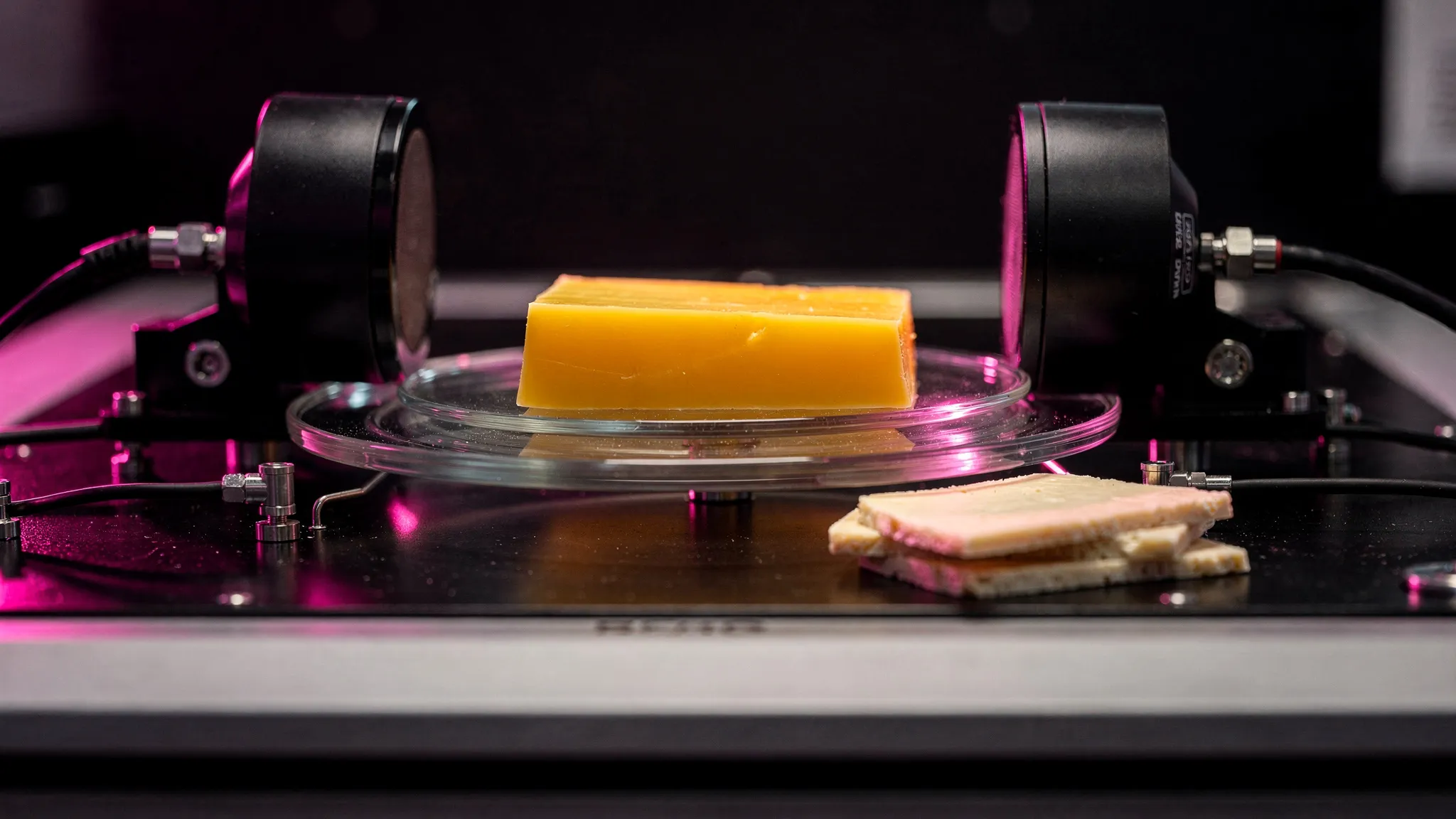
Wenjing Feng, Thomas Hazlehurst and Nik Watson, of the University of Leeds and the UK’s National Alternative Protein Innovation Centre, used air-coupled ultrasound: two transducers facing each other, 125 mm apart, sending a 100 kHz sound wave through the air and through the slice, with no gel or contact. Moving them across a 20 × 20 mm area takes about one minute and produces two images: how much sound gets through, and how long it takes.
They bought 13 sliced cheeses in Leeds supermarkets — nine dairy, from mature Cheddar to mozzarella, Emmental and Red Leicester, and four plant-based — and scanned 119 slices three times each, before crushing samples from the same spots in a texture analyser.
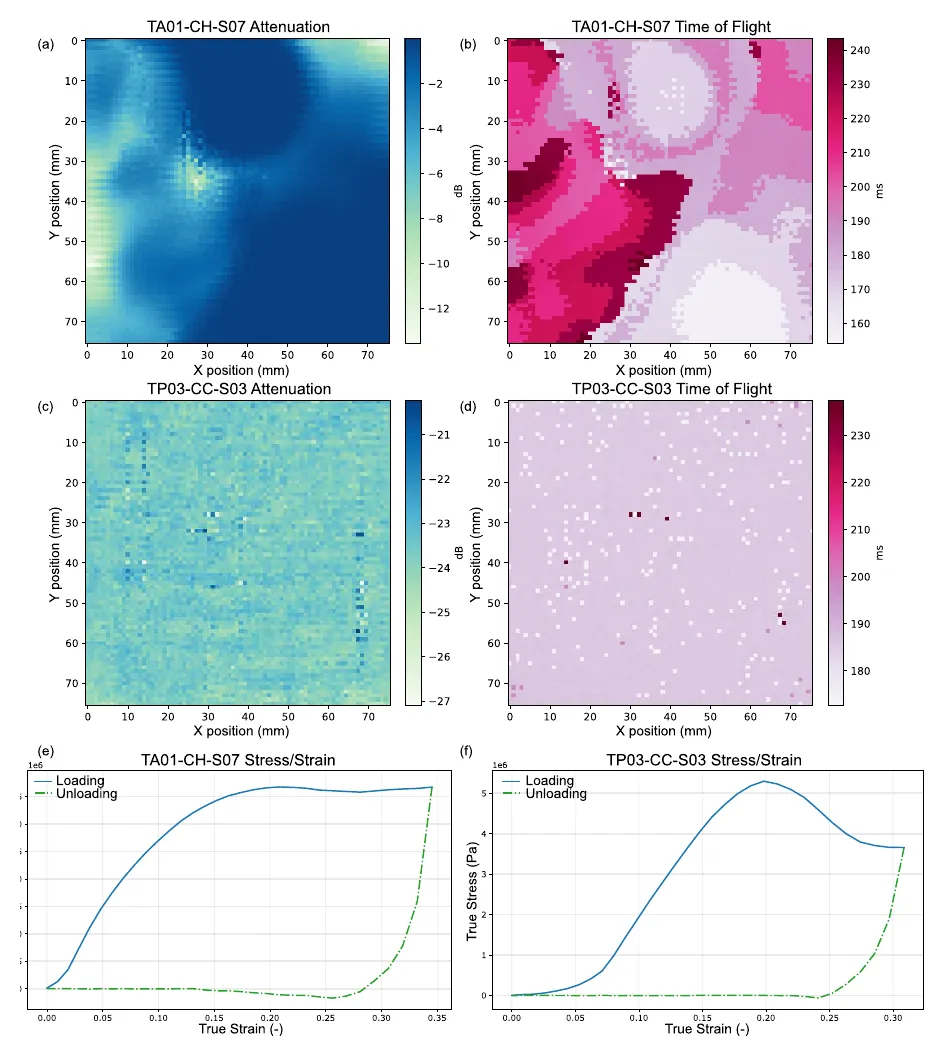
Mature Cheddar (top) shows acoustic domains several millimetres wide; a plant-based slice (middle) is a uniform speckle. Bottom: the Cheddar yields and holds a plateau, the plant slice peaks then softens. — Figure 3, Feng, Hazlehurst & Watson (2026), arXiv:2610.19924.
Patches of curd, a uniform gel
The difference shows at once. In mature Cheddar, the transmitted sound varies by about 10 decibels within a single scan, organised into patches several millimetres across. The authors link them to Cheddar’s structure: fused curd particles whose junctions are richer in protein and poorer in fat. The plant-based slices show nothing of the kind — a fine, structureless speckle — and they absorb 15 to 20 decibels more sound.
The squeeze tests reveal a second difference. Mature Cheddar rises to a plateau of about 3.7 megapascals and deforms like soft plastic. The Cathedral City plant-based slice climbs higher, to about 5.3 MPa, then softens by a third: a stiff, brittle gel that cracks inside. It is actually firmer than the Cheddar.
Not softer — narrower
Across all products, average firmness is about the same for dairy and plant-based cheese. What differs is the range. Dairy firmness spans a 7.5-fold range, from smoked Cheddar slices to Emmental; the four plant-based products sit in a narrow central band, a 1.9-fold range. None reaches the soft end (mozzarella, smoked Cheddar, hard Gouda) or the hard end (Emmental). The gap, the authors conclude, is one of range and of the way the cheese fails, not of average firmness — a more precise statement than “plant-based cheese is softer”.
No single ultrasound number tracks texture across such different products. So the team trained a compact convolutional neural network to turn the two images directly into the full squeeze curve, loading and unloading.
A texture map, with an empty corner
On slices it had never seen, the network reproduced the curves of all thirteen products with no calibration for each one. Mozzarella was its clear failure: it predicted a Cheddar-like curve, overestimating the stress by about 65%, because mozzarella’s acoustic signature looked like the crowd’s.
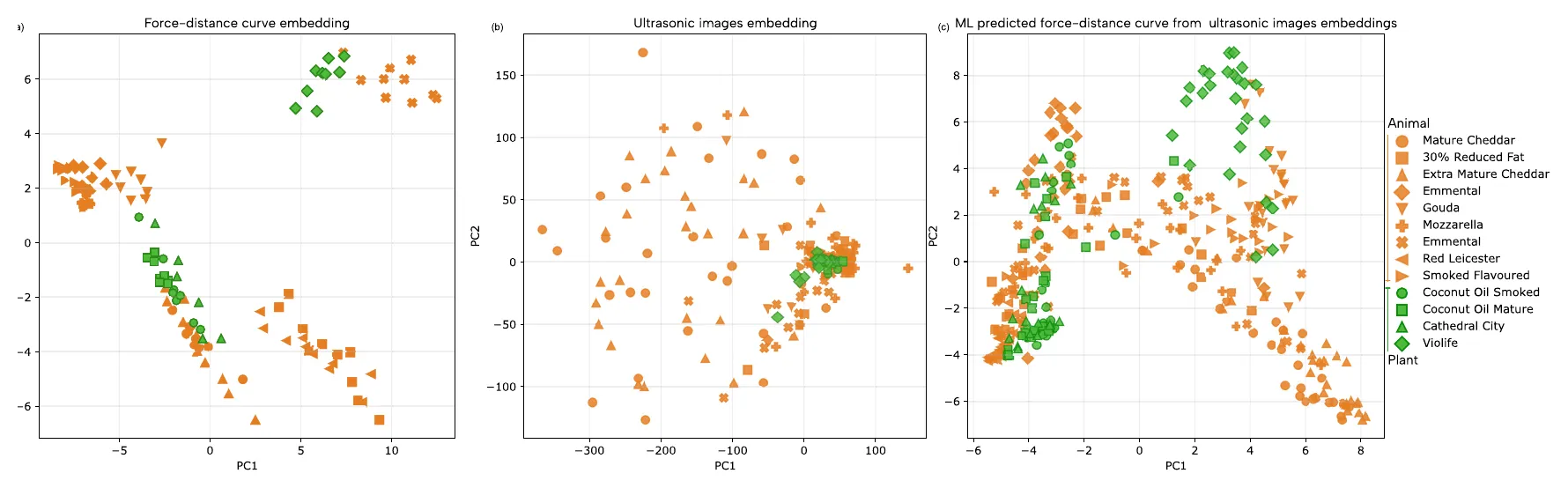
Texture maps built from measured curves (left), raw ultrasound images (middle) and curves predicted from the images (right). Plant-based slices (green) form a Cheddar-like group and a separate Emmental-like group (Violife). — Figure 6, Feng, Hazlehurst & Watson (2026), arXiv:2610.19924.
Placed on a map, the predictions recover the main picture. Three plant-based slices sit with the Cheddars; Violife sits with Emmental, whose curve shape it shares; and the soft, mozzarella-like corner stays empty. The limits are clear: one shop purchase per product, only slices of products the network had already seen, and no melting or stretching tests — precisely where plant-based cheese differs most. But the authors see a one-minute, contact-free test suited to quality control on a production line and to screening new recipes, pointing developers at the textures nobody has made yet.