WHEN SEA BUBBLES LAUNCH TOXIC ALGAE INTO THE AIR
Along some coasts, harmful algal blooms come with a public health problem: a growing number of reports of respiratory irritation among people living or working by the sea. One culprit is a microalga, Ostreopsis cf. ovata. It has bloomed along Mediterranean shores for more than 20 years and has recently settled on the Atlantic coast, with a first documented outbreak in the Bay of Biscay in 2021. Its cells make potent toxins, which dissolve in seawater but are quickly broken down by sunlight and bacteria.
Dissolved toxins are known to reach the air. Whether particles — whole cells or fragments — carry toxins too was unknown.
Cells in the beach air
During an Ostreopsis bloom in July 2025, at the Erromardie and Mayarco beaches in Saint-Jean-de-Luz, on the French Basque coast, the team installed an air sampler 20 metres from the shoreline at high tide. On three sampling days it systematically caught intact and broken Ostreopsis cells. Assuming a person breathes a cubic metre of air an hour, that is up to about twenty cells inhaled per hour by beachgoers, coastal workers and residents.
The jet from a bursting bubble
Sea spray is the main bridge between ocean and atmosphere. Wind tears drops off wave crests, and bubbles bursting at the surface throw out two kinds of drops. First the thin film capping the bubble shatters into tiny droplets. Then the open cavity collapses within milliseconds, and its bottom shoots up a fast, thin jet that breaks into larger jet drops.
Experiments with bacteria and microplastics had shown that the first jet drop is often richer in particles than the water — up to several hundred times. The usual explanation is a surface effect: the rising bubble sweeps up particles on its skin. But that explanation does not account for how cells as large as Ostreopsis, about 35 micrometres across, end up in drops of 100 to 800 micrometres.
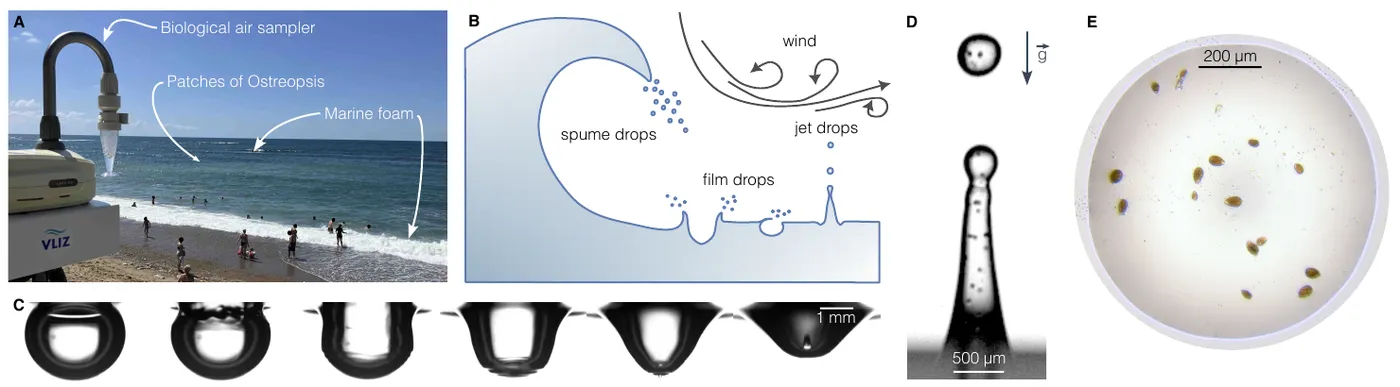
A: the air sampler on the beach. B: the three ways the sea makes spray. C: a bubble cavity collapsing. D: a jet breaking up in an Ostreopsis culture (dark dots are cells). E: the first drop under the microscope, carrying several swimming cells. — Figure 1, Figà Talamanca et al. (2026), arXiv:2610.29719, CC BY 4.0.
One bubble at a time
Elettra Figà Talamanca, Juliette Pierre and Hélène de Maleprade, at the Institut Jean Le Rond d’Alembert (Sorbonne University and CNRS, Paris), with oceanographers from Villefranche-sur-Mer and the Flanders Marine Institute, released single bubbles into algal cultures, filmed the jets at up to 40,000 frames per second under red light, and caught the first drop on a glass slide to count the cells under a microscope.
Their main test subject was a harmless, well-studied freshwater alga, Chlamydomonas reinhardtii, about 8 micrometres across. They varied bubble size, the depth the bubble rises from, and algal concentration over four orders of magnitude, then added three marine species of different sizes and shapes.
Two regimes
- The first drop always captures algae, from none up to a thousand cells.
- In dilute water, it is about ten times richer than the culture, close to the value measured for microplastics — a figure obtained on the small freshwater alga used as a model. The large marine species, Ostreopsis among them, were measured in already crowded water and gave enrichments about ten times lower — around one or less.
- In crowded water, from about 100,000 cells per millilitre, the enrichment — how many times richer in algae the drop is than the water — drops sharply — a behaviour the authors say had never been reported. The bigger the cells, the sooner it happens.
- Swimming plays no role: chemically fixed, motionless cells behaved the same, and changing the length of their flagella — the two whip-like tails they swim with — changed nothing. Proximity to the bubble’s surface does not seem to be the key.
Cells that overtake the jet
High-speed films of Ostreopsis in a jet gave the answer. Some cells start outside the part of the jet that will become the first drop — and catch up with it before it detaches. The core of the jet rises faster than its tip, which gravity slows down, so cells pile up at the top.
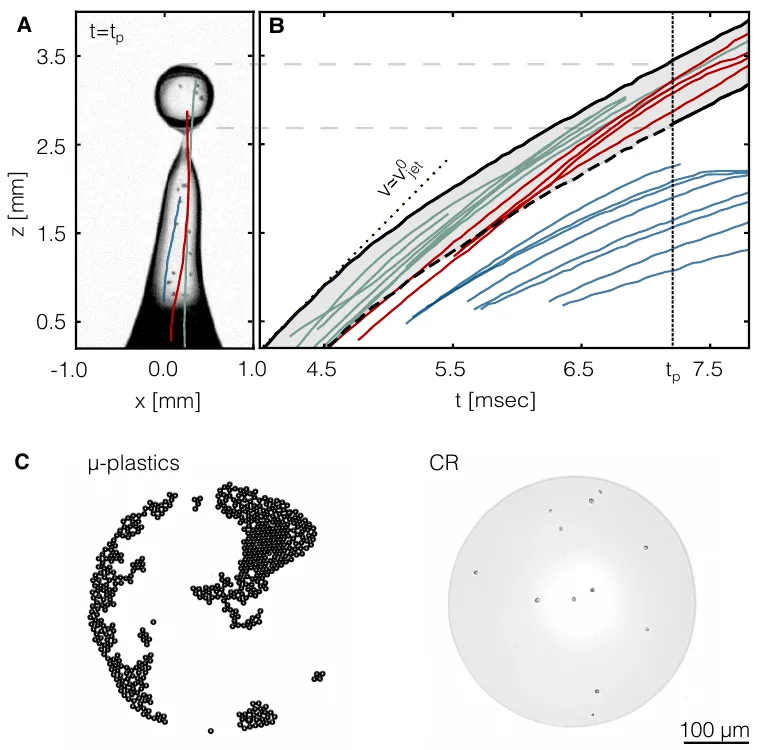
A–B: cells tracked inside a jet; red trajectories enter the future first drop (grey band) before it pinches off. C: in identical conditions, microplastics (left) are far more concentrated in the drop than algae (right). — Figure 3, Figà Talamanca et al. (2026), arXiv:2610.29719, CC BY 4.0.
Treating the jet tip as a reservoir filled by this flow gives a simple law. It predicts an enrichment of about 5, without any adjustable parameter — the right order of magnitude for a model with nothing fitted, within a factor of two of the measurements — and it explains why very small drops can be extremely enriched.
In crowded water, the drop simply fills up. But algae behave as if they were about ten times larger than their bodies, and the physical cause of that factor remains open. Microplastics of the same size do not saturate: in identical conditions, the drop was 3.4 times richer than the water for microplastics, but 25 times poorer (an enrichment of 0.04) for algae.
A particle route for toxins
The study shows that sea spray can lift whole toxic Ostreopsis cells into the air, a possible particle pathway for airborne toxicity during blooms. How much it adds to dissolved toxins is the next question, along with the other kinds of spray drops.