A BLACK HOLE WEIGHED 470 MILLION YEARS AFTER THE BIG BANG
Quasars powered by black holes of billions of solar masses already existed when the universe was less than a billion years old. How they grew so big, so fast, is one of the open puzzles of astronomy. Wide-field surveys have found hundreds of these monsters, but only the most luminous ones.
The James Webb Space Telescope changed the picture. It can see much fainter active galactic nuclei — galaxies whose central black hole is feeding — by catching broad emission lines: light from gas orbiting so fast near the black hole that its spectral lines — the precise colours each element emits — are smeared out. Many of these objects are compact, very red-looking sources nicknamed “Little Red Dots”, whose nature is still debated.
A search without a shortcut
Xingyao Cai, Akio K. Inoue, Masafusa Onoue and colleagues, led from Waseda University in Tokyo, went through the public spectra of the DAWN JWST Archive: 1,247 sources with secure distances between redshift 6 and 10.3 — redshift, written z, measures how much the expansion of the universe has stretched their light: the higher it is, the farther away the source and the further back in time we see it. They did not pre-select by colour or size. For each spectrum they asked whether a model with a broad hydrogen line fits better than one without. 66 candidates passed.
The most distant is MoM-BL-z10, observed in the “Mirage or Miracle” program, at redshift z = 9.9837 — when the universe was only 470 million years old.
Its broad hydrogen-beta line, emitted as visible blue-green light, reaches us stretched about elevenfold (1 + z), into the infrared, at 5.35 micrometres, just beyond the 5.3-micrometre cut-off of Webb’s standard processing. It was only visible because the archive’s reduction recovers that extra stretch of spectrum.
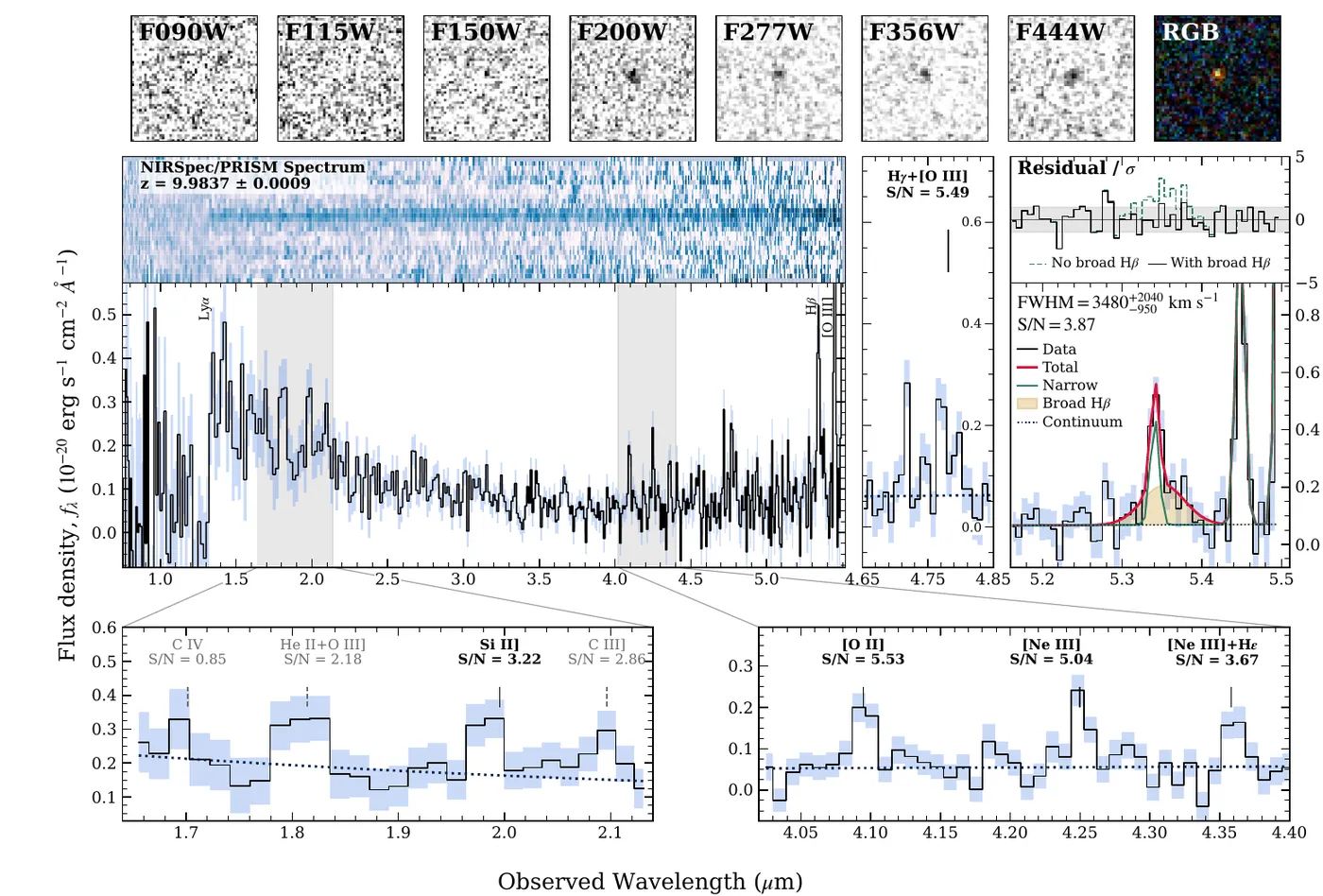
Webb images of MoM-BL-z10 in seven filters (top) and its spectrum, with the broad hydrogen-beta line fitted on the right. — Figure 1, Cai et al. (2026), arXiv:2610.28735, CC BY 4.0.
Weighing the black hole
The broad line is detected at a signal-to-noise ratio of 3.87, barely above the threshold of 3 the authors had set. Light from gas coming towards us is shifted one way, from gas moving away the other (the Doppler effect), so the line’s width is measured as a spread of speeds: 3,480 kilometres per second (with large uncertainties: −950, +2,040). Ratios of other lines, from neon and oxygen, place the object among active nuclei rather than ordinary star-forming galaxies.
Combining the speed of the gas with the brightness of the source, which sets the size of the region the light comes from, gives a “virial” mass — the first such estimate at redshift 10:
- with the standard recipe used for quasars, about 36 million solar masses (3.6 × 10⁷, between roughly 19 and 94 million), feeding at 11% of its theoretical maximum rate, the Eddington limit — the ceiling beyond which the light from the infalling matter pushes the gas away and starves the black hole;
- with a recipe proposed for Little Red Dots, and assuming it feeds at that maximum, about 2.1 million solar masses — 17 times less.
The object looks compact and has the colours expected of a Little Red Dot, but the authors decline to classify it as one with the current data.
Too heavy, too early
The team traced back how such a black hole could have grown, starting at redshift 25, long before the 470 million years at which it is seen. From a light seed — the remnant of a star of 10 to 100 solar masses — reaching 36 million solar masses requires an average rate about twice the Eddington limit. A heavy seed of 10,000 to 100,000 solar masses, perhaps born from the direct collapse of a gas cloud, could get there while feeding at the limit. At its observed rate of 11%, it could never have grown this big: it must have eaten faster in the past.
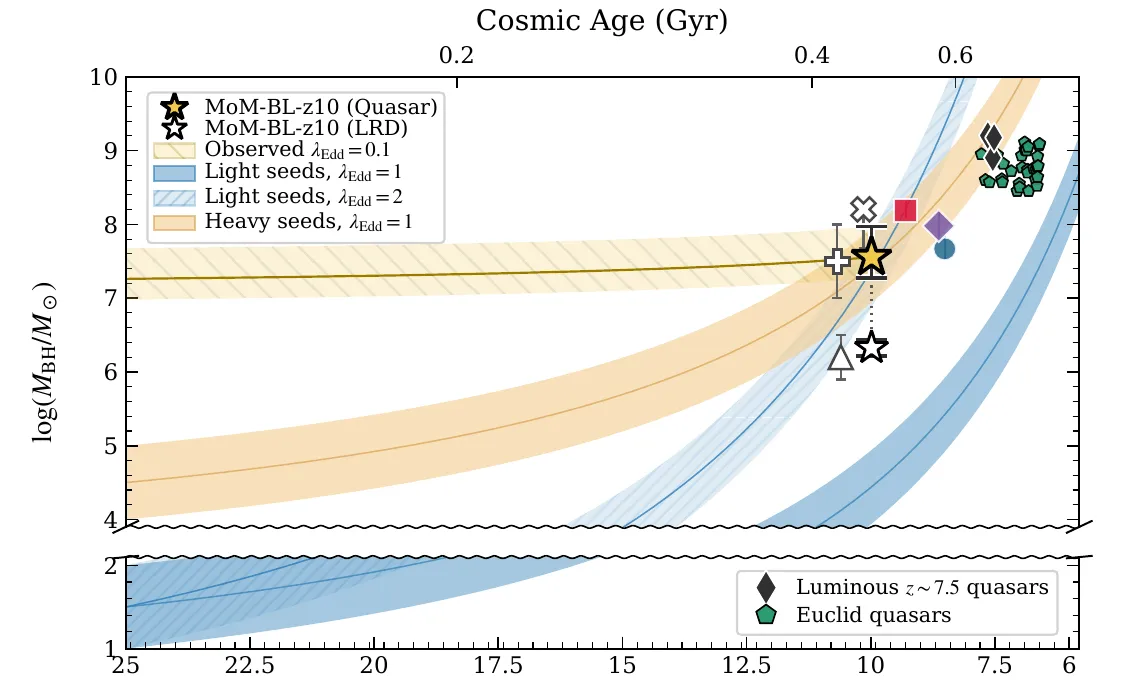
Possible growth histories: the yellow star (standard mass) sits where light seeds need super-Eddington feeding and heavy seeds suffice. — Figure 5, Cai et al. (2026), arXiv:2610.28735, CC BY 4.0.
Even the lower mass remains hard to reach from a stellar seed growing at the limit.
At the edge of what Webb can do
MoM-BL-z10 is now the most distant broad-line active nucleus known, beyond CAPERS-LRD-z9 at z = 9.29. Two earlier candidates near redshift 10, UHZ1 and GN-z11, never showed a securely detected broad line. Because the hydrogen line here sits at the very edge of Webb’s spectrograph, the authors suspect that redshift 10 may be close to the practical limit for finding faint black holes this way. A larger search, with a full catalogue, is in preparation.