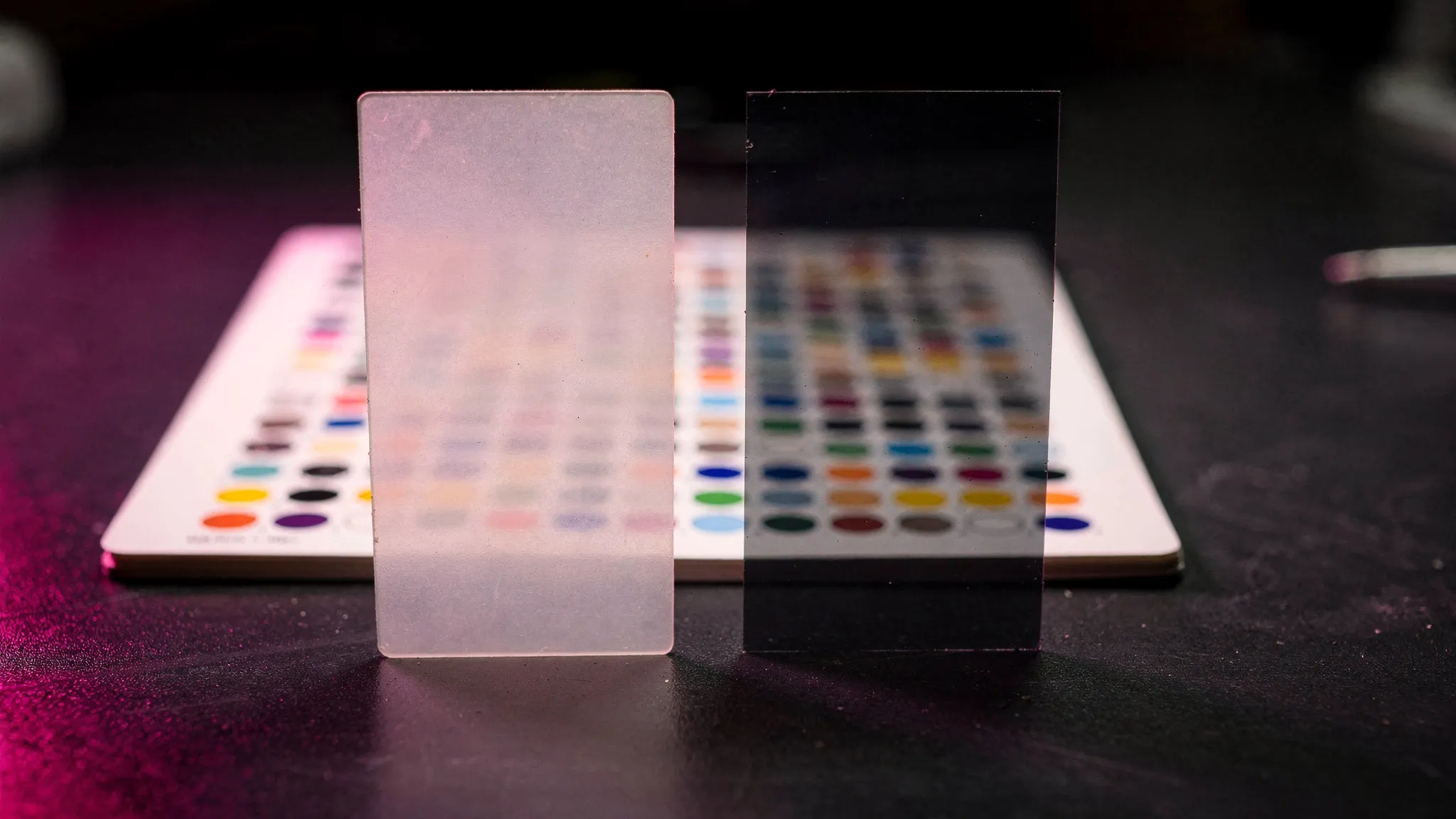
A POLARIZING FILTER SHARPENS THE VIEW THROUGH TRANSPARENT WOOD
A sheet of balsa wood one millimetre thick, stripped of its lignin — the component that absorbs light — and filled with a clear plastic, lets you make out a building about 200 metres away.
Yet the view stays milky. Optics calls this haze: the share of light that gets through but is knocked off the straight path. The more haze, the blurrier the image. For a team at KTH Royal Institute of Technology and Stockholm University, in Sweden, haze is what still separates this material from “wooden glass”, a renewable option for windows — ordinary glass, they note, takes a lot of energy to make and depends on a finite resource, riverbed sand.
Ninety per cent through, much of it astray
Their plastic, PMMA, is doped with a molecule called phenanthrene. This raises its refractive index — a number that sets how strongly a material bends light — to about 1.53, close to that of the wood’s cell walls. When two materials share the same index, light crosses between them without bending. The wood makes up only 8% of the volume.
In ordinary, unpolarized light, the sheet transmits about 90% of green light (wavelength 550 nanometres) and about 92% of deep red light, towards 800. Haze, however, falls only from about 60% in violet light (400 nanometres) to 43% in green and about 30% in deep red. By the authors’ count, with rare exceptions, the best haze so far for cellulose-rich samples at least a millimetre thick hovers around 50%. Practical wooden glass, they write, needs at least ten times less.
Turning the light’s vibration
Light is a wave whose electric field oscillates in a given direction: its polarization. A polarizing filter passes only one direction. The team rotated that direction from 0° (along the wood fibres) to 90° (across them), collecting the light that came out with an integrating sphere, a hollow sphere that gathers it from every direction.
- Across the fibres, haze drops to about 21% in deep red light, near 800 nanometres — approaching, the authors note, the level of soiled glass.
- Along the fibres, haze stays much higher and hardly changes with wavelength.
- With a separate laser at 532 nanometres, haze falls from 55.9% at 0° to 40.7% at 90°; unpolarized light gives about 45%.
- The total light transmitted barely moves. Only the share that is deflected changes.
A certified reference sample gave the same haze in both polarizations, so the effect does not come from the instrument. A sheet made with ordinary, untuned PMMA stays hazy either way: about 86% along the fibres, 79% across.
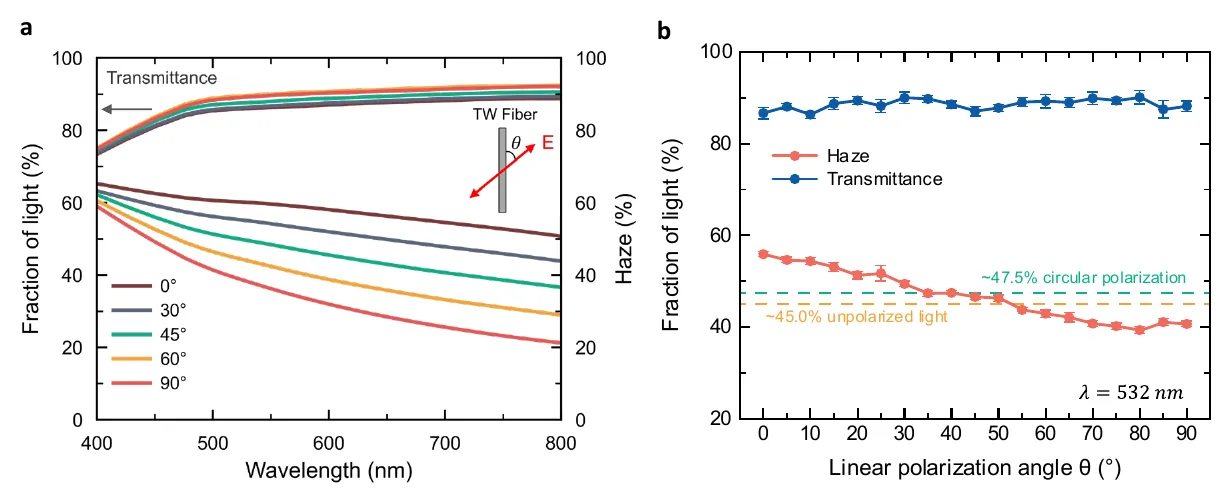
Haze falls with wavelength, fastest when light is polarized across the fibres (90°) and barely at all along them (0°); at 532 nanometres it drops from about 56% to 41% while transmittance stays between 86% and 90%. — Figure 2, Song et al. (2026), arXiv:2610.33459.
One index along the fibres, another across
The culprit is cellulose, the crystalline skeleton that gives the composite its strength. Cellulose is birefringent: its refractive index depends on the polarization. With the representative values used in the paper, the plastic sits at about 1.53, cellulose at about 1.52 across the fibres and 1.58 along them: a mismatch of 0.01 one way, 0.05 the other. Light vibrating across the fibres therefore meets an almost matched material and is barely deflected; along them, the five-times-larger mismatch scatters it.
Across the fibres, haze falls as one over the wavelength squared, plus a constant of about 8 percentage points that may come from surface roughness (a near-perfect fit: R² = 0.994, where 1 is perfect). In the classical Rayleigh limit, which treats the scatterers — the tiny features that knock light off course — as vanishingly small, the law would be far steeper: one over the wavelength to the fourth power. The gentler slope instead fits weakly contrasting specks of finite size, described by a model called Rayleigh–Gans–Debye. Applied to thin cylinders, with a mismatch of 0.02 down to 0.01, it gives a typical size of 50 to 200 nanometres — an estimate resting on assumptions, not a measurement. That is far smaller than the wood’s cell cavities, about 30 micrometres wide: the scatterers sit inside the cell walls.
Air gaps would do the opposite: thin gaps along the fibres would scatter light polarized across them the most. Electron microscope images show no obvious gaps between plastic and walls in the regions examined.
A patchwork inside the wall
With scanning electron diffraction, an electron beam crosses a slice 200 nanometres thick every 30 nanometres; the pattern at each point shows whether ordered cellulose is there. The team compared sheets made with and without a soak in sodium hydroxide, which swells the walls so the plastic can get in. Cellulose signals appear at 98% of positions without the soak, 51% with it.
The treated walls form a patchwork: sharp crystalline spots beside areas with weak or no signal, perhaps rich in plastic. The soak remains essential, since it lets the plastic fill pores that would scatter far more strongly. The authors’ aim is to keep it while making neighbouring patches optically alike.
Light that goes straight
Laser pulses lasting 150 femtoseconds (millionths of a billionth of a second), polarized across the fibres, were timed as they came out; light zigzagging through the wood would arrive late and smear each pulse. Shifting the collecting slit 0.70 millimetre off-centre cut the light to 19% of its central value, yet the pulses stayed 5 to 8 picoseconds (trillionths of a second) wide — little more than the camera’s own blur of about 4 picoseconds — with no stretching — unlike natural wood in earlier measurements. The light takes nearly straight paths. At about 20% haze, the authors estimate the chance of a photon being scattered twice in the sheet at a few per cent.
A filter instead of a new recipe
The team then photographed a logo and a colour card 30 centimetres behind the sheet, in room light.
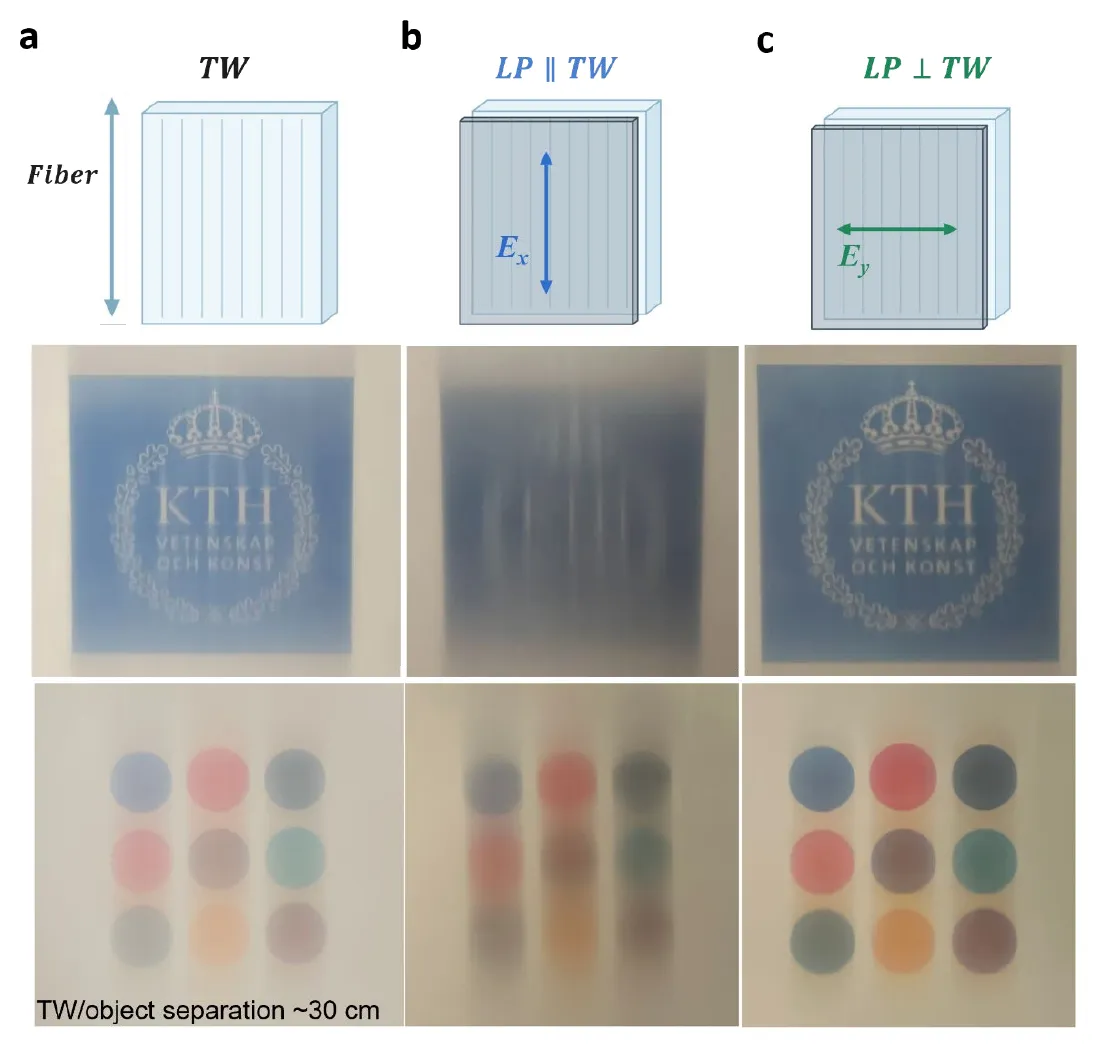
The same logo and colour card seen through the sheet alone (a), with a polarizer along the fibres (b) and across them (c), 30 centimetres away. — Figure 5, Song et al. (2026), arXiv:2610.33459.
Through the bare sheet, the logo is recognizable but its lettering is soft. With the filter along the fibres, the logo gets even blurrier. Turned across them, the letters sharpen and the edges between colours firm up — in a dimmer picture, the price of keeping only one polarization.