THE GLASSY DUST OF AN INTERSTELLAR COMET
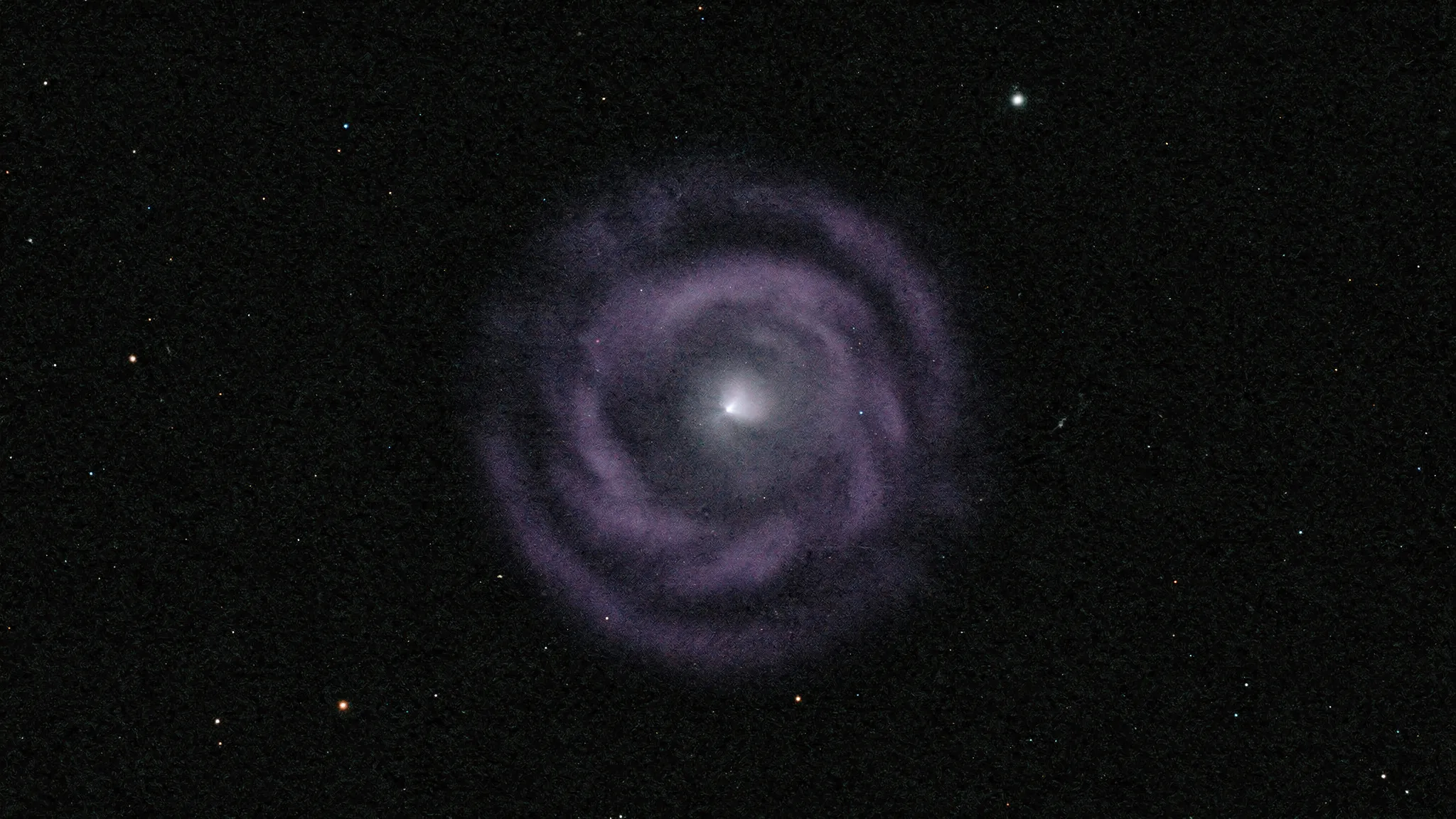
Interstellar objects are small bodies born in other planetary systems, under other chemical and physical conditions. When one crosses the Solar System, it brings material from elsewhere close enough to study in detail. 3I/ATLAS is the third one documented, after 1I/’Oumuamua in 2017 and 2I/Borisov in 2019.
Several studies had already found that 3I/ATLAS is unlike our comets: unusual proportions of isotopes — heavier and lighter variants of the same atom — of hydrogen, carbon and nitrogen in its gas, and abundant carbon dioxide. Together, these point to a birth at 30 kelvin or colder, in an environment relatively poor in heavy elements. Those were clues from its gas. Cristina Thomas, of Northern Arizona University, and colleagues from NASA, ESA and several universities looked at what it is made of in solid form: its dust.
A difficult spectrum
On 16 December 2025, after its closest approach to the Sun, the comet was 2.21 times the Earth–Sun distance from the Sun. The James Webb Space Telescope recorded its light between 5 and 14 micrometres (thousandths of a millimetre) with its mid-infrared instrument, MIRI, for about seven and a half minutes.
The comet was neither a point nor a broad patch: a nucleus wrapped in a fuzzy cloud of dust. The standard processing for extended objects left a sawtooth pattern between 10 and 12 micrometres, exactly where the key signal lies. The team rebuilt the spectrum as a point source, then corrected for the fact that the dust cloud spreads its light beyond a single point.
A smooth bump
Warmed by the Sun, to about 198 kelvin here, dust glows in infrared light. Silicates — the minerals that make up most rocks — add a bump near 10 micrometres, caused by vibrating silicon–oxygen bonds. Its shape tells which minerals are present.
In 3I/ATLAS the bump is broad and smooth. In comets of the Solar System, it stays high to longer wavelengths, up to about 11.5 micrometres. In some, such as 17P/Holmes, it carries peaks at 9.95 and 11.15 micrometres: the marks of crystals of magnesium-rich olivine.
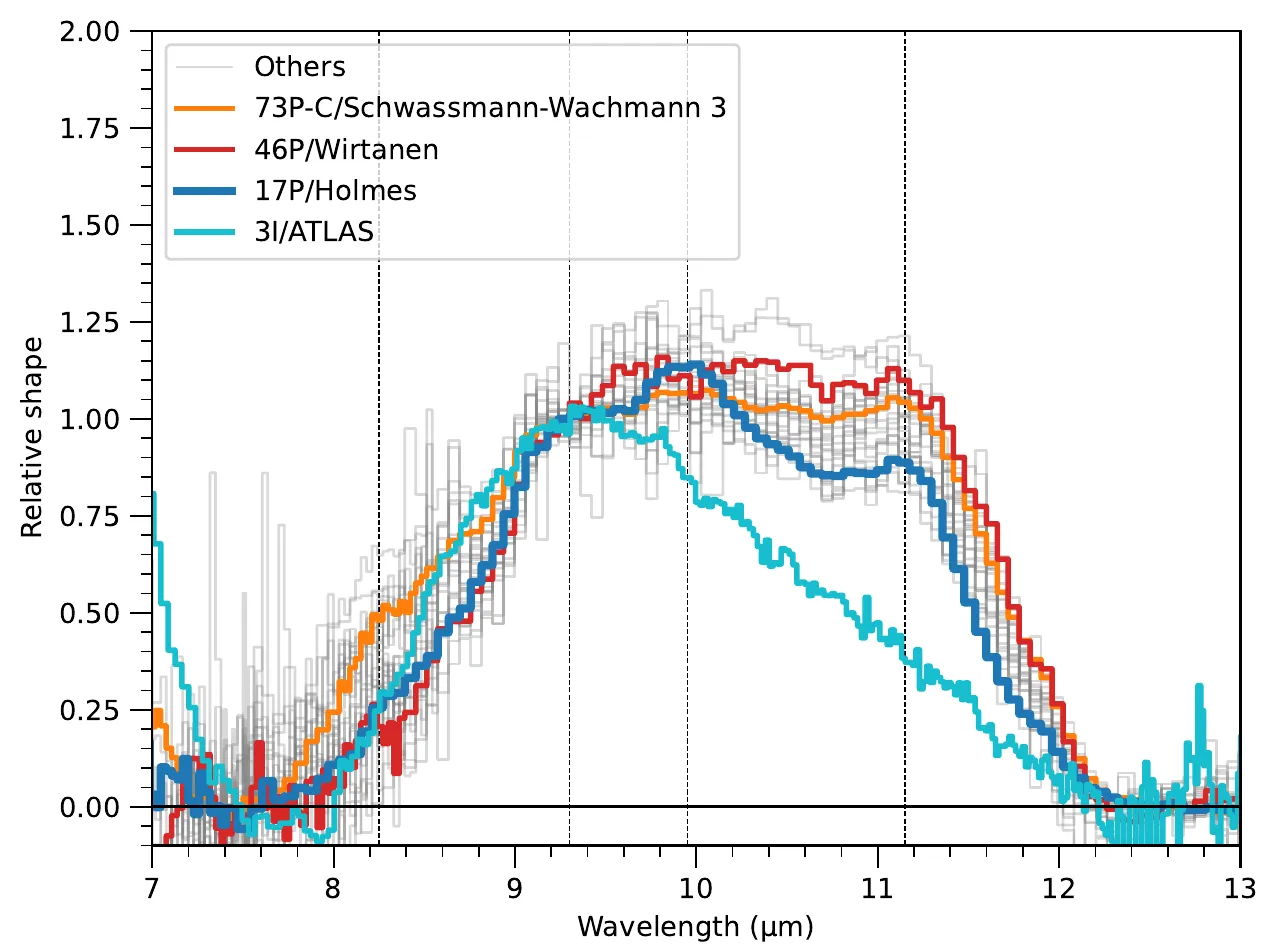
The 10-micrometre silicate band of 3I/ATLAS (light blue) compared with Solar System comets: 3I’s band drops early and smoothly. — Figure 2, Thomas et al. (2026), arXiv:2610.37540.
Counting crystals that are not there
The team modelled the dust as a mix of three ingredients: amorphous carbon and two kinds of amorphous silicate, the olivine type and the pyroxene type. Amorphous means disordered at the atomic scale, like glass, rather than neatly stacked like a crystal.
Crystals were then added little by little, until the fit became clearly worse. The best fit always contains no crystals at all. The upper limit is 5.3% of the silicate emission; another team, using a different Webb mode, puts it at 3.1% by mass.
The fit also favours pyroxene by about 180 to 1 over olivine — though the other Webb team, with its own dust model, finds mostly olivine-type grains — in compact grains smaller than a micrometre. A second peak near 6.83 micrometres fits organic matter rich in carbon–hydrogen bonds, or carbonate minerals; these data cannot tell which.
A cold, quiet birthplace
Crystalline silicates in comets mark dust that was once strongly heated. Their absence means the dust of 3I/ATLAS saw very little heat, consistent with its gas. According to the authors, it probably formed in a calm part of the disc around its star, with little mixing. The comets of our Solar System, by contrast, took in some dust cooked close to the young Sun.
One puzzle remains. Dust between the stars is thought to be mostly of the olivine type, yet in this team’s fit 3I/ATLAS, like our comets, is pyroxene-rich: an unknown process may transform the dust somewhere along the way.
Fresher dust from deeper down
Cosmic rays from the galaxy can, in principle, turn crystals into glass, but only in the outer layers of a body. The authors note that 3I/ATLAS probably lost 10 metres or more of its surface during its passage through the Solar System. The dust Webb saw after that pass may therefore come from deeper, less altered layers — closer to what this comet was made of when it formed.