DOES GRAVITY ACT INSTANTLY? TWO SPINNING SPECKS COULD TELL
Every laboratory measurement of the gravitational pull between two masses has been, in effect, a slow one. Torsion balances work at millihertz. A recent Cavendish-type experiment on milligram masses modulated its source at 12.7 millihertz; others run at a few tens of hertz. The record for generating and detecting a gravitational interaction in the lab is still 1,660 hertz, set in 1968 with an acoustically stressed cylinder — “a result now nearly six decades old”, as Matteo Fadel (Peking University and ETH Zurich) and Andrea Vinante (CNR and Fondazione Bruno Kessler, Trento) put it.
Gravitational waves do not count: they are a radiated effect, not the near-field pull between nearby objects, and they carry almost no signal above a kilohertz. So the interpretation of every near-field measurement rests on an assumption tested only up to those 1,660 hertz: that up close, gravity acts instantly.
A spinning source
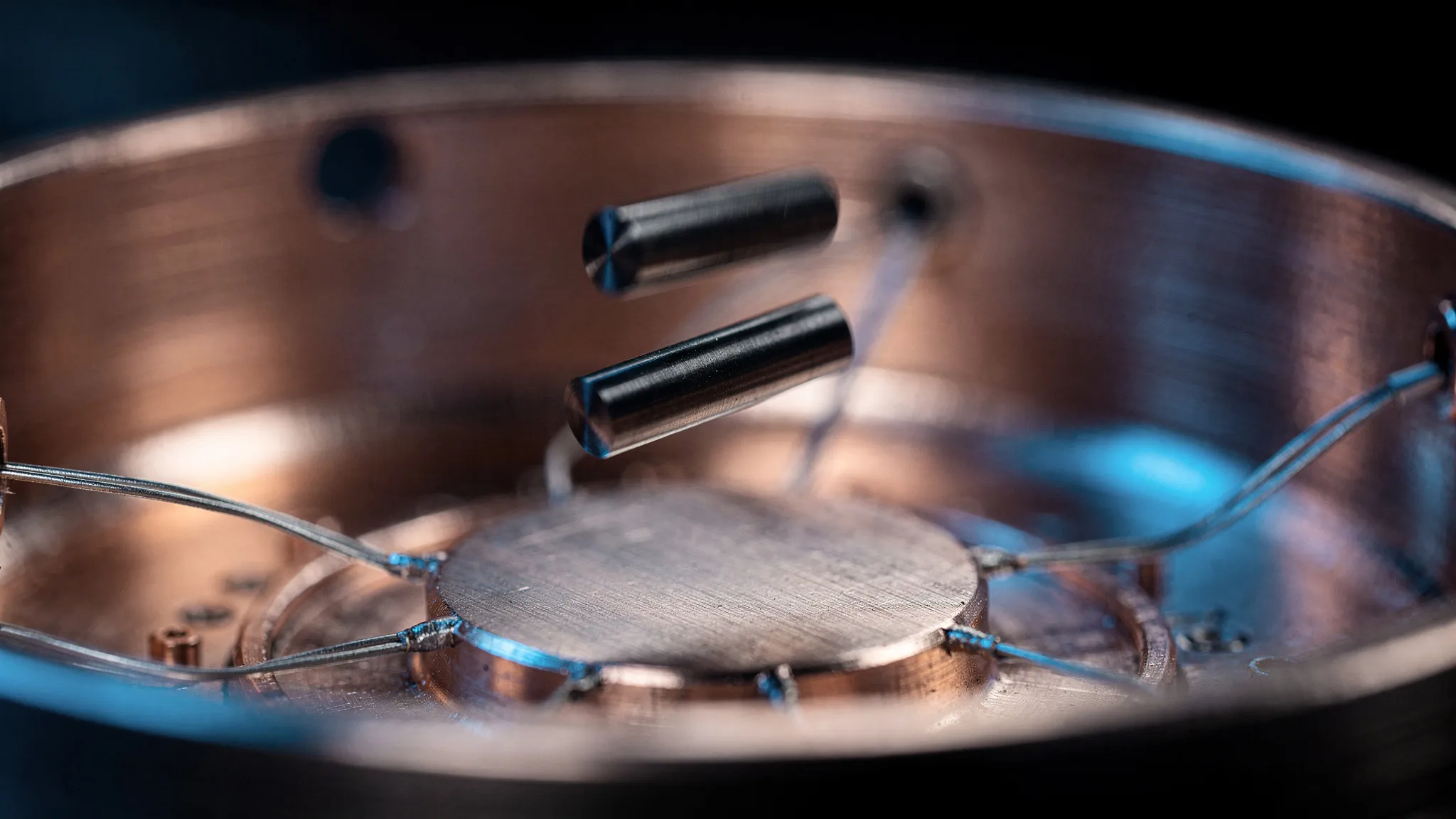
Fadel and Vinante propose to go a thousand times faster. Their source is a microscopic rotor — a small cylinder of rare-earth magnet material (NdFeB), levitated above a superconductor and spun as fast as the material allows before it flies apart.
A spinning body is a good gravity source for a simple reason. Its mass and centre of mass stay put, so the part of its field that changes in time comes from its shape: an elongated rod spinning end over end looks the same twice per turn, so its gravitational field pulses at twice the rotation frequency. Spin it at 1 million turns per second, and its field oscillates at 2 megahertz.
How fast can it go? A rotor’s tip speed is limited by its strength to a few hundred metres per second at most, so smaller rotors spin faster. A rod of 300 micrometres could reach about 1 megahertz of rotation, by the authors’ estimate. And because the near-field pull depends only on the ratio between the size of the source and its distance, shrinking everything costs nothing, provided the detector moves closer too.
A rotor that listens like a radio
The detector is a second spinning rotor, placed on the same axis. The changing gravitational field twists it with a tiny torque. The clever part is what its own rotation does: like the local oscillator of a radio receiver, it shifts the megahertz signal down to a slow beat of a few hertz, set by the small difference between the two spin rates. The experimenter chooses that frequency.
That gives the scheme two unusual properties. At fixed geometry, neither the torque nor the measuring time depends on how fast the rotors turn, so higher frequencies come at no cost in sensitivity. And the spin rate can be tuned continuously, so one apparatus could map gravity from kilohertz to megahertz in a single sweep.
How small, how long
For two cylinders of 300 micrometres, 600 micrometres apart, each spinning at 1 megahertz, the authors calculate a torque of 2 × 10⁻²⁵ newton-metres. With the very low friction the authors assume — close to what levitated rotors have already achieved — detecting it would take about 55 minutes at 10 millikelvin, or 15.9 days at 4.2 kelvin.
The numbers scale steeply. The measuring time grows as the tenth power of the separation measured in rotor lengths: halving the gap would shorten it by about a thousand. Going faster, though, means going smaller: a rotor already spinning as fast as its material allows can only go ten times faster if it is ten times shorter, and that shrinking costs a factor of 100,000 in time. This caps the useful range at a few megahertz; at the other end, below roughly 100 kilohertz, the limit is practical — levitating millimetre-sized rotors, and slow drifts.
What a delay would look like
If gravity were not instantaneous, its field would lag behind the spinning source by some relaxation time. The authors treat that time as a free parameter. A lag would show up in two ways: as a slightly weaker torque and, more sensitively, as a shift in its phase — the timing of the twist — relative to the measured positions of the two rotors.
At 2 megahertz, a measurement reaching a signal-to-noise ratio of 10 — about 3.8 days at 10 millikelvin — could limit any such delay to about 8 × 10⁻⁹ seconds using the phase. The 1968 experiment, taken at 10% accuracy, corresponds to about 5 × 10⁻⁵ seconds. That is an improvement of more than a thousand times. Theories in which gravity emerges from some underlying “medium” naturally allow such a delay; this would be a direct test.
The magnetic elephant
The authors are frank about the obstacles. Two magnetic rotors 600 micrometres apart feel a magnetic torque about 18 orders of magnitude stronger than the gravitational one. The two can be told apart — the magnetic coupling beats at the difference frequency, gravity at twice it, and turning one rotor by half a turn flips the magnetic sign but not the gravitational one — yet roughly thirteen orders of magnitude of superconducting shielding would still be needed. A rotor with the same volume but a shape that produces no gravitational pulse would provide a null test, in the authors’ view the most valuable check of all.
Other open questions remain: the true breaking strength of NdFeB at this scale, which the estimates assume and which has never been tested, and keeping a fast-spinning, thermally isolated rotor at millikelvin temperatures.
An antenna on the side
The same rotor, used alone, would also respond to a passing gravitational wave near twice its spin rate, especially one with circular polarisation, whose stretching pattern rotates. The authors estimate a noise level around 10⁻²² per root hertz in the megahertz band — a strain, that is, the fraction by which a passing wave stretches distances, quoted “per root hertz” as is usual for noise — in a window about a hertz wide that can be tuned across the whole range — a band where no astrophysical source is guaranteed, but where a detection could point to new physics.
For now this is a detailed proposal, not a measurement. But it maps a route into a region of gravity that no experiment has entered.