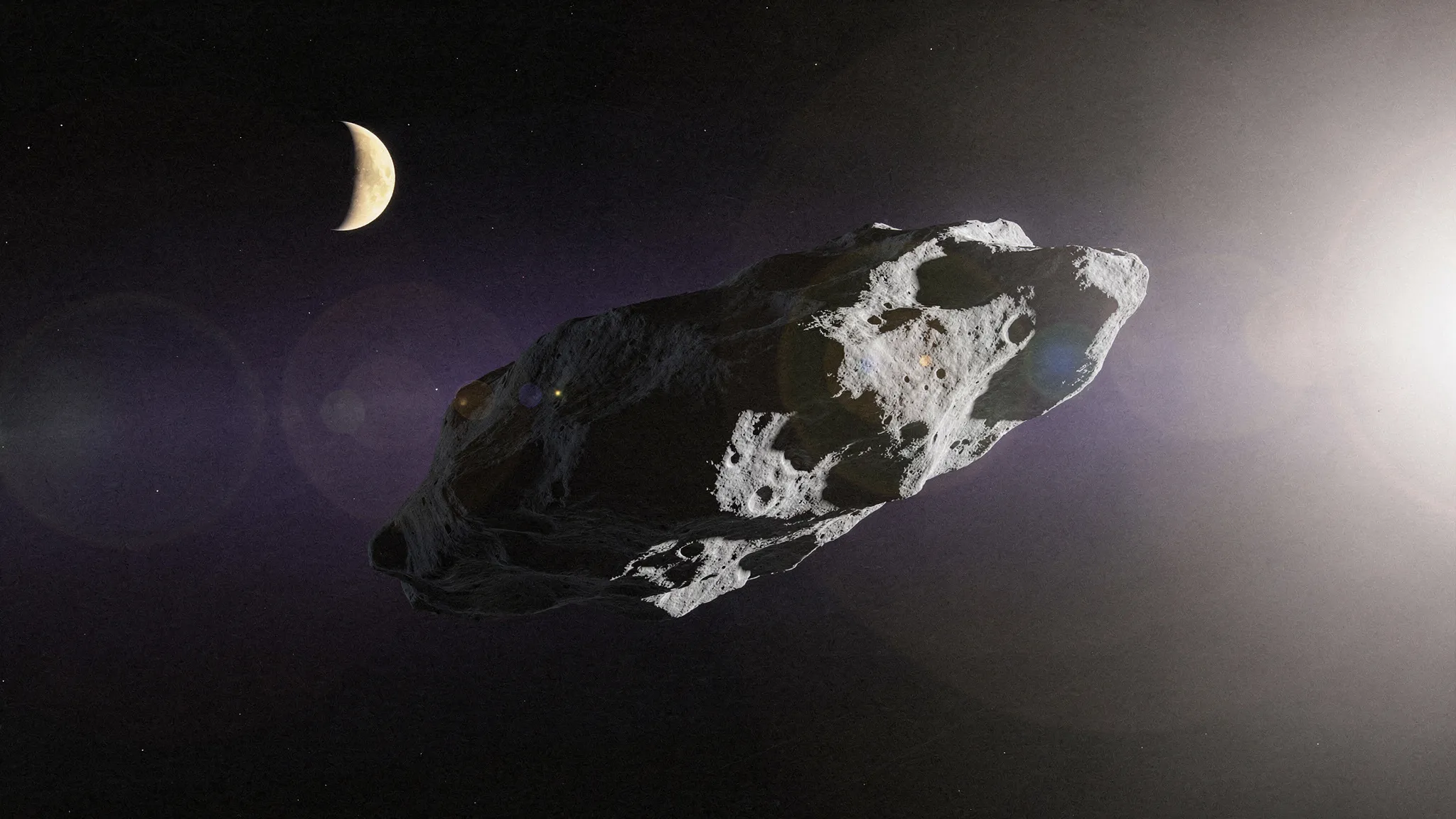
AN ASTEROID ON THE EDGE OF VENUS'S ORBIT
Most asteroids circle the Sun between Mars and Jupiter. A few have been nudged much closer in. Astronomers call Atiras the asteroids whose entire orbit stays inside Earth’s: even at its farthest from the Sun, an Atira never gets as far out as Earth’s closest point. A still more exclusive club, the ꞌAylóꞌchaxnim asteroids, never even reaches the closest point of Venus’s orbit, 0.718 astronomical units from the Sun (one astronomical unit is the average distance between Earth and the Sun).
Such objects are hard to catch. They always appear close to the Sun in the sky, so telescopes must look for them in twilight, low on the horizon, through a bright sky. One recent study’s sample of known objects inside Earth’s orbit held 37 Atiras and a single ꞌAylóꞌchaxnim.
Right on the border
On 27 September 2025, the astronomer S. S. Sheppard discovered 2025 SC79 with a camera on the 4-metre Blanco telescope at Cerro Tololo. Its orbit takes it as close as 0.27 astronomical units to the Sun and as far as 0.719 — just beyond the closest point of Venus’s orbit, by less than a thousandth of an astronomical unit. On paper it is an Atira, but only just.
A team led by Bryce Bolin, of Eureka Scientific in California, set out to find it again a year later. On 7 October 2026, four 30-second exposures with the Keck I telescope in Hawaii picked it up 19 arcseconds — a tiny angle on the sky — from where it was expected, inside the predicted uncertainty zone. On 24 and 25 October, the Very Large Telescope at Paranal photographed it twenty times through four colour filters.
A piece of basalt?
Comparing those colours with 24 standard classes of asteroid, the closest match is the V type — the basaltic rock typical of fragments chipped off large bodies that once melted and separated into layers, such as the asteroid Vesta. The authors note that spectroscopy is needed to confirm it.
The asteroid’s brightness gives its size, provided you know how much light its surface reflects — its albedo. With the typical albedo of V-type asteroids, it is about 0.38 kilometres across; with a lower albedo predicted by a population model, about 0.48. A population model also traces its likely origin: with 95.4% probability, it escaped from the inner part of the main asteroid belt, through escape routes known as resonances, zones of the belt where the repeated tugs of the giant planets stretch an orbit until it leaves. The Vesta family is a plausible source, but the data cannot pin down a parent.
Ten thousand copies
An asteroid’s future cannot be computed from a single orbit, because the orbit is never known perfectly. So the team created 10,000 clones of 2025 SC79, each with a slightly different orbit within the measurement uncertainties, and followed them for five million years into the past and into the future, under the gravity of the Sun, the eight planets and the Moon.
The clones keep crossing the Venus border. Over the past 100,000 years, they spent on average 30% of their time inside it, as ꞌAylóꞌchaxnim asteroids. Over the next 100,000 years, that share drops to about 4%. Over the next five million years, 18.55% of them hit a planet: 14.56% Venus, 3.77% Mercury, 0.22% Earth, none Mars. Among the clones that hit Venus, half do so within about 1.5 million years, at about 17.5 kilometres per second.
One rock, two families
For the authors, 2025 SC79 shows that material delivered from the inner asteroid belt can move back and forth between the Atira and ꞌAylóꞌchaxnim populations — the same behaviour found for the asteroid (594913) ꞌAylóꞌchaxnim. Infrared observations of its heat could now settle the question its colours leave open: how big, and how bright, this rock on the edge of Venus’s orbit really is.