SUPERCONDUCTIVITY'S ELECTRON PAIRS, CAUGHT LEAVING TOGETHER
Superconductivity appears when electrons bind into Cooper pairs and move together in step, carrying current without resistance. Yet almost every tool physicists use to study superconductors sees electrons one at a time. Photoemission, the workhorse technique, uses light to knock a single electron out of a material and measures its energy and direction. It reveals how pairing affects each electron, but never the pair itself.
That gap is felt most in the cuprates, copper-oxide compounds that stay superconducting at unusually high temperatures and whose behaviour is still debated. A direct probe would tell whether the electrons really leave as coherent pairs, and what total momentum each pair carries — whether the pair as a whole drifts in some direction.
One photon, two electrons
The idea is called two-electron photoemission. A single high-energy photon is absorbed, two electrons fly out, and two detectors record both — their energies and directions — as a coincidence. Theory has long predicted that in a superconductor, this would produce a telltale peak at zero energy for both electrons — energies counted from the cheapest possible extraction, so zero means neither electron paid anything extra to leave. Physicists have attempted such double-photoemission measurements in solids for more than four decades, but this peak had never been seen. It takes a high rate of coincidences, energy resolution fine enough for the tiny energies of superconductivity, and detectors placed to catch electrons that were moving in opposite directions inside the crystal, as the two partners of a Cooper pair do.
A team at the University of Illinois Urbana-Champaign, led by Fahad Mahmood, built such a setup. A laser firing 525,000 pulses per second shines into a fibre filled with xenon gas, which produces extreme-ultraviolet light; one colour is selected, with photons of 22.8 electronvolts. Two time-of-flight analysers, which time each electron’s trip to deduce its energy, set at right angles, catch the electrons with an energy resolution better than 15 millielectronvolts. To remove accidental coincidences — two unrelated electrons arriving from the same pulse — the team compared them with electrons paired across neighbouring pulses, which cannot share an origin.
A peak that only exists below 93 kelvin
The sample was Bi-2212, a cuprate that becomes superconducting below 93 kelvin. At 8.5 kelvin, the map of the two electrons’ energies shows a sharp peak exactly where both energies are zero. At 200 kelvin, far above the transition, the peak is gone.
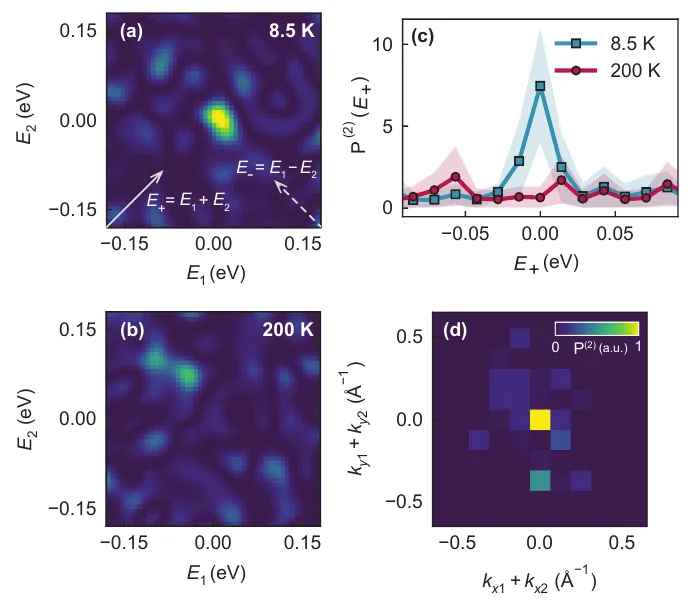
Two-electron signal at 8.5 K (a) and 200 K (b), a cut through both maps (c), and the total momentum of the pairs near the peak (d). — Figure 3, Amir, Zwettler et al. (2026), arXiv:2611.09857.
The authors explain why the peak sits at zero. Pulling one electron out of a Cooper pair breaks it, which costs a binding energy. Pulling both out at once does not break the pair, so it costs nothing. The same events also gather at zero total momentum, as expected for Cooper pairs in this material. Pairs carrying momentum — a proposed state called a pair-density wave — would show a peak off-centre; none was seen, at least at this level of doping — the chemical tuning that sets how many mobile charges the crystal holds, here the one that gives the highest transition temperature.
According to the team, this is the first observation of Cooper-pair emission resolved in both energy and momentum.
A width that grows in the cold
Then came a surprise. The peak’s spread can be read in two directions: the total energy of the two electrons, and the difference between them. On cooling from 70 to 8.5 kelvin, the spread in the total barely changes. The spread in the difference nearly doubles, from about 12 to about 23 millielectronvolts.
The instrument’s resolution does not change with temperature, and ordinary thermal blurring should shrink, not grow, in the cold. Static disorder does not explain it either. The authors conclude that the escaping electrons must interact with collective excitations of the superconductor itself — ripples that involve many of its electrons at once.
They sketch two possible mechanisms without choosing between them. In one, the first electron scatters off the material’s electrons before the second leaves, exchanging energy with collective spin or charge excitations. In the other, the two electrons start with equal energies, then each meets fluctuations of the superconducting state along its own path.
A probe of what happens inside
Beyond seeing the pairs, the method may read the collective behaviour of a superconductor’s electrons in the way two departing electrons share their energy. The authors call it a way to study “the interactions and dynamics accompanying pair removal in correlated materials” — a door opened at a single doping level, in a single cuprate, for now.