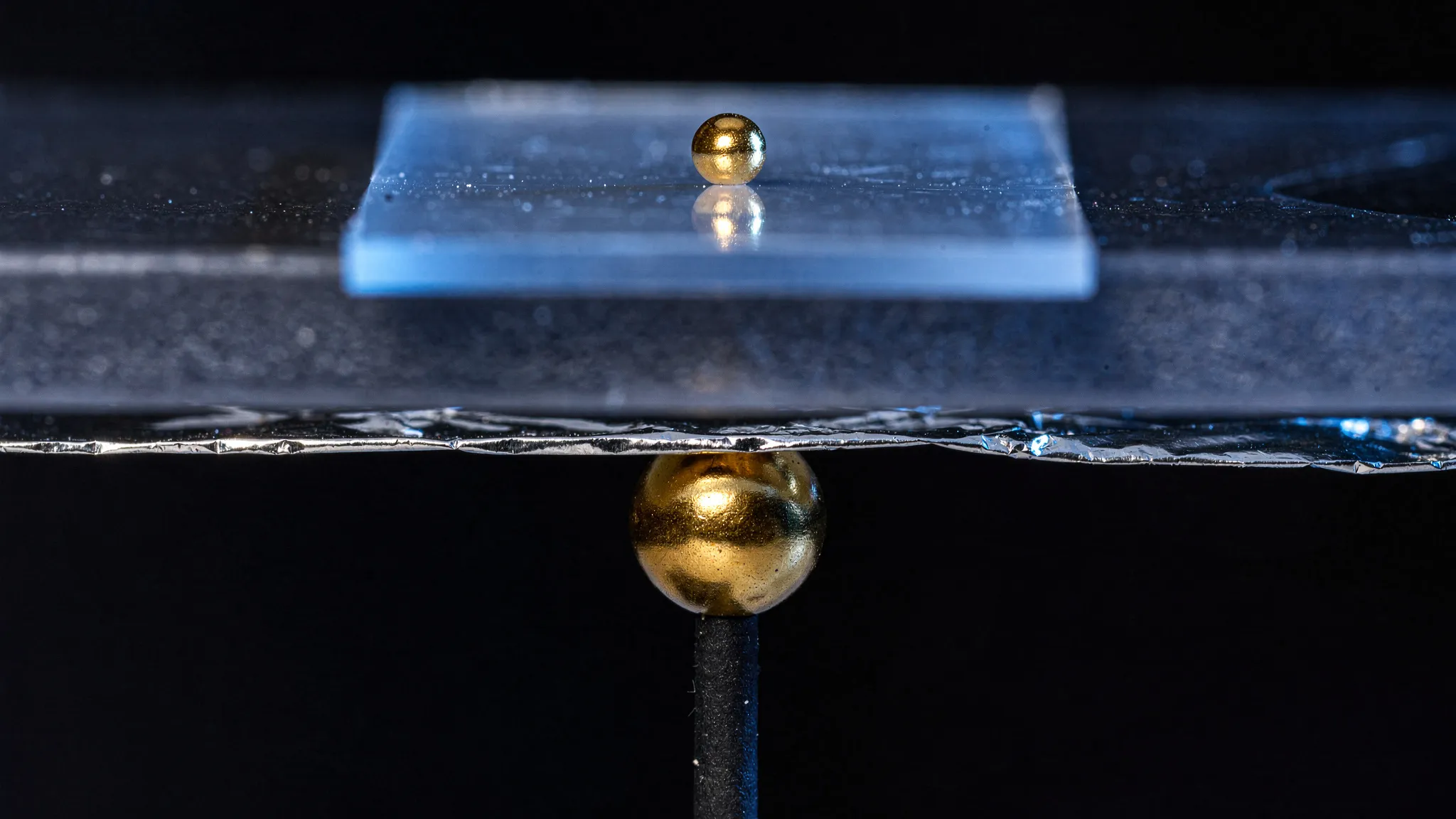
TWO GOLD BEADS, TEN ATTONEWTONS OF GRAVITY
Gravity holds galaxies together, yet it is by far the weakest of the known forces. Between two small objects it is so faint that it has barely been explored. That gap matters for one of the great open questions in physics. General relativity, our theory of gravity, and quantum mechanics, the theory of the very small, have never been combined in a satisfactory way. Nobody knows whether gravity itself is quantum.
One recent idea is to test it indirectly: put two small masses into genuinely quantum states and watch them attract each other. To get there, gravity experiments must shrink their masses while quantum experiments grow theirs, until the two meet.
A bead on a drum
A team at Aalto University in Finland — Matthew Herbst, Mika Sillanpää and colleagues — has taken a step toward that meeting point. Their test mass is a gold sphere 250 micrometres in radius, weighing 1.26 milligrams. It is glued to the centre of a silicon nitride membrane 2 millimetres wide and only 100 nanometres thick, stretched tight like a drum skin. The membrane vibrates up and down about 2,139 times per second.
The source of gravity is a second gold sphere, weighed at 86.6 milligrams, on the tip of a carbon-fibre rod. A piezoelectric disc taken from a commercial buzzer — a disc that flexes when a voltage is applied — shakes it up and down by 2.5 micrometres, at almost exactly the membrane’s frequency. Each time the big bead comes closer, its pull grows a little; each time it moves away, the pull weakens. That rhythmic tug drives the drum the way small pushes, well timed, build up a swing.
A fridge built for quantum experiments
The drum is read with microwaves: it forms part of a superconducting aluminium cavity, a small box in which microwaves ring at one precise frequency; that frequency shifts slightly as the bead moves. This “microwave optomechanics” setup is the kind physicists use to control vibrations at the quantum level. The whole assembly sits in a dilution refrigerator at about 0.26 kelvin, a quarter of a degree above absolute zero.
Keeping every other force out was the hard part. Each bead hangs from its own chain of 1.1-kilogram copper cubes and springs, which filter out vibrations. The test bead is sealed inside the superconducting cavity, and a two-layer aluminium shield separates the two beads. Earth’s magnetic field is cut down to about 15 nanotesla. The authors went through a long list of stray effects — static charges, contact voltages, currents in the buzzer’s cable — and estimated each one to be negligible.
Because of all these layers, the centres of the two beads can get no closer than about 1.54 millimetres. At that distance, Newton’s law predicts a rhythmic force of about 10 attonewtons: ten billionths of a billionth of a newton.
Hunting for a hotspot
Each measurement averaged at least twenty recordings of one hour each. The team first moved the source bead sideways, across a 5-by-5-millimetre square. Almost everywhere, they found nothing. But at one spot, where the two beads were stacked vertically, a force of about 10 attonewtons appeared, fading over about a millimetre around it.
They then parked the source bead over that hotspot and moved it up and down, from about 0.3 to 4 millimetres of gap between the two surfaces.
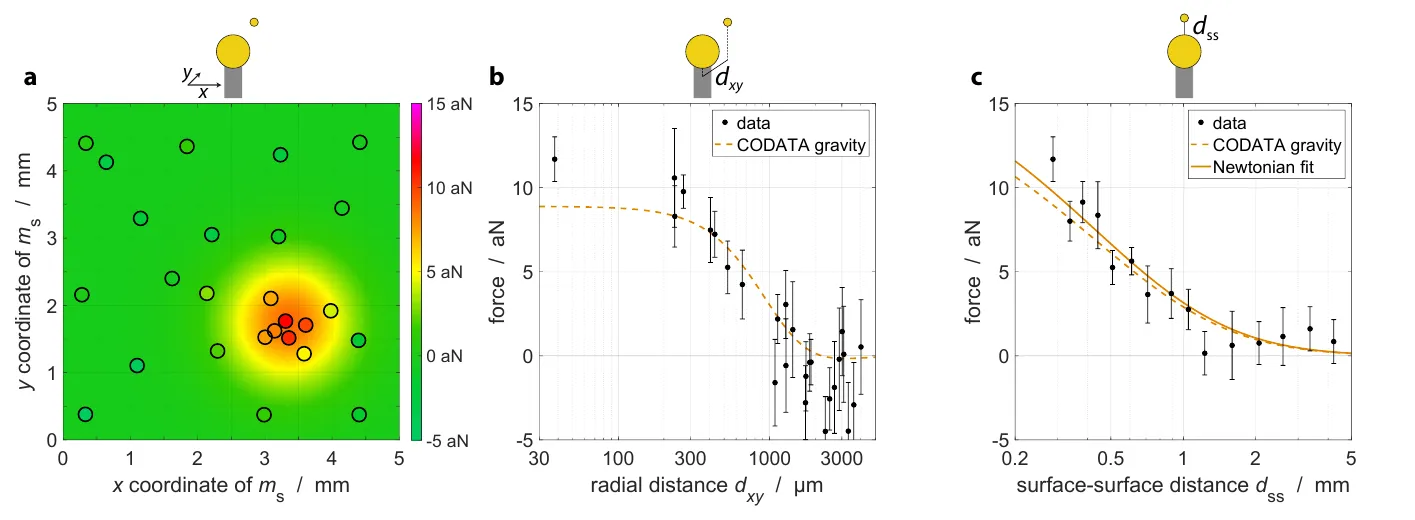
Measured force as the source bead moves sideways (a, b) and vertically (c): the data follow the gravity expected from the standard value of the gravitational constant (orange dashes). — Figure 4, Herbst et al. (2026), arXiv:2611.08619.
The fingerprint of gravity
Two clues point to gravity rather than a stray effect. The timing of the force always matched a pull, never a push: it was strongest each time the big bead came closest. And it fell off with the cube of the distance between the centres, as expected for the changing pull of a moving mass. A vibration leaking through the supports would not depend on the distance at all, and an electric force between surfaces would shoot up steeply at short range.
From these data, the team extracted the gravitational constant, the number that sets the strength of gravity in Newton’s law: 7.26 × 10⁻¹¹ in SI units, give or take about 0.4 × 10⁻¹¹ from random noise (statistical uncertainty) and 0.7 × 10⁻¹¹ from imperfectly known settings of the experiment (systematic uncertainty). The reference value, 6.67 × 10⁻¹¹, lies within that second margin.
According to the authors, this combination of masses marks progress of about two orders of magnitude in sensing gravity at small scales, mainly because the test bead is so light. Their sensitivity to accelerations at kilohertz frequencies beats the previous best by 35 decibels — a background noise about fifty times lower.
Not quantum yet
The drum is still far from quantum: at its temperature it holds about 3.6 million quanta of vibration. The team expects colder operation and feedback cooling to bring it close to its ground state, the calmest state quantum mechanics allows. They also sketch a further target: two masses of 22 micrograms each, the Planck mass, where quantum mechanics and gravity can become equally strong. With a wider swing, a 100-micrometre gap and mechanical coherence — how long the drum’s vibration stays undisturbed by heat — improved a hundredfold, they expect averaging times similar to today’s.
The authors do not call this quantum gravity, which “still lies years ahead”. Their name for the stage they have reached: “Noisy Intermediate Scale Quantum Gravity”.