WATCH A QUANTUM PARTICLE TOO OFTEN AND IT NEVER ARRIVES
Quantum mechanics is very good at saying where a particle will be found. Ask when it will reach a detector, and the theory hesitates. Time is not a quantity you can measure the way you measure position: there is no standard rule for the moment a detector clicks. Nearly a century after the question was first raised, physicists still have no universally accepted answer.
The problem runs deeper because measuring changes what is measured. If you check a detector very often to catch the exact moment of arrival, each check disturbs the particle. Push this far enough and you reach the quantum Zeno effect: watched too closely, the particle stops arriving at all.
A particle in a row of qubits
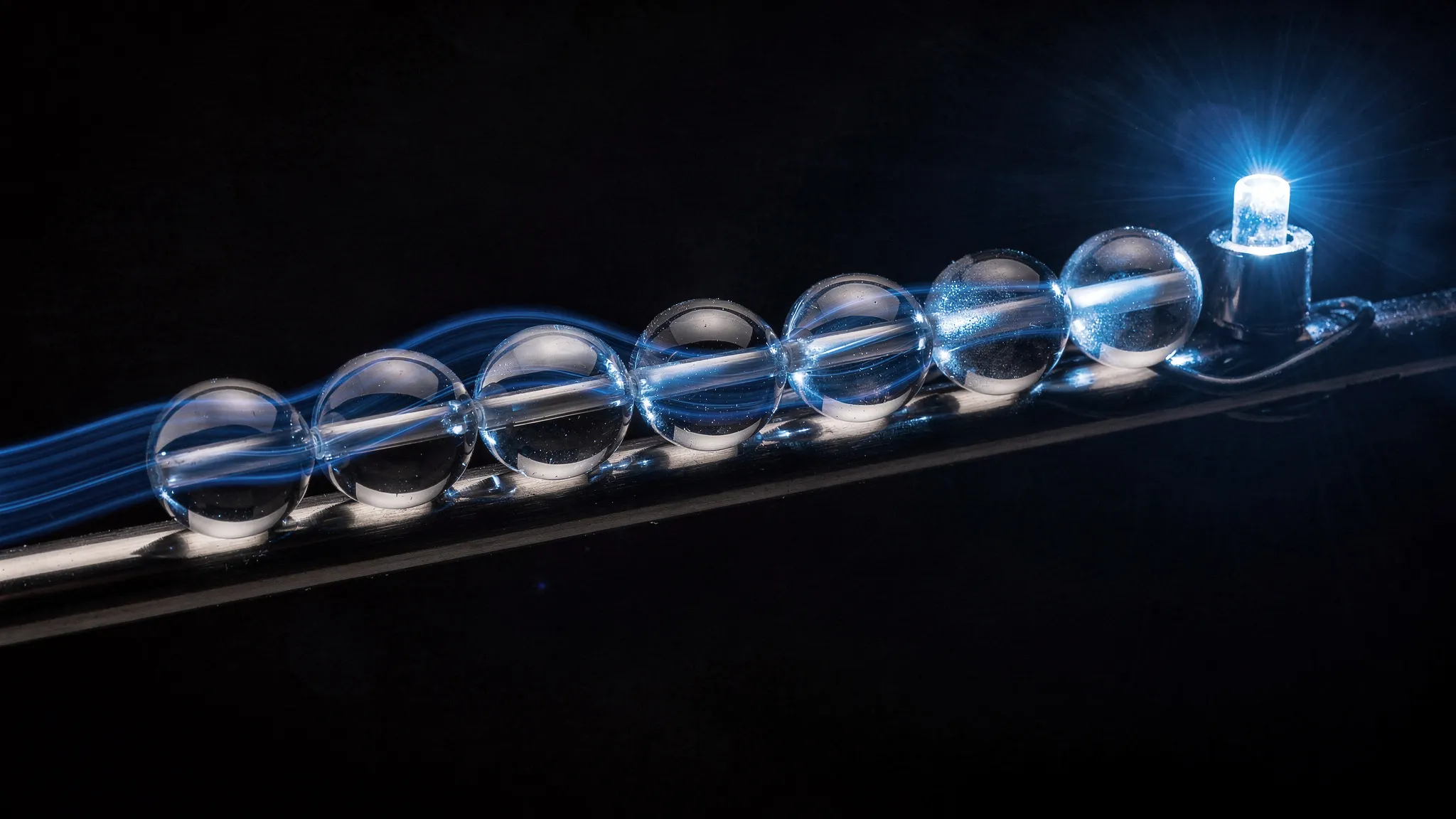
Yousef Mafi, Teemu Ojanen and two colleagues at Tampere University in Finland built the problem into a quantum circuit. Picture a row of seven qubits, the quantum bits of the processor. A qubit pointing “up” counts as a particle, one pointing “down” as an empty site. The particle starts at one end and spreads along the row like a wave. The qubit at the far end plays the detector: at regular intervals Δt, it is measured, until it reads “up” for the first time — the click.
Repeating the run many times gives the arrival-time distribution: the probability that the first click comes at each check.
Too often, too rarely
Theory predicts two regimes, separated by an optimum.
- Checking often: the Zeno regime. Between two checks, the chance of a click is at most J²Δt²/4, where J sets how fast the particle hops. That holds for any state, any number of particles, in any dimension. Halve the interval, and this ceiling on each check’s chance to click drops fourfold: arrival stalls.
- Checking rarely: the low-monitoring regime. The particle’s wave bounces back and forth along the row. When the checks fall in step with that motion, some wave patterns slip past every check unseen and detection is delayed. Arrival then rises and falls irregularly as the interval changes.
The best interval sits in between, close to Δt ≈ π in the article’s time units. It can be estimated from the range of energies a single particle can have — its bandwidth. The circuit advances in whole time steps, so the closest interval it can test is Δt = 3.
On real hardware
The team ran the circuit on ibm_kingston, a 156-qubit IBM processor. Noise was the main enemy. A mid-circuit measurement takes 2,180 nanoseconds, against 68 for a two-qubit operation, and idle qubits lose their state while they wait; extra pulses kept them steady. Errors that created or destroyed particles were caught by checking, at the end of each run, that the number of particles was unchanged, and discarding the runs where it was not. Each point used 20,000 runs, for a statistical uncertainty of about 1%.
The measured curves follow theory closely. Going from Δt = 1 to Δt = 3, the probability of arrival rises: the Zeno regime. Going from 3 to 6, it falls again: the low-monitoring regime. The data even reproduce the fine periodic structure left by the wave’s round trips along the row.
More particles, a second dimension
With two and three interacting particles, Δt = 3 remained the best interval among those tested. Late arrivals became more likely, since any particle can trigger the detector, and the steps due to round trips were washed out. On a 4 × 4 grid run on a second processor, ibm_berlin, noise was much stronger and agreement looser — but frequent checks still suppressed arrival.
According to the authors, this is the first experimental measurement of arrival-time distributions for a particle travelling to a monitored site.
Which arrival time?
The result also speaks to an old debate. One classic argument, by the physicist Mielnik, invoked the Zeno effect to doubt that repeated measurements could ever define arrival times; the Zeno regime seen here makes that effect real in a transport setting. The authors favour a more modern view: different arrival-time distributions are not rival answers to one question, but the outcomes of different measurement procedures. Another recent proposal measures each copy of the system only once, at a chosen time, which sidesteps the Zeno effect. Both protocols, they note, can now be run on the same processor — “one of the longest-standing open problems in quantum mechanics” has found a laboratory.