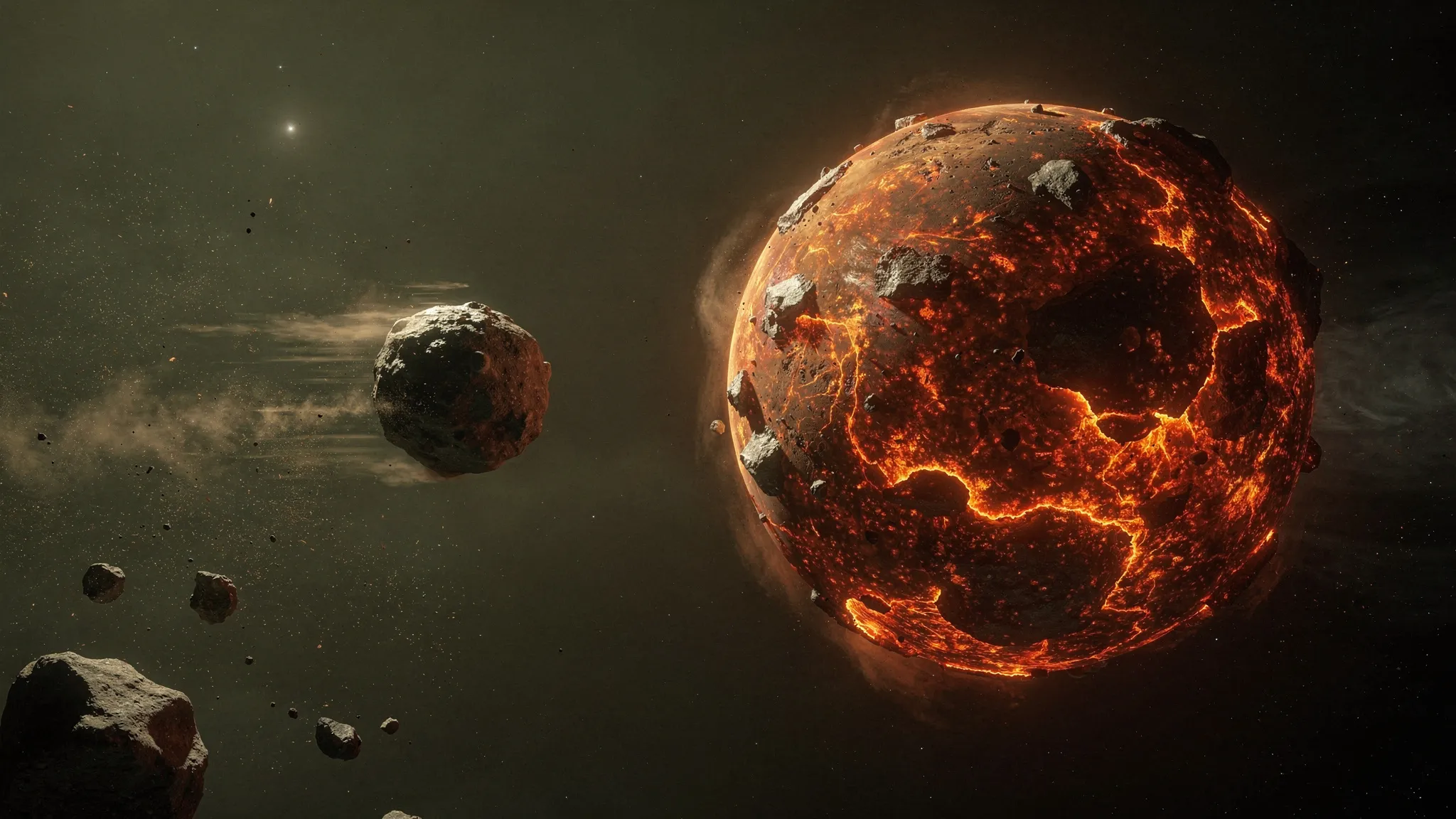
EARTH'S MANTLE POINTS TO A SMALL THEIA
Computer simulations of how the rocky planets formed have become very good — perhaps too good. Several scenarios, incompatible with one another, all reproduce the masses and orbits of the planets. To tell them apart, Gabriel Nathan, Hung Nguyen and Seth Jacobson, at Michigan State University, turned to a different referee: the chemistry of Earth’s mantle.
Three ways to build the inner Solar System
The team tested three families of scenarios. In the Classical one, the rocky planets grow from material spread across the inner disk, with Jupiter and Saturn on circular or eccentric (elongated) orbits; it tends to make Mars far too big. In Annulus scenarios, the building blocks start in a narrow ring. In the Grand Tack, Jupiter and Saturn migrate inwards and then back out, sweeping the inner disk into a narrower band.
From published simulations of all three, the authors picked 164 “Earth analogs”: planets of 0.75 to 1.55 Earth masses that finished growing in 50 to 200 million years.
Iron as a gauge of oxidation
Iron can sit in a planet in two ways. As metal, it sinks into the core. Bound to oxygen, as iron oxide (FeO), it stays in the rocky mantle. Material whose iron is mostly metal is called reduced; material whose iron is mostly bound to oxygen, oxidized. Across the Solar System, the balance shifts with distance from the Sun: Mercury keeps almost all its iron as metal, while bodies farther out are more oxidized. Earth’s mantle today holds about 8.1% FeO by mass.
The model follows every collision. Each impact melts part of the growing planet’s mantle; the impactor’s metal mixes with that molten rock, trades elements with it according to laboratory measurements, then sinks to the core. The authors let five parameters vary — mostly the shape of the oxidation gradient across the disk, assumed fully oxidized and water-bearing beyond 4.5 astronomical units (4.5 times the Earth–Sun distance) — and searched, for each simulation, the settings that reproduce the measured mantle best, element by element (iron, silicon, nickel, cobalt, niobium, tantalum, vanadium, chromium).
164 Earths, one recipe
Every scenario passed. The average score measuring the gap between simulated and real mantle was 3.39 (median 2.47; lower is better; every simulation stayed below 20), and no family of scenarios did systematically better than the others.
But they all needed the same ingredients. The disk had to switch sharply from fully reduced to mostly oxidized material — from 100% of the iron as metal to about 50% within 0.2 astronomical units or less — right where Earth’s building blocks came from. About half of Earth’s mass had to come from bodies whose iron was all metal: not iron meteorites, the authors stress, but rocky bodies with no FeO in their mantle, like the meteorites called aubrites. Only about 2% came from fully oxidized bodies.
And Earth had to receive them in a certain order: reduced material first, more oxidized material later.
Why the order matters
To check, the team built artificial Earths from the same ingredients, changing only the order. Starting reduced and ending oxidized gave a score of 81.4; a random order, 111.5; starting oxidized and ending reduced, 295.2 — by far the worst. (None of these crude test histories matched the real simulations, as expected.)
The reason lies in a simple exchange between metal and molten rock: 2 Fe (metal) + SiO₂ (rock) ⇌ 2 FeO (rock) + Si (metal). When silicon moves into the core, it leaves oxygen behind, and that oxygen turns metal iron into FeO — two FeO for each silicon. Once the mantle holds more than about 8% FeO, the process acts like a pump: adding reduced material later no longer brings the FeO down. And no later impact can fix it: even the largest ones mix their sinking metal with only part of the mantle, never all of it.
The sequence also fits the dynamics. Material from farther out meets the growing planets near 1 astronomical unit less often, so it tends to arrive late — and in this picture, it is also the more oxidized material.
What the mantle says about Theia
In each simulation, the last large body to hit the Earth analog plays the role of Theia, the impactor whose collision formed the Moon. Because what arrives late is oxidized, the mantle of the Proto-Earth, Earth just before that impact, was typically as reduced as today’s, or more so. Theia’s own mantle could range from about 0% to about 30% FeO — but only if Theia was small.
Two constraints stand out. Theia and the Proto-Earth cannot both have had mantles more oxidized than Earth’s today. And when Theia’s mass exceeds about 0.3 times that of the Proto-Earth, the simulated Earths match the real one noticeably worse; a Theia as massive as the Proto-Earth would need a mantle close to present-day Earth’s. One proposed scenario, a Theia of 0.4 Earth masses with 15% FeO, was rare in the simulations and never among the best matches. The timing of the impact, by contrast, made no difference to how well the mantle was reproduced.
Speed rather than size
Earth and Moon are isotopic twins: for oxygen, chromium, titanium and other elements, their rocks carry the same mix of isotopes, versions of an atom that differ only in mass. So some mixing or re-equilibration must have happened during or after the impact. The authors’ conclusion is that if an energetic impact did the job, the energy came from a fast Theia rather than a huge one. A collision between two bodies of equal mass remains possible, but it requires finely tuned starting conditions. The authors also flag their own assumption: the oxidation gradient they impose “likely is not the true structure of the disk” — the next test is whether the sharp gradient each scenario demands could really have existed. The study has been accepted for publication in Icarus.