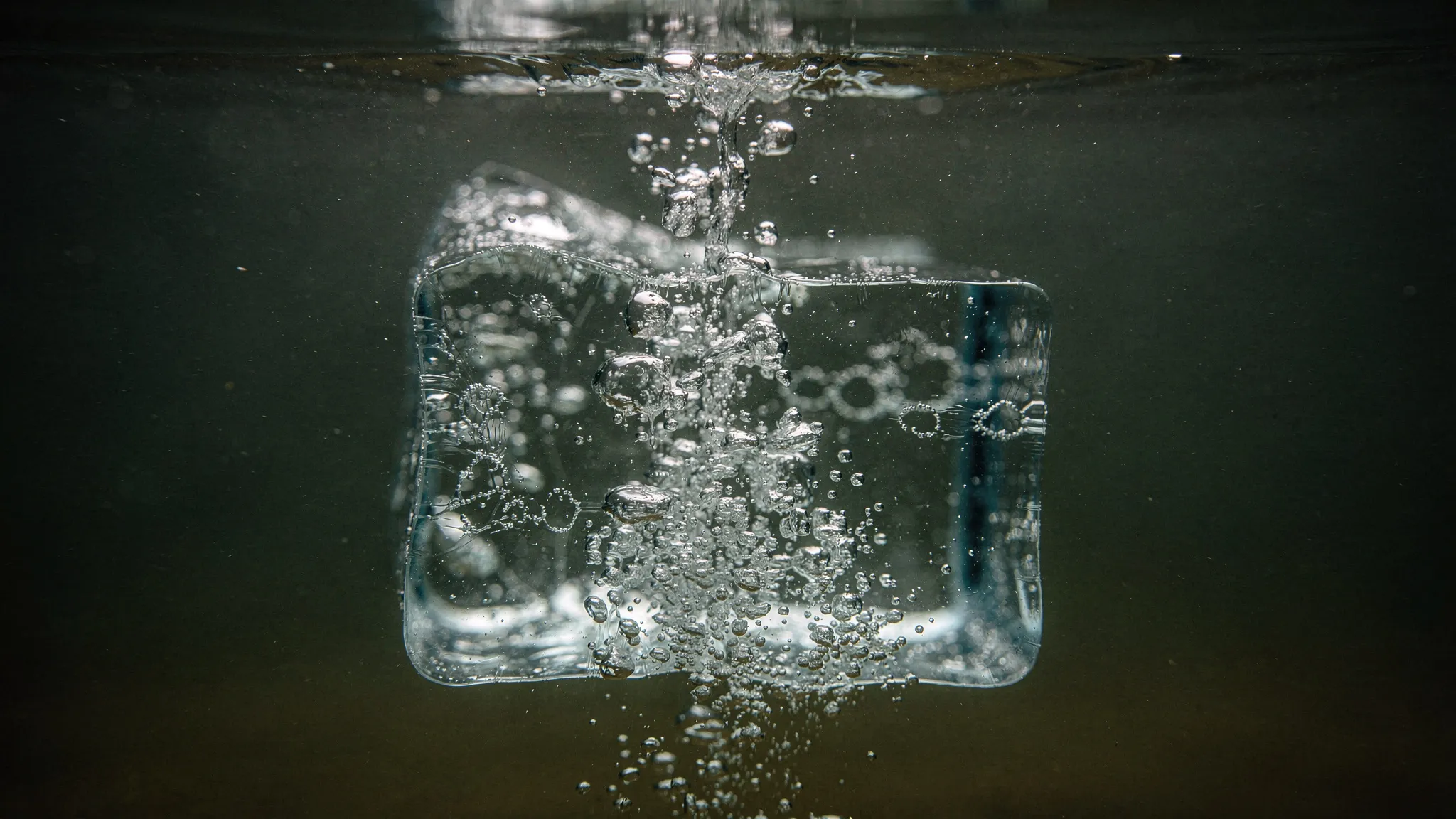
TRAPPED AIR MAKES ICE MELT FASTER
How fast ice melts in water depends on how the water moves against it. That is central to glaciers, ice shelves and sea ice, and to what their melting does to ocean currents and sea level. In the standard formulas used to model melting at the ice-ocean boundary, the stirring of the water enters through one quantity: the speed of the flow next to the ice.
But natural ice is not clear. It holds pockets and bubbles of air, from a fraction of a millimetre to about a millimetre across, which can make up around a percent of its volume. Earlier experiments disagreed on whether they matter. Ice made with gas in the laboratory showed little effect, whereas natural glacier ice melted appreciably faster when bubbly: in one study, bubble release roughly doubled the melt rate. Yet in such ice, many effects act at once, from gas bursting out under pressure to salt.
Jin Hu, Feng Wang, Yihong Du, Enrico Calzavarini and Chao Sun, at Tsinghua University in Beijing and the University of Lille in France, isolated one of them: what the bubbles do once they are free.
Ice in a box
Their simulations follow a block of ice melting in a square cavity of fresh water 10 centimetres high. One wall is held at −1 °C, the other at 10 °C, a value at the upper end of summer meltwater in polar regions, and also at 15 and 20 °C to test stronger stirring. At the start, a quarter of the box is liquid.
The ice contains 0.1 to 1.5% air by volume, in bubbles about 0.12 millimetres across. Each bubble stays locked in the ice until the advancing melt front reaches it. Then it is released, rises, and pushes on the surrounding water, and the simulation tracks that push.
Bubbles that stir
Bubbly ice melts faster through most of the process, and more so with more air. To compare fairly, the team matched states rather than times: the melt rate with bubbles against the bubble-free melt rate when the same fraction of the box had melted. The gain is weak at first, then switches on sharply. At gas fractions around one percent, the melt rate can more than double.
The bubbles act in stages. Fresh water is densest near 4 °C, and early on it forms a fairly well-defined layer of water near 4 °C that organises the flow; rising bubbles cross and deform it. Later, the shape of the melting face matters. Bubbles released high up rise freely through the water, while those released lower down are trapped for a while beneath overhanging ice. In the late stage, the bubbles keep pushing the water upward along the ice and keep scrambling its thermal layers.
A ratio of powers
To make the result usable, the team compared two powers: the mechanical power supplied by rising bubbles and the power already driving the background flow, the convection the water has without bubbles. As the air content rises from 0.1 to 1.5%, the typical value of this ratio climbs from about 0.03 to 0.87. Bubbles start to matter once it passes roughly 0.1.
There is a ceiling, though. With the warm wall at 20 °C, the water already churns so strongly that the melt rate barely changes, even though the bubbles still supply power. The effect works only within a window: the bubbles must reach the thin layer of water that controls melting, and that layer must be able to turn their push into extra heat transfer.
The team checked their ratio against the earlier glacier-ice experiment, where it comes out at about 2.86 to 4.0, with a melt rate about 2.25 times higher: an independent example where bubble power matches or exceeds the background flow.
From the box to the ocean
Finally, the authors propose a simple correction for ocean models: add the bubbles’ power as an extra contribution to the effective water speed next to the ice, without changing the models’ heat, salt or freezing-point balances. Plugging in field conditions reported at the ice-ocean boundary — water speeds of about 1 to 12 centimetres per second and melt rates of 0.2 to 1.6 metres per day — a substantial part of that range lands in the regime where bubbles matter in the simulations, even with only one percent of air. This is an order-of-magnitude comparison, not a field measurement.
The effect also feeds itself: faster melting uncovers trapped gas sooner, which adds bubble power and speeds the melting further, within limits. For the authors, the trapped air in ice is not just a passive property of the material. Uncovered by a moving melt front, it becomes an engine of its own.