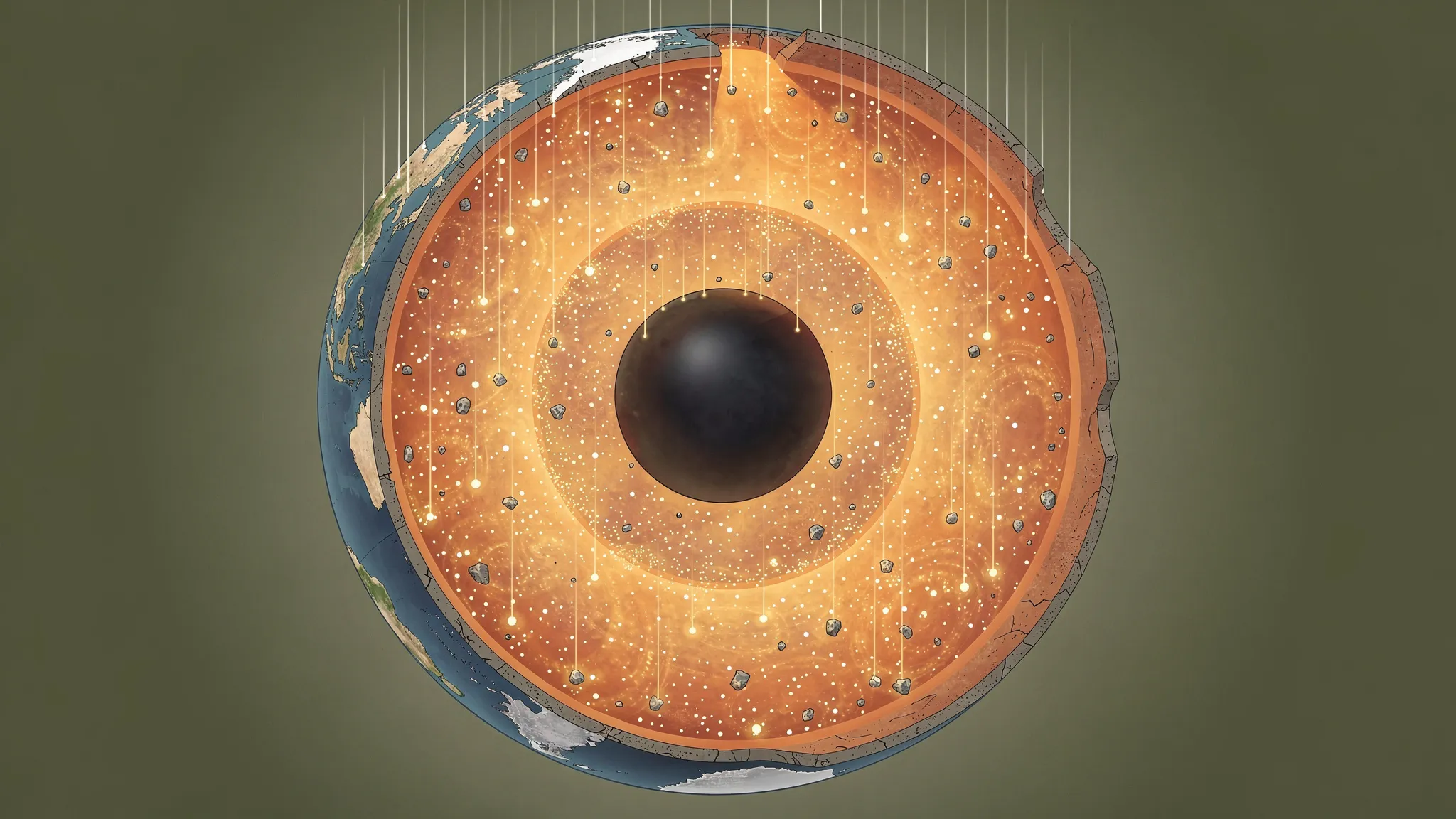
GHOST PARTICLES WEIGH THE EARTH'S HIDDEN HEAT
The Earth loses 47 terawatts of heat through its surface. Some of it is left over from the planet’s formation, some flows up from the core, and some comes from the decay of radioactive uranium, thorium and potassium. Heat-flow measurements cannot tell these sources apart. Models of the Earth’s composition put the radioactive share between about 10 and 33 terawatts, of which the lithosphere, the outer layer that includes the crust, provides about 7.9. That leaves the mantle’s share uncertain by more than a factor of ten: somewhere between 2 and 25 terawatts.
That number matters. According to the paper, it governs how fast the mantle cools, how vigorously it churns and drives plate tectonics, and how much heat leaves the core to sustain the Earth’s magnetic field.
Particles that come from inside
Rock samples only reach the crust and the shallow mantle. But uranium and thorium betray themselves another way: their decay chains emit geo-neutrinos, antineutrinos, elusive particles that pass through rock almost untouched and so reach the surface from deep inside the planet. Very rarely, one strikes a proton inside a large detector and is recorded.
Four underground detectors now measure them: KamLAND at Kamioka, Japan; Borexino at Gran Sasso, Italy; SNO+ at Sudbury, Canada; and JUNO at Jiangmen, China. Their rates are counted in NIU, the field’s unit: one interaction per year for every 10³² protons in the detector. Kamioka records about 30.7 NIU and Jiangmen about 73. Potassium’s geo-neutrinos, too weak in energy, remain out of reach.
Subtracting the crust
Each detector sits on its own patch of crust. Sudbury lies on the Canadian Shield; Jiangmen sits among granites rich in uranium and thorium. So the first step is to subtract the signal expected from each site’s lithosphere, predicted from geological models and field studies to within about 5 NIU.
M. Leyton, of Pasadena City College, and S. T. Dye, of the University of Hawaii, then asked the simplest question: can a single mantle signal, the same everywhere, plus each site’s predicted crust, account for all four measurements? It can. The best common value is 14.8 ± 4.5 NIU, detected at about 3.2 sigma, the statistical yardstick physicists use: the higher the number, the less likely the signal is a fluke.
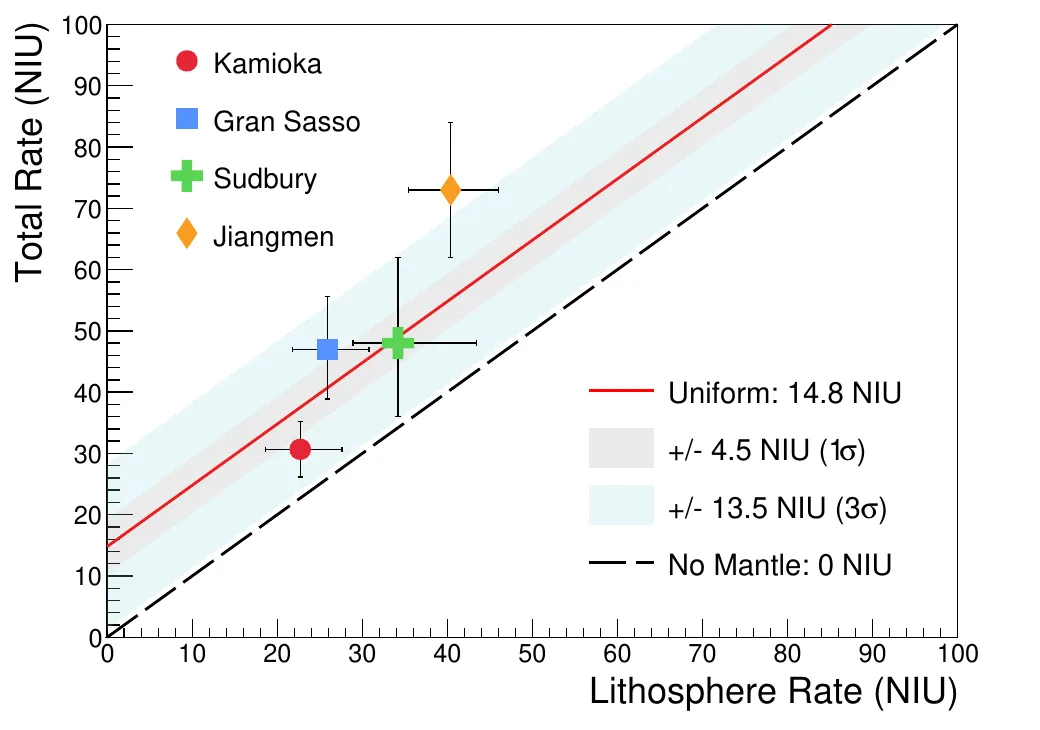
Measured rate at each site versus the rate predicted from its lithosphere. The red line adds a uniform mantle signal of 14.8 NIU to every site; the dashed line would mean no mantle signal at all. — Figure 3, Leyton & Dye (2026), arXiv:2611.16715.
Converted into heat, with assumed ratios between the three elements (thorium to uranium 3.77, potassium to uranium 13,000, by mass), that is 18.5 ± 5.6 terawatts of radioactive heating in the mantle. Adding the lithosphere’s share brings the Earth’s total radioactive heat to about 26 ± 6 terawatts.
A tale of two sites
Look at each site separately, though, and a gap appears. Once its predicted crust is removed, Kamioka is left with a mantle signal of 8.0 NIU and Jiangmen with 32.6 NIU: a difference of 24.6 ± 13.8 NIU, a 1.8-sigma tension: on the same yardstick, too weak to rule out chance.
That is strange, because the two sites are only about 2,900 kilometres apart, both in East Asia. The mantle signal at a detector gathers geo-neutrinos from thousands of kilometres of rock, so two neighbours should see nearly the same thing.
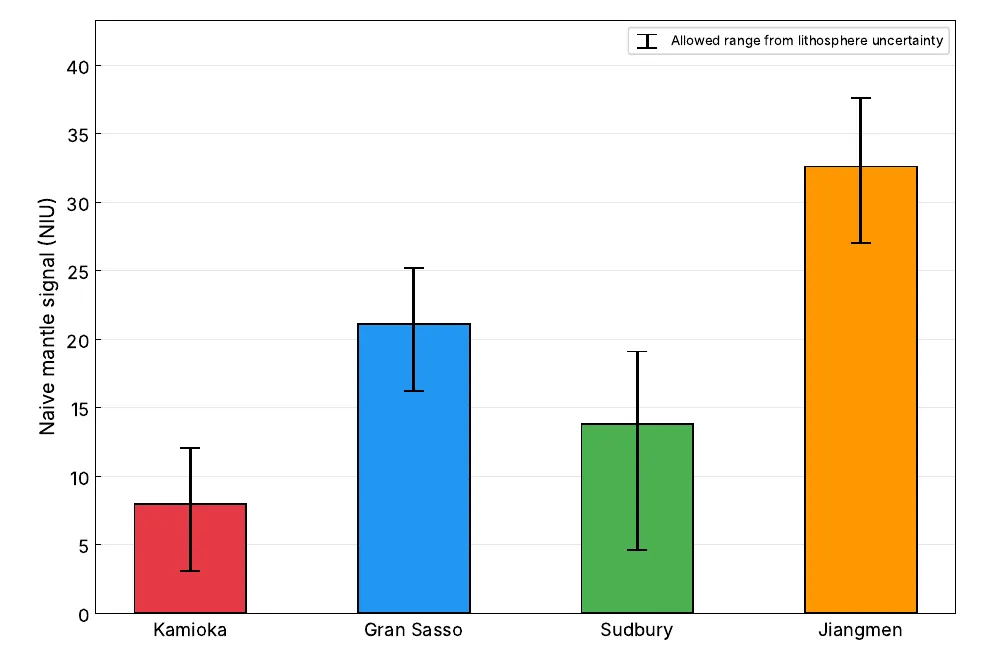
Mantle signal left at each site after subtracting its predicted lithosphere. Error bars show only the uncertainty of the lithosphere prediction. — Figure 4, Leyton & Dye (2026), arXiv:2611.16715.
Three million attempts
The team tested whether a hidden structure could produce such a contrast. Six families of models placed extra heat-producing material in the mantle: two broad piles on top of the core, beneath Africa and the Central Pacific, where seismic waves slow down; other slow and fast regions mapped by seismology; subducted slabs; a richer crust; and local deposits near each detector. In all, 968,274 configurations and about 3 million fits.
None of the large-scale models came close. With plausible compositions, they produce a gap of at most 4 NIU, against the 24.6 required. Only local, site-specific deposits, such as material near Jiangmen that would have to be almost pure continental crust, reproduce the gap.
The authors therefore lean towards a local effect, such as an error in the model of Jiangmen’s crust, or simple statistical scatter: in simulated repeats of the experiment, at least one site strays as far as Jiangmen 39% of the time. Revised crust predictions and longer measurements should settle it. Either way, the authors conclude, geo-neutrino detectors are beginning to map not just how much radioactivity the mantle holds, but where.