
M87'S RING SURVIVES A SECOND LOOK
The first image of a black hole’s shadow came from the Event Horizon Telescope (EHT): radio telescopes spread across the Earth, combined to act like one dish the size of the planet. At the core of the galaxy Messier 87, it showed a ring of light, bent and reddened by gravity, around a dark centre: the shadow of the supermassive black hole called M87*.
The ring is tiny on the sky. Seeing it takes a sharpness of a few millionths of a second of arc (microarcseconds) — roughly, the authors write, the angle of a human hair seen from more than 1,000 kilometres away.
Why the ring was questioned
A planet-sized telescope made of a handful of dishes leaves huge gaps in what it records. On top of that, every antenna has to be calibrated against fast fluctuations of the atmosphere. Building an image from such data is a problem with many possible answers, and the result shifts with the choices made along the way.
Different methods therefore gave different fine details of M87*. Some outside analyses went further and challenged the ring shape itself: when the reconstruction was allowed to spread over a wide enough patch of sky (its “field of view”), one of them favoured a single elongated bright spot instead of a ring.
Measurements that calibration cannot spoil
Samuel Lai, Nithyanandan Thyagarajan, O. Ivy Wong and Foivos Diakogiannis, at CSIRO (the Commonwealth Scientific and Industrial Research Organisation) and the University of Western Australia, went back to the public EHT data from 2017, 2018 and 2021.
They kept only closure invariants: combinations of the signals from several antennas in which each antenna’s calibration errors cancel out. What is left carries information about the shape of the source, and nothing about the instruments’ quirks.
To turn these into an image, they used GenDIReCT, an algorithm the team developed. It never saw a black hole while learning: it was trained mostly on ordinary pictures unrelated to astronomy, plus simple shapes. As a check, the team also trained it with no geometric shapes at all — the reconstructions did not change significantly. Unlike the EHT’s own imaging pipeline, it needs no starting image. Each model was tested on simulated data before being run on the real observations, and left untouched afterwards.
The same ring, three years running
Every dataset gives a compact ring about 40 microarcseconds across, whatever field of view the algorithm is allowed. On the best observing day of each year — 11 April 2017, 21 April 2018 and 18 April 2021 — the ring is round, consistent in size and orientation, and brightest towards the south or south-west.
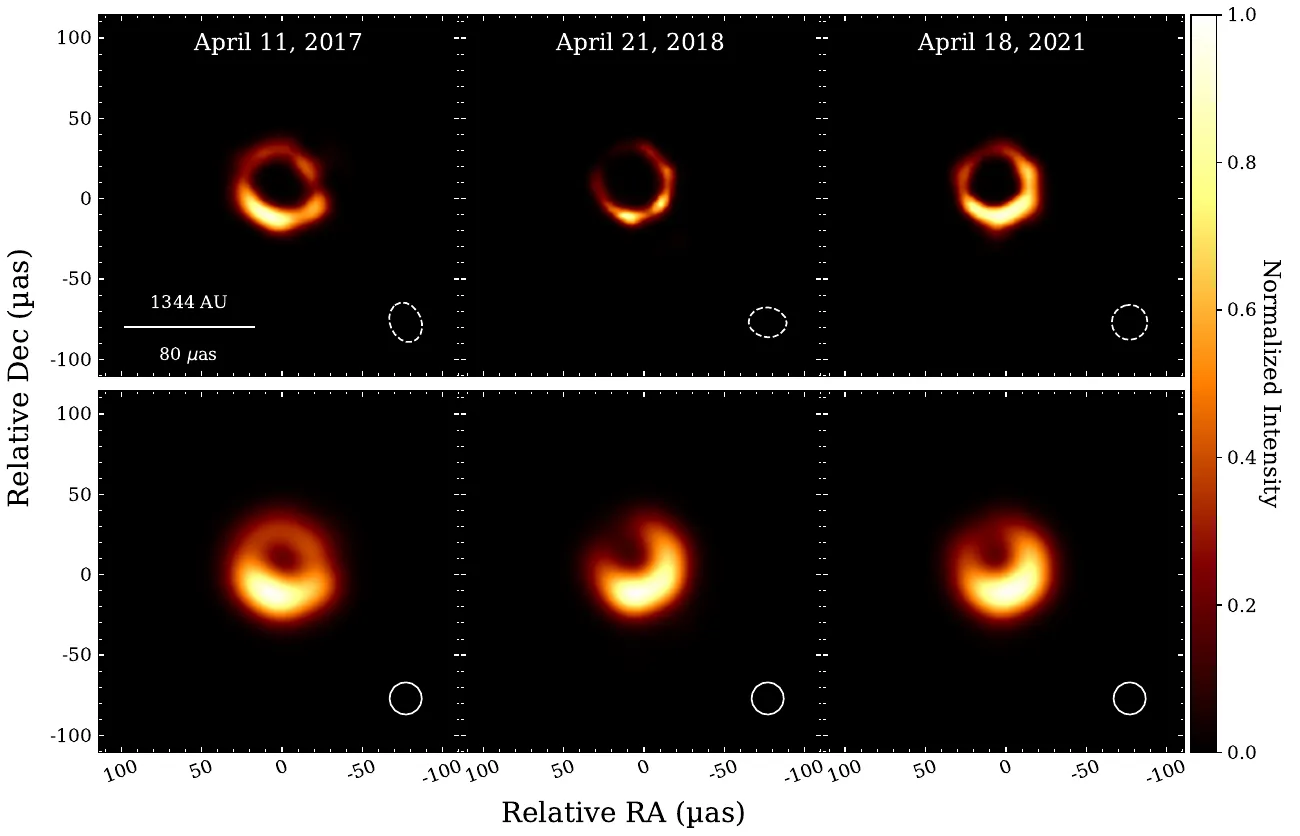
The ring of M87* rebuilt from the best observing day of 2017, 2018 and 2021; bottom row, blurred to the EHT’s usual sharpness. — Figure 1, Lai et al. (2026), arXiv:2611.20418.
The average diameter is 42.2 ± 1.5 microarcseconds. A separate method, fitting a simple geometric ring model straight to the same invariants, gives 42.3 ± 1.1. The sensitivity to the field of view reported by earlier critics vanishes on the best-quality data; according to the authors, it possibly came from gaps in coverage or poor data.
The orientation of the bright side, however, moves: it turns between 2017 and 2018, which the authors attribute to the turbulent flow of matter falling into the black hole. In 2018 and 2021, it lines up more closely with the galaxy’s large jet.
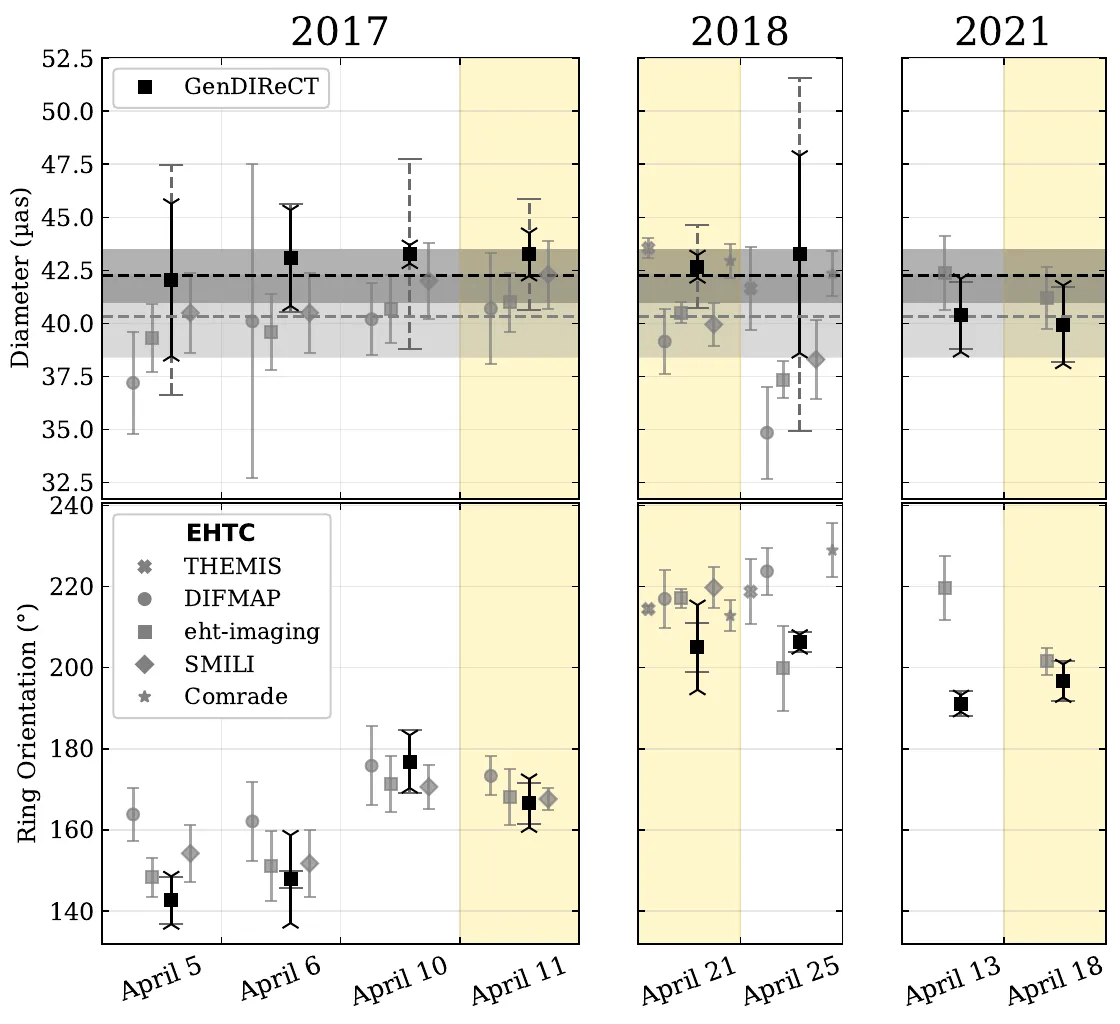
Ring diameter (top) and orientation (bottom) for each observing day, from this method (black) and from the EHT’s methods (grey). — Figure 2, Lai et al. (2026), arXiv:2611.20418.
Weighing the black hole
The size of the ring grows in step with the mass of the black hole. Simulations calibrated by the EHT give the rule: the ring is about 11 times a basic angle set by the mass and the distance, here 16.8 megaparsecs. For a black hole of 6.6 billion Suns, that angle is 3.9 microarcseconds, and the ring should measure 42.7.
The measured ring gives 6.5 ± 0.5 billion solar masses. That agrees with an earlier estimate from the motion of stars, 6.6 billion. Another estimate, from the motion of gas, gave 3.5 billion — a ring of only 22.6 microarcseconds, half the size of the one measured, and one the EHT would struggle to resolve. The measurement sides with the stars.
What the ring does not tell
Comparing the images with simulations, the best match comes for a view about 20 degrees from the jet pointing towards us. The best scores favour a spinning black hole, but the analysis cannot say how fast it spins. Radio dishes in space could one day resolve the finest structure of the ring, called the photon ring, and measure that spin directly. Closer to home, the James Webb Space Telescope will track the motions in the core of M87 and sharpen the mass.